8 Macro-Prudential Policies
8.1 Financial Cycles: Booms and Crises
Financial historians such as Charles Kindleberger and Hyman Minsky documented historical evidence of how the financial sector tends to go through its own cyclical ups and downs, often involving extreme booms and crashes.
In his famous book “Manias, Panics and Crashes”, Kindleberger describes a financial cycle as follows:
What happens, basically, is that some event changes the economic outlook. New opportunities for profit are seized and overdone, in ways so closely resembling irrationality as to constitute a mania. Once the excessive character of the upswing is realized, the financial system experiences a sort of “distress”, in the course of which the rush to reverse the expansion process may become so precipitous to resemble panic. In the manic phase, people of wealth or credit switch out of money or borrow to buy real or illiquid assets. In panic, the reverse movement takes place, from real or financial assets to money, or repayment of debt, with a crash in the prices of commodities, houses, buildings, land, stocks, bonds—in short, in whatever has been the subject of the mania.
In 1998, famous bond trader Paul McCulley coined the term “Minsky moment” to describe the moment when investors realise the boom is unsustainable and a crash is imminent.
8.2 Financial Cycle Mechanisms in Normal Times
Beyond the mechanisms emphasised by Kindleberger that generate major booms and crises, there are some general mechanisms whereby the financial sector and the real economy tend to reinforce each other during normal economic cycles.
Pricing of Risk: The longer an expansion goes on, the more financial market participants start to forget about risk. Risky assets increase in price and risky borrowers receive lower-cost finance.
Asset Prices: These rise during an expansion and provide borrowers with better collateral. With better collateral, banks think borrowers have become a lower risk and borrowers think they can safely borrow more.
The same mechanisms operate negatively on the financial sector during a downturn though often in a more intense fashion than during expansions.
8.3 Financial Cycles and Property Markets
In many cases, property markets are at the centre of pro-cyclical interactions between asset prices and banks.
Banks that are confident property prices will rise may provide loans that fund almost all of the purchase price (or which are a high fraction of the borrower’s income) because they are confident they won’t lose money should the borrower default and the bank repossesses the home.
Rising property prices strengthen the balance sheets of households and firms, who then borrow more money, which further fuels property prices.
When property prices fall, banks make losses on mortgages and cut back on providing credit to the wider economy, perhaps triggering a recession and further reducing property prices.
These points clearly apply to residential property, where most purchases are debt-financed via mortgages, but commercial property booms and busts have traditionally been more dangerous.
Commercial property deals are often speculative and take time to plan and execute. Often, by the time the cycle has turned, investors are left with lots of debt and projects that are no longer economically viable.
8.4 Capital Adequacy Rules Can Increase Procyclicality
Micro-prudential capital adequacy rules are intended to keep the banking system stable. But they can have the unintended consequence of making the economy more procyclical.
Consider a bank starting to incur serious losses on its loans and expecting to go below its regulatory capital ratio.
The bank could raise more equity capital by selling shares to private investors. But this would dilute the claim on future dividends of the current owners. And with bank having made recent losses, the cost of equity finance would probably be high.
The other option is to maintain the equity capital at its current level and instead reduce risk-weighted assets. There are two ways to do this:
Reduce Assets. In particular, the bank can use incoming payments from loans to pay off liabilities instead of using them to issue new loans.
Take Less Risk. Invest any new funds in government bonds rather than make potentially risky loans to customers.
These actions can contribute to causing a credit crunch.
8.5 Micro Stability versus Macro Stability?
The point of capital rules are to keep individual institutions solvent. This is why they are termed prudential regulation: They are there to maintain stability by encouraging prudence.
However, rules put in place to encourage each institution to be prudent can add to the self-reinforcing cycles to financial system as a whole, which make it more unstable:
- In upswings, we get the following re-inforcing mechanisms:
- Asset prices rise, loans are all paid back and this increases equity for banks.
- Because of the increase in equity, the regulatory capital rules allow banks to expand their operations by acquiring new assets.
- With lots of demand for financial assets, asset prices rise further.
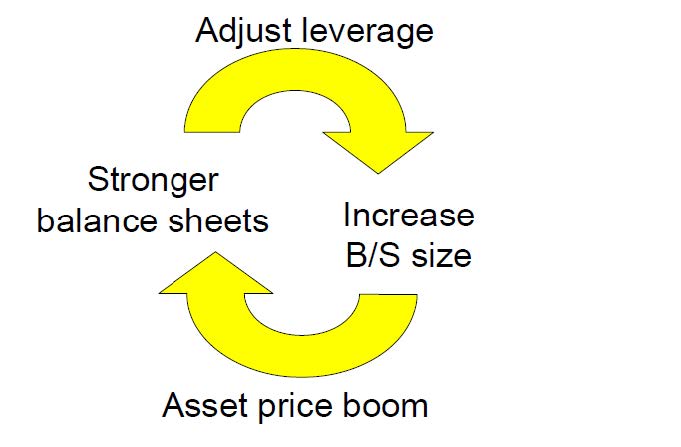
- But booms never go on forever.
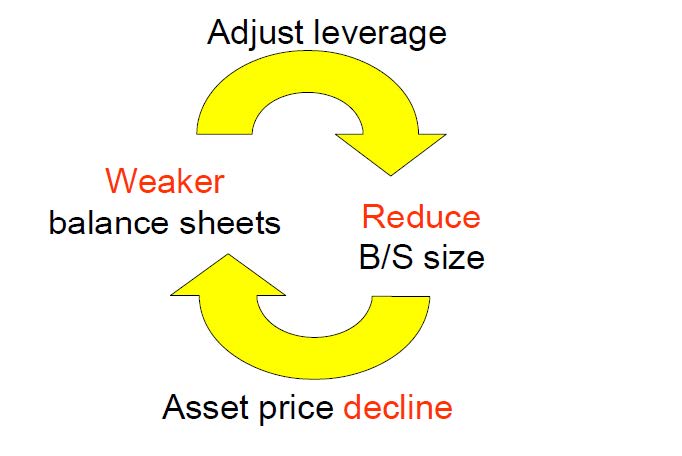
- Eventually, cycles play out and recession arrives. Then asset prices fall and loans default, eroding equity.
- Banks worry about meeting their capital requirements and so they sell off assets.
- These sales drive down asset prices and erode equity across the system.
In an important 2000 paper, Andrew Crockett, former head of the Bank of International Settlements, distinguished between micro-prudential and macro-prudential policy. Here are some quotes.
It follows that the macro-prudential paradigm stresses the possibility that actions that may seem desirable or reasonable from the perspective of individual institutions may result in unwelcome system outcomes. This is a logical contradiction in the micro-prudential vision as defined here. Illustrations of such fallacies of composition are not hard to find. For instance, for a single bank it is only natural to tighten lending standards in a recession, but if all banks do the same the resulting impact on economic activity can lead to a further deterioration in the credit quality of its portfolio. The mirror image during the upswing could generate an unsustainable lending boom, sowing the seeds of subsequent financial instability. Likewise, cutting exposures as market prices fall can deepen the decline in those prices, leading to a drying up of liquidity and exacerbating financial distress.
The quintessential micro-prudential dictum is that “financial stability is ensured as long as each and every institution is sound”. From a macro-prudential perspective, two objections can be levied against this, on the surface, compelling statement. First, it may strive for too much; second, it may deliver too little.
It may strive for too much, because the occasional failure of individual institutions is not the problem. Trying to avoid such outcomes risks providing excessive protection, with the result that market disciplinary and allocative mechanisms are weakened. The statement may deliver too little, because while at one level it is a truism, how the soundness of each individual institution is pursued is crucial. Unless the authorities take into account the impact of the collective behaviour of institutions on economic outcomes, they may fail to monitor risks and take remedial action appropriately.”
8.6 Risk Modelling and Cyclicality
Prior to Basel 2, some academics warned that the use of internal risk models to calibrate risk-weighted assets could exacerbate the procyclicality induced by capital adequacy rules.
Many of the models were estimated using relatively short time windows for calculating risk. During expansion periods, they thought risk was low, during recessions they thought it was high.
Because the risk models told the banks that risk was low during expansions, this meant that risk-weighted assets didn’t increase nearly as much as total unweighted assets.
Banks could increase their leverage during expansions and yet their regulatory capital ratio didn’t show them to be taking big risks.
Again, Andrew Crockett’s paper has a useful alternative way to think about this: “The received wisdom is that risk increases in recessions and falls in booms. In contrast, it may be more helpful to think of risk as increasing during upswings and materialising in recessions.”
8.7 What Is Macro-Prudential Policy?
A rough definition: Policies aimed at reducing the financial sector’s procyclical tendencies and making the financial system as a whole more stable (increasing resiliance).
Macro-prudential policies focus on systemic risk rather than risk associated with one or more institution.
From the Central Bank’s macro-prudential policy framework:
The objective of macro-prudential policy is to mitigate the risk of a disruption to the provision of financial services, caused by an impairment of all or parts of the financial system, with serious negative consequences for the real economy. This risk is known as systemic risk.
While there are over-laps between the two parts of this definition—the “reducing procyclicality” and “making the system more stable”—I will briefly mention a number of types of policies under these two headings.
8.7.1 Reducing the Financial Sector’s Procyclical Tendencies
- Counter-Cyclical Capital Requirements: This is the classic “macro-prudential” policy. Make banks have higher capital ratios in good times than bad times. Require banks to retain earnings and build up capital during booms and allow lower ratios in recessions.
- Regulating the Property Sector: Using limits on mortgages and speculative commercial property borrowing to dampen property-related cycles.
- Concentration Limits: Crashes often happen after the financial sector rushes into investing too much in the “next big thing” whether that be property or technology stocks or other asset classes. Limiting exposure to particular sectors, such as commercial property, dampens this kind of excessive concentration.
- Monetary Policy: At inflation-targeting central banks, monetary policy is usually set by looking at inflation and the real economy. However, there is an active debate about whether policy rates should be used more actively to “lean against the wind” to reduce credit growth (or “pop bubbles”) during expansions.
8.7.2 Making the Financial System More Stable
- More Loss Absorption: The more banks are funded by equity and loss-absorbing bonds, the safer the funding from deposits and senior bonds will be. This reduces the chance of banks runs and all the negative effects they trigger.
- Higher Quality Capital: More focus on instruments that can absorb losses while banks keep operating (going concern capital) and less on those that only lose money when banks are liquidated (gone concern capital). Regulators have encouraged the issuance of contingent capital bonds i.e. bonds that turn into equity when capital ratios fall below a trigger level.
- Liquidity Regulation: Discourage excessive use of short-term debt and encourage holding of assets less likely to be subject to fire-sale discounts.
- Too Big to Fail?: Special regulatory treatment of systemically important banks such as requiring them to have higher levels of capital.
- Stress Tests: Regular detailed reporting of how banks would respond to large shocks.
8.8 Financial Stability Bodies Around World
Since the global financial crisis, there has been an explosion in new bodies charged with maintaining financial stability and implementing macro-prudential policies.
Edge and Liang (2019) report that only 11 countries had Financial Stability Committees (FSCs) for macroprudential purposes in 2008, whereas 47 countries had FSCs in 2018.
Edge and Liang point out that these committees vary widely in their powers: Some can set capital requirements and put limits on loan-to-value (LTV) rates while others are charged with co-ordinating policy across several different bodies.
8.8.1 An Example: The UK Financial Policy Committee
13 members consist of:
6 Bank of England staff (the Governor, four Deputy Governors and the Executive Director for Financial Stability Strategy and Risk)
external members who are selected from outside the Bank
Chief Executive of the Financial Conduct Authority and one non-voting member from HM Treasury.
Formal description:
Identifies, monitors and takes action to remove or reduce systemic risks with a view to protecting and enhancing the resilience of the UK financial system.”
Informal description (Andy Haldane):
to monitor the punchbowl before it is emptied and before aspirin needs administering.
Powers include the ability to:
- Set the countercyclical capital buffer (CCyB) rate for the UK.
- Set sectoral capital requirements for UK financial institutions.
- Set a leverage ratio requirement for UK financial institutions.
- Set loan-to-value and debt-to-income limits for UK mortgages on owner-occupied properties.
- Set loan-to-value and interest cover ratio limits for UK mortgages on buy-to-let properties.
8.8.2 Macro-Prudential Policy in Europe and Ireland
8.8.2.1 Europe:
EU Regulation (1092/2010) established a European Systemic Risk Board (ESRB) responsible for the macroprudential oversight of the EU financial system and the prevention and mitigation of systemic risk.
The SSM Regulation (1024/2013) assigns the ECB specific powers in the field of macroprudential policies. It is responsible for assessing macroprudential measures adopted by national authorities in the countries subject to ECB banking supervision.
8.8.2.2 Central Bank of Ireland:
Has “stability of the financial system overall” as an objective under the Central Bank Act.
Is designated by the ESRB as the national macro-prudential authority and is represented on its board.
Is the designated national authority responsible for certain macro-prudential powers in the Capital Requirements Regulation and Directive.
8.8.3 Identifying Financial Stability Risks
Identifying financial stability risks can be tricky.
New regulations and policies are often put in place to deal with the causes of the previous financial crisis (“fighting the last war”, “closing the barn door after the horse has bolted”) but then something new destabilises the system.
Financial Stability committees around the world now issue regular reports devoted to monitoring a wide range of indicators so as not to miss the factors that could trigger the next round of financial disruption.
Many institutions, including the IMF, the ECB and Central Bank of Ireland release regular reports on Financial Stability, .
I have provided links to some of these reports.
Typically, the reports monitor vulnerabilities in the financial system, looking at various sectors such as households, businesses and governments and then review the various policy tools that are available and the options for adjusting them.