18 Exchange Rate Regimes and the Euro
18.1 Exchange Rates and Interest Rates
We have talked a lot about interest rates but have not yet focused on another important aspect of monetary policy: exchange rates. To understand why exchange rates matter, consider the euro–pound exchange rate, defined as €1 = £\(X\).
18.1.1 Exchange Rates and Economic Growth
Suppose \(X\) increases, so that the euro becomes worth more pounds. What happens to exports and imports?
- For exports, each pound of sterling revenue earned by an Irish firm now translates into fewer euros unless the firm increases the price charged to UK customers. Exporting therefore becomes less profitable and total exports decline. If the firm instead attempts to maintain its profits by raising its UK price, demand for its products falls, so exports still decline.
- For imports, UK firms receive more euro revenue from selling to Ireland at unchanged prices and may therefore export more to Ireland. Alternatively, they may lower their euro-denominated prices in Ireland, gaining market share while maintaining the same sterling revenue per unit. In either case, Ireland’s imports increase.
Although an increase in the value of the euro may sound desirable for Ireland, it tends to reduce exports, increase imports and consequently reduce Irish GDP. In contrast, a currency depreciation boosts exports and has a positive effect on economic growth. This is why depreciation is often welcomed during a recession and why losing the ability to depreciate is commonly identified as a disadvantage of fixed exchange rate regimes.
Depreciation nevertheless has costs.
- Inflation may increase because imported goods become more expensive. This is one reason central bankers often express a preference for a strong currency; the inflationary effect is particularly important in small open economies that import heavily.
- Furthermore, the boost to growth is temporary. Over time, higher import prices may feed into higher wages, gradually eroding the initial improvement in international competitiveness.
18.1.2 Exchange Rates and Bond Yields
Suppose capital can flow freely between the United States and the euro area, and investors can purchase risk-free one-period bonds in either market. Let \(i_t^E\) denote the European bond interest rate and \(i_t^{US}\) the US bond interest rate. Investing $1 in a US bond at time \(t\) therefore delivers \(1+i_t^{US}\) dollars at time \(t+1\). For example, when the US interest rate is 4%, \(i_t^{US}=0.04\), and $1 invested now pays $1.04 next period.
Define \(e_t\) as the number of US dollars obtainable for one euro. A risk-neutral US investor has 2 options:
- keep her money invested in US bonds and receive \(1+i_t^{US}\) dollars next period.
- Alternatively, she can exchange her dollars for euros, purchase a European bond, and convert its proceeds back into dollars at the exchange rate prevailing next period. The latter strategy yields
\[ (1+i_t^E)\frac{e_{t+1}}{e_t} \]
dollars per dollar initially invested.
Which investment will she choose?
18.1.3 Uncovered Interest Parity
Risk-neutral investors care only about expected returns. They prefer euro-denominated bonds when
\[ (1+i_t^E)\frac{E_t e_{t+1}}{e_t}>1+i_t^{US}, \]
where \(E_t e_{t+1}\) denotes the exchange rate for next period expected at time \(t\). They prefer dollar-denominated bonds when
\[ (1+i_t^E)\frac{E_t e_{t+1}}{e_t}<1+i_t^{US}. \]
The theory of uncovered interest parity (UIP) states that bond yields adjust until investors are indifferent between holding domestic and foreign bonds. As in the expectations theory of long-term interest rates, the idea is based on arbitrage in financial markets: financial prices should adjust so that investors cannot systematically outperform others through an obvious investment strategy. Thus UIP predicts
\[ \boxed{(1+i_t^E)\frac{E_t e_{t+1}}{e_t}=1+i_t^{US}.} \]
18.1.4 Uncovered Interest Parity and Expected Exchange Rates
The UIP condition implies that if European interest rates are lower than US interest rates, the euro must be expected to appreciate against the dollar. Rearranging gives
\[ \frac{E_t e_{t+1}}{e_t}=\frac{1+i_t^{US}}{1+i_t^E}. \]
For relatively small interest rates, the right-hand side can be approximated by
\[ \boxed{\frac{E_t e_{t+1}}{e_t}\approx 1+i_t^{US}-i_t^E.} \]
Consequently, if US interest rates are one percentage point above euro-area rates, the dollar is expected to decline in value by approximately 1%, or equivalently the euro is expected to appreciate by approximately 1%.
18.1.5 The Trilemma of International Finance
The lecture argues that UIP holds reasonably well in practice and implies that a country cannot simultaneously maintain
- free capital mobility,
- a fixed exchange rate
- independent monetary policy.
This is known as the trilemma of international finance: any two of these objectives can be achieved, but not all three.
If a country allows free capital mobility while fixing its exchange rate, then \(E_t e_{t+1}=e_t\), and its interest rates must equal those in the economy to which it has pegged its currency, as illustrated by Ireland’s experience.
If a country instead allows capital to move freely while choosing its own monetary policy, so that interest rates differ across countries, its exchange rate must be free to fluctuate, as in the United Kingdom.
Finally, a country can maintain both an independent monetary policy and a fixed exchange rate only if it intervenes in capital markets to prevent investors from exploiting international arbitrage opportunities, as illustrated in the lecture by China.
For further discussion, the lecture refers to the paper by Obstfeld, Shambaugh and Taylor.
18.2 Exchange Rate Pegs
An exchange rate peg is an arrangement in which one country promises to exchange its currency at a fixed value relative to another currency. Such policies are common, particularly among small countries that peg their currency to an anchor currency, most often the US dollar.
In practice, maintaining a peg requires a sufficient supply of the asset for which the authorities have promised to exchange their currency.
Under the gold standard, before and after the First World War, currencies were pegged to gold. A country running a trade deficit would lose gold because foreigners receiving its currency in payment for exports could demand gold in exchange. A country that depleted its gold reserves might eventually be unable to maintain the promised exchange rate.
After the Second World War, the Bretton Woods system used US dollars as the principal reserve asset backing exchange rate pegs. The same logic applied: persistent trade deficits could cause a country’s holdings of US dollars or other foreign currencies to run out. One response to this situation was to abandon the existing parity and devalue the domestic currency. Devaluation could restore export competitiveness and potentially turn trade deficits into surpluses.
capital account convertibility(资本账户可兑换)
欧洲先试图在保留各国货币的情况下维持固定汇率,但随着资本自由流动,这套体系越来越难维持;1992–93 年 EMS 危机最终让欧洲各国认识到,与其不断“保卫汇率”,不如直接建立货币联盟。
18.2.1 Exchange Rate Pegs and Speculation
Exchange rate pegs are often unstable because macroeconomic conditions change over time. An exchange rate that once produced an approximate balance between imports and exports may cease to be sustainable.
Pegs also create opportunities for speculation. Suppose the United Kingdom is pegging sterling to the dollar while running a persistent trade deficit. Investors may anticipate that sterling will eventually be devalued. They can withdraw sterling, convert it to dollars, and then exchange the dollars back into sterling after the devaluation. If they borrowed sterling to make the trade, they can repay the original sterling loan and retain a profit.
These incentives can create self-fulfilling exchange rate crises. Investors expecting devaluation withdraw funds, depleting central bank foreign exchange reserves and potentially forcing the very devaluation they anticipated. The pressure is asymmetric: countries running large trade surpluses at a pegged exchange rate can simply accumulate foreign currency reserves without being compelled to revalue their currencies upward.
18.2.2 Bretton Woods and the IMF
Capital did not move freely during the Bretton Woods era. The system was designed to support stable exchange rates while allowing countries to retain independent macroeconomic policies. From 1958 onward, however, current account convertibility(经常账户可兑换)permitted foreign exchange transactions undertaken to purchase goods. This compromise was intended to facilitate international trade while reducing the risk of self-fulfilling currency crises.
The International Monetary Fund (IMF) could provide loans to countries whose trade deficits had depleted their holdings of gold or dollars, helping them maintain their fixed exchange rates. If temporary financial assistance could not solve the problem, countries could apply to the IMF for permission to devalue. The IMF would assess whether the trade deficit was sustainable and whether the peg should be maintained or adjusted downward. In practice, the arrangement did not always function as intended: large countries sometimes notified the IMF of a devaluation rather than seeking its prior approval.
18.2.3 European Monetary Arrangements From the 1970s
The Bretton Woods system collapsed in the early 1970s. From March 1973, major currencies began to float freely, with their prices determined in financial markets. Restrictions on international capital movements were also gradually relaxed in the following decades.
European countries nevertheless continued to value exchange rate stability and the resulting support for trade within the EU. In 1979 the EU introduced the European Monetary System (EMS), effectively a European counterpart to Bretton Woods. The German Deutsche Mark replaced the US dollar as the principal anchor currency, meaning that German monetary conditions strongly influenced the rest of the system. EMS currencies could fluctuate, but only within relatively narrow exchange rate bands.
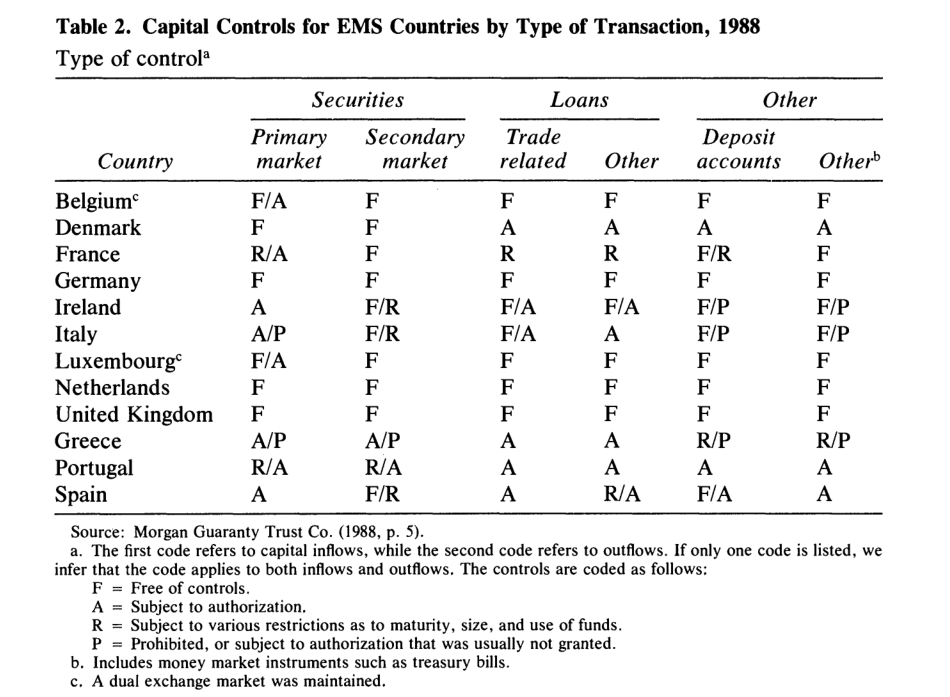
The EMS experienced considerable instability and many devaluations between 1979 and 1987. Despite this, the system survived, partly because substantial capital controls constrained speculative attacks.
Figure 1. Exchange-rate realignments within the EMS, 1979–1987 (percent). Source: Barry Eichengreen and Charles Wyplosz (1993).
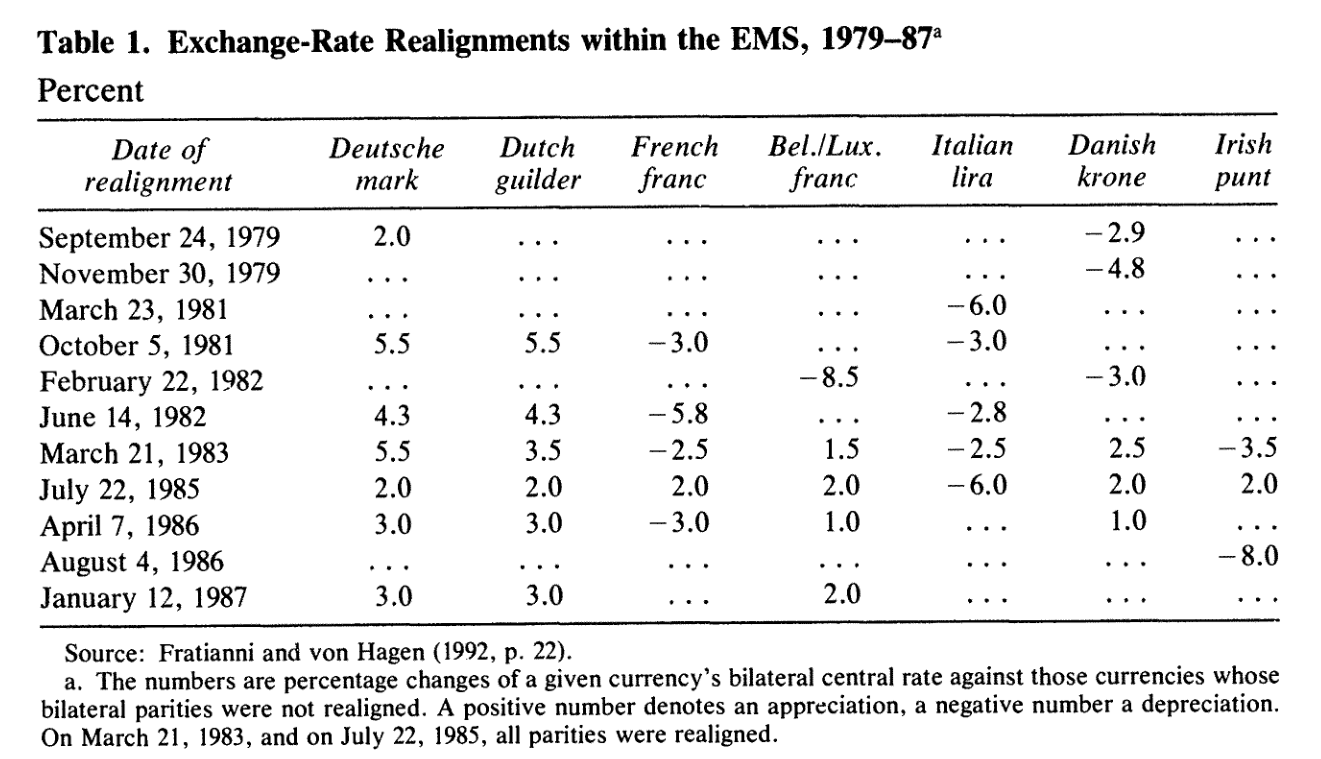
Figure 2. Capital controls for EMS countries by type of transaction, 1988. Source: Barry Eichengreen and Charles Wyplosz (1993).
18.2.4 The “Hard EMS” Years: 1987–92
After numerous exchange rate realignments, EMS members took steps to make the system less unstable. The Basle–Nyborg agreement of 1987 provided for more active central bank intervention in foreign exchange markets to keep exchange rates close to target, better credit facilities for deficit countries, and stronger coordination of macroeconomic policies to discourage large trade deficits or surpluses.
Initially, these changes appeared successful. There were no currency realignments for five years, and the United Kingdom joined the EMS in 1990, expanding the area of planned exchange rate stability in Europe. Many observers came to believe that Europe would rapidly advance toward full Economic and Monetary Union (EMU) without further exchange rate realignments. The Delors Report of 1989 launched the plan for EMU, and the Maastricht Treaty, agreed in February 1992, formalised this intention.
18.2.5 Doubts Grow About EMU
Three developments ended the period of EMS stability.
- The first was German reunification, which generated substantial public spending in Germany and a consumer boom in Eastern Europe. Germany required tighter monetary policy than other EMS members, and in summer 1992 financial markets began to anticipate that other countries would need to devalue their currencies.
- The second was growing doubt about EMU. On 2 June 1992, Danish voters rejected the Maastricht Treaty in a referendum, leading investors to question whether sufficient political support existed for monetary union to proceed.
- The third was the freer movement of capital. The Single European Act, which provided the foundation for the single market, required most capital controls to be removed by July 1990. International capital flows then became large enough to force exchange rate realignments, with daily foreign exchange transactions exceeding the total foreign exchange reserves held by central banks.
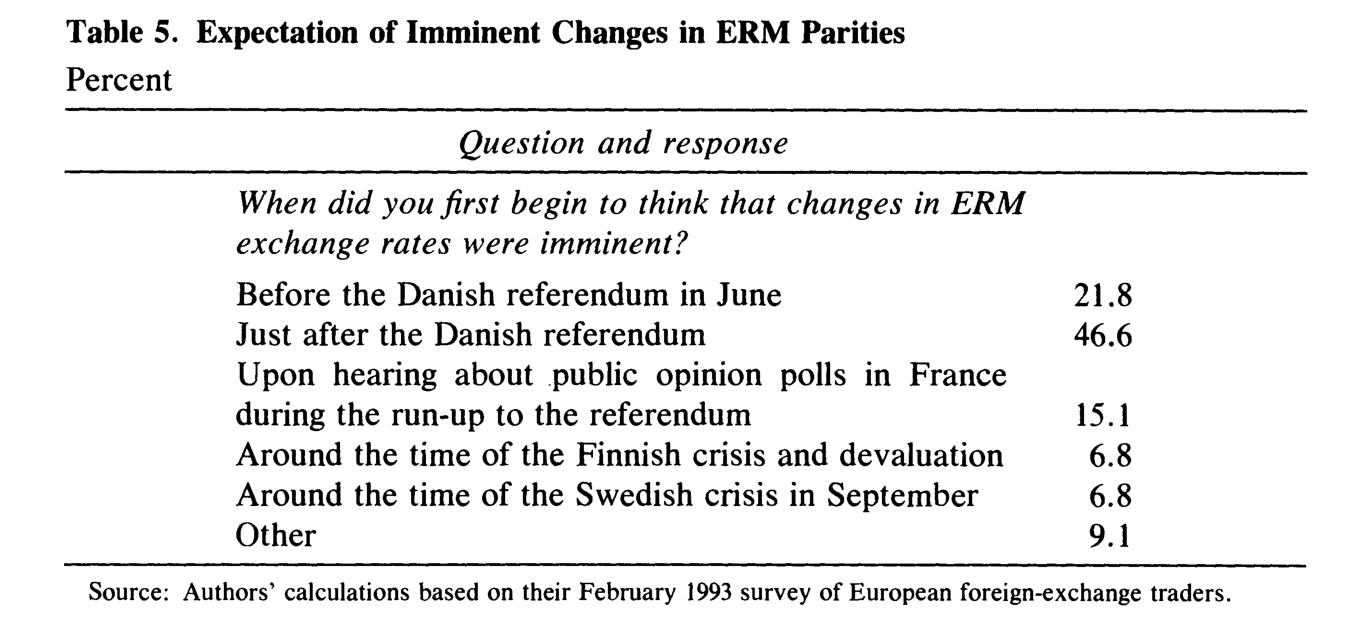
Eichengreen and Wyplosz (1993) surveyed foreign exchange investors to investigate why the EMS crisis of 1992–93 occurred. The next two exhibits present evidence from these surveys.
Figure 3. Foreign exchange traders’ assessments of the reasons for the 1992 EMS crisis. Source: Barry Eichengreen and Charles Wyplosz (1993).
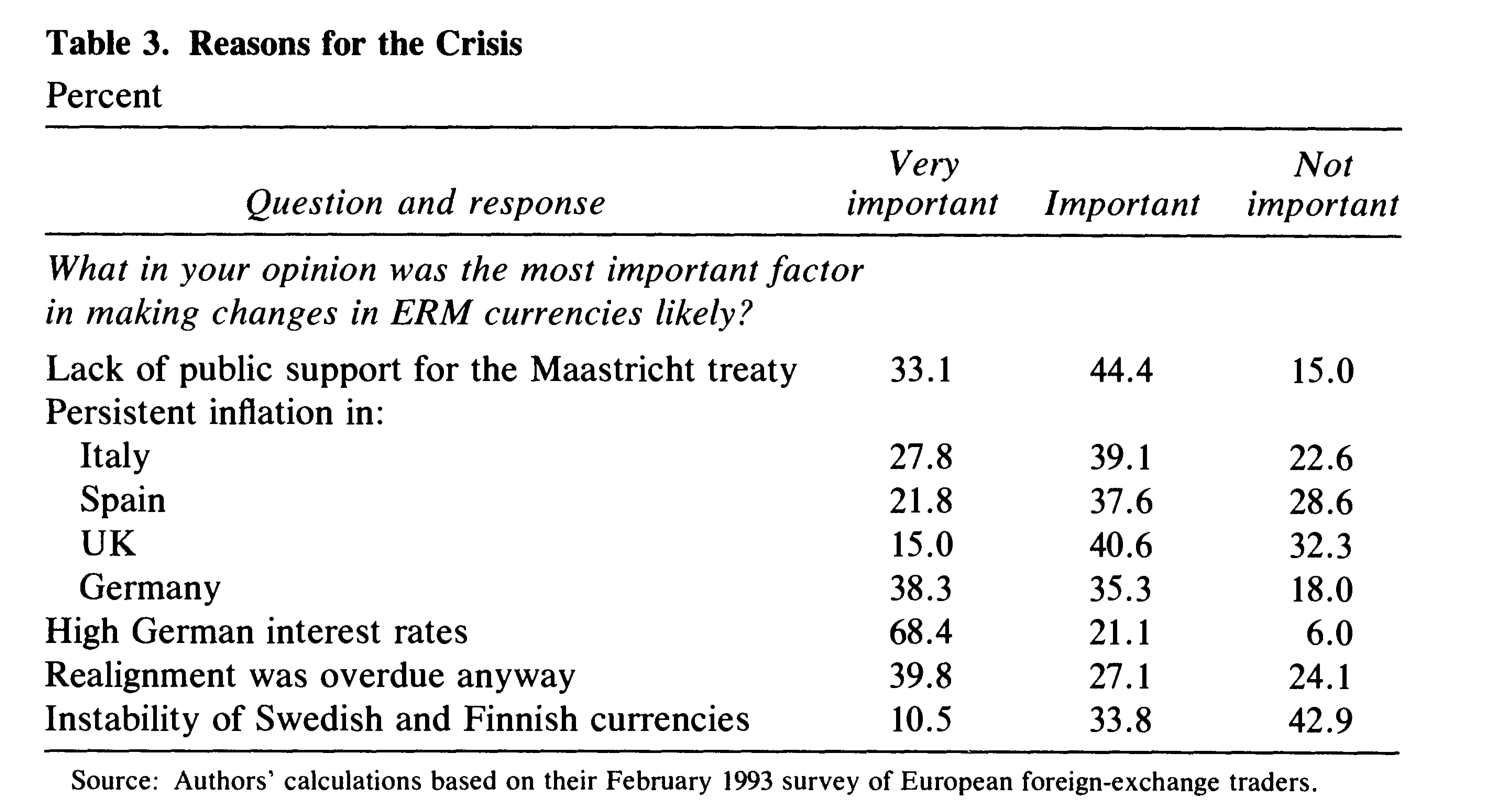
Figure 4. Survey evidence on when traders expected imminent ERM parity changes. Source: Barry Eichengreen and Charles Wyplosz (1993).
18.2.6 Hard EMS Falls Apart and the Road to EMU
After the Danish referendum in June 1992, investors increasingly expected currencies to be realigned through devaluations against the Deutsche Mark. The currencies of countries with wider allowable exchange rate bands—notably the UK, Spain and Italy—began to fall.
Sterling came under particularly severe pressure by September 1992, and comments by the Bundesbank President that devaluations could not be ruled out increased this pressure. The United Kingdom raised interest rates to 15% to attract capital inflows and spent $20 billion in foreign exchange reserves, approximately half of its holdings, in an unsuccessful effort to support the pound.
On 16 September 1992, remembered as Black Wednesday, the UK withdrew from the EMS and never rejoined the effort to establish monetary union. Italy withdrew on the same day. Other member countries subsequently devalued, including Ireland by 10% in January 1993. By summer 1993 the “hard EMS” had ended and exchange rates were permitted to move within much wider bands.
The crisis persuaded most EU governments that pegged exchange rates were difficult to reconcile with free capital mobility, and that full monetary union offered a better route to lasting exchange rate stability.
18.3 Deciding to Join the Euro
18.3.2 Arguments for a Common European Currency
Many European countries wanted stable exchange rates against the German Deutsche Mark. Within the EMS, they had generally needed to follow German monetary policy without having a voice in German monetary decisions. A common currency would give all participating countries a say in the conduct of monetary policy.
A common currency was also expected to eliminate devaluation risk, which had increased borrowing costs for governments, firms and households in many EMS members. The experience of recurrent self-fulfilling speculative crises under fixed exchange rate arrangements strengthened the argument for full monetary union rather than a system of nominally fixed exchange rates subject to repeated crises.
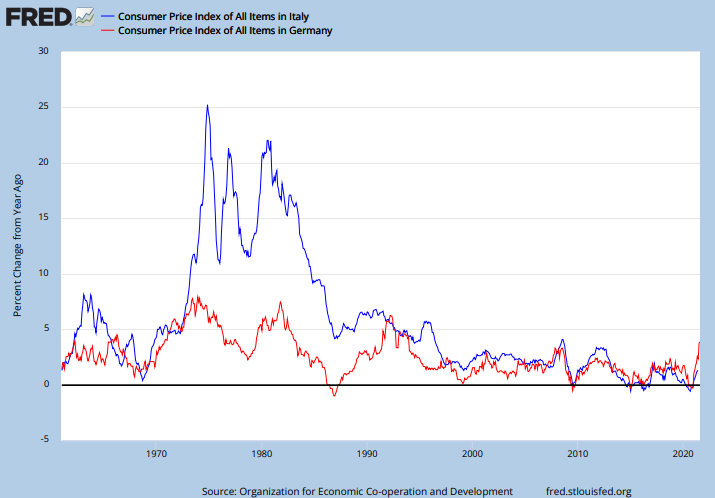
Countries such as Italy, with historically weak inflation performance, hoped to gain from the credibility of Germany’s Bundesbank by participating in a new, more credible common currency. A common currency was also expected to reinforce the microeconomic benefits of the European single market, while its political significance lay in deepening European integration beyond monetary arrangements.
18.3.3 Complications for the Euro as a Common Currency
A common European currency faces several difficulties.
- First, the size and economic asymmetries of the euro area mean that member countries can be at very different stages of the business cycle. A monetary policy suited to Germany, for example, may be inappropriate for Ireland or Spain.
- Second, there is a lack of fiscal integration. Within a common currency area, regions experiencing economic weakness can benefit from lower tax payments and additional transfers, which helps offset their inability to run an independent regional monetary policy. This kind of fiscal insurance is less extensive in the euro area.
- Third, labour mobility between EU countries is relatively limited. As a result, unemployment in a badly affected member state is less likely to be reduced by migration to stronger regions than would be the case between US states.
- Fourth, the euro area lacks a fully centralised banking backstop. In the US, deposit insurance and the resolution of insolvent banks are organised centrally. The euro area has a common bank supervisor, but the lecture notes that deposit insurance and bank resolution are still likely to remain largely national responsibilities.
Figure 5. Consumer price inflation in Italy and Germany, illustrating historical differences in inflation performance. Source: FRED/OECD as reproduced in the lecture.
18.3.4 Currency Choice for Ireland
All EU member states must allow free capital mobility as a requirement of the Single Market. Therefore, they face a choice between accepting a flexible exchange rate and relinquishing their own monetary policy independence. For Ireland, joining the euro was a complex decision, and the overall consequences of membership have been mixed.
As a small open economy, Ireland could be considered too small to form an optimal currency area by itself. However, Ireland did not have one dominant trading-partner currency: it traded extensively with the euro area, the United Kingdom and the United States. There was therefore no unambiguous choice of foreign currency against which to peg the Irish currency, and retaining a floating exchange rate might have made sense.
On the other hand, a floating currency exposes investors to possible future devaluation, and they may demand a risk premium for holding that country’s debt. Euro membership eliminated this particular devaluation risk and contributed to lower Irish interest rates. Those lower interest rates boosted economic growth. Yet during a period of exceptionally strong growth, this stimulus also undermined macroeconomic stability by helping to fuel the housing bubble and the subsequent banking crash.