4 The Fed and the ECB
Having introduced the general functions of central banks, we now examine two important central-banking systems:
- The Federal Reserve System (Fed) in the United States.
- The Eurosystem, comprising the European Central Bank (ECB) and the national central banks (NCBs) of euro-area member states.
The comparison focuses on seven questions:
- Legal mandates: What objectives must each central bank pursue?
- Organisation: Who makes monetary-policy decisions, and how is the system structured?
- Political independence and accountability: How are central banks insulated from political pressure, and to whom do they report?
- Banking supervision: What is their role in overseeing financial institutions?
- Lender of last resort: How do they provide emergency liquidity in financial crises?
- Meetings: How are monetary-policy decisions reached?
- Communications: How are decisions explained to the public and financial markets?
4.1 Legal Mandates
4.1.1 The Federal Reserve
The Fed was founded in 1913, and its legal framework has evolved substantially since then.
Historical evolution
- Initial purpose — lender of last resort. The Fed was originally created primarily to supply liquidity to the banking system during crises and thereby reduce the risk of bank runs and financial panics.
- Problems during the Great Depression. Despite this original purpose, the Fed did not adequately prevent the banking difficulties of the 1930s.
- Institutional reform and a broader policy role. With the development of the modern Board of Governors in Washington, D.C., and greater banking stability after the 1930s, monetary policy gradually became its central responsibility.
- Renewed focus on banking stability. More recent financial crises have once again highlighted the importance of financial stability and banking supervision.
The Fed’s principal legal foundation is the Federal Reserve Act, as subsequently amended. The Act identifies several objectives:
- A high level of employment.
- Stable prices, meaning low and stable inflation.
- Moderate long-term interest rates.
The first two objectives are commonly emphasized as the Fed’s dual mandate. Nevertheless, moderate long-term interest rates also appear in its statutory objectives.
Economic interpretation: Monetary policy may confront trade-offs between employment and inflation in the short run. The Fed’s mandate requires it to consider both macroeconomic outcomes rather than treating price stability as the only legally specified objective.
4.1.2 The European Central Bank and the Eurosystem
The legal foundation for the euro area’s single monetary policy was established by the Maastricht Treaty (entering into force in 1993).
It is important to distinguish the ECB from the entire monetary-policy system:
Eurosystem = ECB + national central banks of euro-area countries.
The Eurosystem has a clear hierarchy of objectives.
Primary objective: price stability
The Treaty states that the primary objective is to maintain price stability. Unlike the Fed’s multiple statutory objectives, the ECB’s primary objective is explicitly given priority.
Secondary objectives: support broader economic policies
Without prejudicing price stability, the Eurosystem is also required to support broader economic objectives. The lecture identifies these as including:
- A high level of employment.
- Sustainable, non-inflationary growth.
- Competitiveness.
- Convergence of economic performance among member countries.
The qualification “without prejudice to price stability” is crucial: support for employment and growth must remain consistent with the ECB’s primary objective.
Inflation target
The lecture describes the ECB’s current strategy at that time as aiming for 2% inflation over the medium term. An earlier formulation was “below, but close to, 2%.” The newer formulation places 2% at the centre of the objective rather than making an inflation rate just below 2% the preferred outcome.
4.1.3 Comparing the mandates
| Dimension | Fed | ECB / Eurosystem |
|---|---|---|
| Main legal foundation | Federal Reserve Act | European treaties, originating with the Maastricht framework |
| Core objectives | Employment, price stability, moderate long-term rates | Price stability as the primary objective |
| Other economic objectives | Explicitly included in the statutory mandate | Supported only insofar as price stability is not compromised |
| Institutional setting | One country with a federal structure | Multiple countries sharing a currency |
4.2 Organisation and Decision-Making Bodies
4.2.1 The Federal Reserve System
Two institutions must be distinguished:
- The Federal Reserve System is the entire central-banking system.
- The Federal Open Market Committee (FOMC) makes the principal monetary-policy decisions.
The Federal Reserve System consists of:
- The Board of Governors, based in Washington, D.C.
- 12 regional Federal Reserve Banks, distributed across the United States.
Together, these institutions perform central-banking functions, including currency-related operations and the management of payment systems. Many operational responsibilities are decentralised to the regional Reserve Banks.
4.2.1.1 The FOMC
The FOMC has 12 voting members:
- The seven members of the Board of Governors.
- The President of the Federal Reserve Bank of New York.
- Four presidents from the remaining regional Reserve Banks, with voting seats rotating among them.
The Chair of the Board of Governors also chairs the FOMC. The New York Fed President serves as the FOMC’s Vice Chair. In the 2025 lecture, these officeholders are identified as Jerome Powell and John Williams, respectively.
The FOMC ordinarily meets eight times per year, although additional emergency meetings can be arranged when necessary.
New York has a central role in U.S. financial markets and in the implementation of open market operations. It is therefore institutionally distinct from other regional Reserve Banks in the FOMC’s voting structure.
4.2.1.2 Geography of Federal Reserve districts
The map shows that the boundaries of the twelve Federal Reserve districts reflect the distribution of the U.S. population around 1913**.
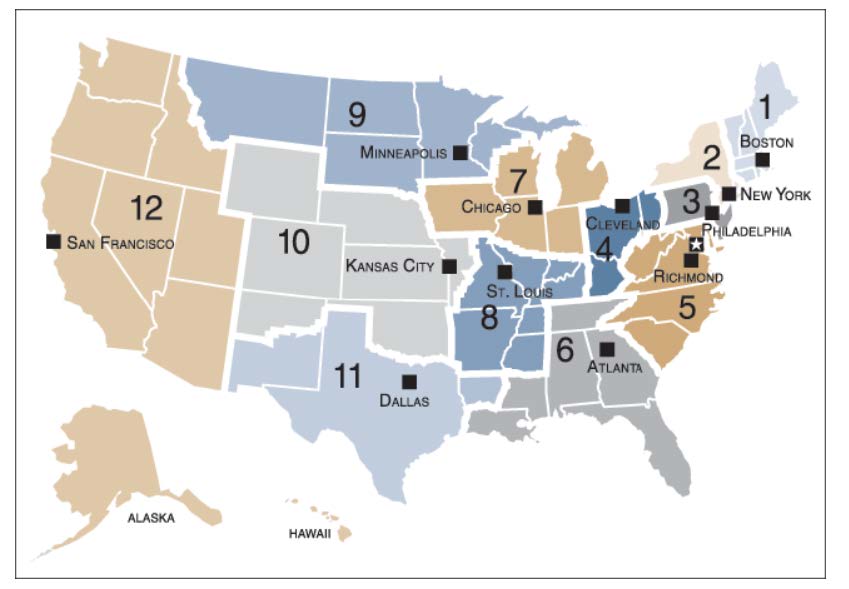
This historical structure matters because:
- Population and economic activity were more concentrated in certain eastern and midwestern regions when the Fed was established.
- The South and West subsequently expanded substantially.
- The district structure nevertheless retains its historical boundaries.
Thus, the geographic structure of the Fed does not simply reproduce the present-day distribution of population or economic activity.
4.2.2 The ECB and the Eurosystem
The ECB is run on a day-to-day basis by its six-member Executive Board. The lecture identifies Christine Lagarde as the ECB President.
The main monetary-policy decision-making body is the Governing Council, which comprises:
- The six Executive Board members.
- The governors of the participating NCBs.
The Autumn 2025 slides describe 20 participating NCB governors, giving the Governing Council 26 members at that time. Its monetary-policy meetings are normally held every six weeks at the ECB’s headquarters in Frankfurt, with an annual meeting hosted elsewhere in the euro area.
4.2.2.1 National central banks remain active participants
Membership in the monetary union does not mean that an individual NCB simply disappears or is fully replaced by the ECB.
For example, the Central Bank of Ireland no longer determines an independent interest-rate policy for Ireland, but its governor participates in the formulation of monetary policy for the euro area as a whole.
NCBs also perform important operational functions:
- Implement many of the Eurosystem’s monetary-policy operations.
- Carry out currency-related functions.
- Operate payment systems.
- Produce economic statistics and forecasts.
- Monitor public finances and other domestic economic developments.
The Eurosystem therefore has a highly decentralised operational structure. Activities that might be performed primarily by a central board in Washington are often distributed across national central banks in the euro area.
4.2.3 Comparing organisational structures
| Dimension | Fed | ECB / Eurosystem |
|---|---|---|
| Central administrative body | Board of Governors | ECB Executive Board |
| Main monetary-policy committee | FOMC | Governing Council |
| Regional / national units | 12 regional Reserve Banks | National central banks of euro-area states |
| Decision-making participants | Federal and regional officials | ECB executives and NCB governors |
| Main operational role | Regional Reserve Banks, especially New York for open market operations | Predominantly national central banks |
| Institutional logic | Federal decentralisation within one country | Monetary integration across sovereign countries |
4.3 Political Independence and Accountability
Central bank independence means that monetary-policy decisions can be made without direct political interference. Accountability means that an independent institution must still explain its decisions and answer to democratically constituted bodies.
These concepts are related, but they are not identical: independence does not imply an absence of accountability.
4.3.1 Political independence of the Fed
The Fed enjoys important operational independence:
- Its monetary-policy decisions do not require approval by Congress.
- The President cannot directly veto individual FOMC policy decisions.
However, the Fed’s independence has institutional limits:
- Congressional authority. Congress can amend the Federal Reserve Act and potentially change the Fed’s mandate or institutional design.
- Political appointments. Members of the Board of Governors are appointed through the U.S. political process.
- Length of tenure. Governors have statutory 14-year terms, designed to reduce the influence of short-term political pressures. A governor appointed to complete a predecessor’s unfinished term may in practice serve a shorter period.
- Chair appointment. The Chair serves a four-year term as Chair, even while holding a longer-term position as Governor, and may need reappointment to continue in the leadership role.
Under the Humphrey-Hawkins framework, the Fed provides Congress with semiannual monetary-policy reports, including its assessments and projections of economic activity and inflation. The Fed Chair also appears before congressional committees to testify and answer questions.
Fed’s independence is relatively limited by international standards.
4.3.2 Political independence of the ECB
The ECB was designed to possess a particularly high degree of institutional independence.
Its protections include:
- Treaty-based mandate. Its key objectives are entrenched in European treaties, making them much harder to amend than ordinary national legislation.
- Long, non-renewable Executive Board terms. Executive Board members serve eight-year terms and cannot be reappointed. This limits incentives to please politicians in order to secure another term.
- Minimum terms for NCB governors. National central-bank governors must have terms of at least five years.
- Euro-area-wide responsibility. Governing Council members are expected to decide according to the interests of the euro area as a whole, not the interests of their home countries.
- Prohibition on political instructions. European treaty provisions prevent political authorities from seeking to direct ECB monetary-policy decisions.
Executive Board appointments involve agreement among the participating countries’ political leaders, but once appointed, board members are protected by the ECB’s independence framework.
The ECB must:
- Prepare an annual report for the European Parliament.
- Have its President appear four times per year before the Parliament’s Committee on Economic and Monetary Affairs.
The ECB has strong legal and political protections for independent policy decisions, while maintaining reporting and hearing obligations at the European level.
4.4 Banking Supervision
Banking supervision involves monitoring the safety and soundness of financial institutions. It is related to, but distinct from, setting policy interest rates.
4.4.1 Banking supervision in the United States
The U.S. system is characterised by multiple supervisory authorities, rather than one single regulator.
The lecture highlights three institutions:
| Institution | Role emphasised in the lecture |
|---|---|
| Federal Reserve | Supervision of major bank holding companies |
| Office of the Comptroller of the Currency (OCC) | Supervision of national banks |
| Federal Deposit Insurance Corporation (FDIC) | Supervision of smaller state-chartered banking institutions in the lecture’s simplified description |
A bank holding company is an entity that owns or controls banks. Supervision at the holding-company level allows regulators to consider risks affecting the wider banking group.
4.4.1.1 Effects of the global financial crisis
Following the 2008 global financial crisis, the Fed’s role in financial supervision expanded, particularly under the Dodd-Frank Act of 2010.
The lecture identifies three changes:
- Thrift supervision: The Office of Thrift Supervision was abolished, and the Fed acquired supervision of thrift holding companies. Thrifts are savings-oriented financial institutions, historically associated with housing finance.
- System-wide oversight: The Financial Stability Oversight Council (FSOC) was established to monitor threats to financial stability. The Fed participates in this interagency council and has a significant role in banking-system stress tests.
- Certain non-bank institutions: The Fed was given supervisory responsibilities for non-bank financial firms whose safety and soundness were considered important to the wider financial system, following FSOC designation.
Main lesson: After the crisis, the Fed’s supervisory responsibilities increasingly reflected concerns about systemic risk, not just the safety of individual banks.
4.4.2 Banking supervision in the euro area
Historically, different euro-area countries organised supervision differently:
- Some relied on their national central banks.
- Others used independent supervisory agencies.
This diversity created a challenge for a common monetary area: financial distress in one member state could have consequences elsewhere, even though supervision remained fragmented.
4.4.2.1 Development of the Single Supervisory Mechanism
In June 2012, euro-area leaders agreed on a framework allowing the European Stability Mechanism (ESM), the common financial-assistance fund, to support undercapitalised banks. A key accompanying institutional step was the creation of common euro-area banking supervision.
The ECB assumed its role in the Single Supervisory Mechanism (SSM) in late 2014.
According to the 2025 course slides, the ECB then directly supervised 119 banks, accounting for more than 80% of euro-area banking assets. These figures should be read as the lecture’s reported statistics, not as live supervisory totals.
The SSM operates through a division of responsibilities:
- Significant banks: Supervised directly by the ECB.
- Other banks: Generally supervised by national competent authorities.
- ECB oversight: The ECB may assume direct supervision of another credit institution when necessary to ensure consistent supervisory standards.
Before taking over, the ECB conducted a comprehensive assessment of the banks within its direct supervisory remit. It also cooperates with the European Banking Authority (EBA) on stress testing.
A stress test asks whether a bank would remain adequately capitalised if it suffered a severe adverse economic or financial shock.
Main lesson: The SSM moved euro-area banking supervision toward a common framework, although national authorities still carry out substantial supervisory work.
4.5 Lender of Last Resort
A lender of last resort provides emergency liquidity when financial institutions face serious funding pressures. This role is especially important when a liquidity crisis threatens to spread through the financial system.
It is useful to distinguish two problems:
- Illiquidity: An institution cannot obtain sufficient cash or immediately usable funds to meet payments as they fall due.
- Insolvency: An institution’s assets are insufficient to cover its liabilities, so liquidity support alone may not repair the underlying problem.
4.5.1 6.1 Lender of last resort: the Fed
4.5.1.1 The discount window
The Fed operates a discount window through which eligible banks can borrow from the central bank when needed. The lecture emphasises that borrowing banks are normally expected to be in generally sound financial condition.
The discount window therefore provides a standing channel for central-bank liquidity assistance to banks.
4.5.1.2 Emergency lending under Section 13(3)
Section 13(3) of the Federal Reserve Act provides a broader emergency-lending authority, enabling the Fed to extend support beyond traditional bank borrowers in exceptional circumstances.
During the 2008–2010 financial crisis, the Fed used emergency facilities to:
- Support funding in disrupted financial markets.
- Prevent the failure or disorderly collapse of important financial institutions.
- Reduce the transmission of financial distress across the economy.
Although these interventions helped stabilise the financial system, they were politically controversial.
4.5.1.3 Restrictions following the crisis
The lecture notes subsequent restrictions, including:
- Emergency lending under Section 13(3) requires approval from the U.S. Treasury Secretary.
- The Fed may no longer use Section 13(3) to make firm-specific rescue loans of the type associated with the crisis; the emergency facilities are instead subject to broader eligibility requirements.
- Orderly Liquidation Authority (OLA) provides a separate framework for resolving certain failing financial firms. The lecture notes that its effectiveness had not yet been tested in practice as of the lecture date.
Key distinction: Emergency lending addresses funding problems, whereas orderly liquidation is a mechanism for dealing with institutional failure. They are related responses to crises, but they are not the same intervention.
4.5.2 Lender of last resort: the ECB / Eurosystem
The Eurosystem provides bank liquidity through:
- Regular refinancing operations, including weekly operations.
- A marginal lending facility, which eligible banks may use to borrow from the central bank when necessary.
These loans require eligible collateral, meaning assets that satisfy the Eurosystem’s requirements for securing central-bank credit.
4.5.2.1 Why can collateral become a constraint?
During a severe funding crisis, a bank may exhaust its available eligible collateral. Even if central-bank borrowing facilities exist, the bank may be unable to borrow enough because it has no additional acceptable assets to pledge.
At that point, the bank may seek Emergency Liquidity Assistance (ELA).
4.5.2.2 Emergency Liquidity Assistance
The lecture describes the ELA framework as follows:
- National central banks provide ELA. The relevant NCB undertakes the lending and bears the associated credit risk.
- ECB oversight remains important. The ECB’s Governing Council can restrict or stop ELA when a two-thirds majority determines that the programme interferes with Eurosystem objectives.
- ELA can create difficult judgments. Authorities must distinguish between a bank that is fundamentally viable but illiquid and a bank whose losses may already have made it insolvent.
4.5.2.3 Historical controversies
The slides discuss several disputes involving ELA during the 2010s:
- Possible insolvency: ELA was sometimes extended to banks that appeared to be insolvent.
- Ireland, Cyprus, and Greece: The ECB’s power to restrict ELA influenced the timing and design of EU–IMF financial-support programmes.
- Anglo Irish Bank: Repayment of ELA by failed, nationalised banks contributed to significant costs for taxpayers.
- Cyprus (2013): Some depositors suffered losses after emergency liquidity had helped finance withdrawals by better-informed depositors.
These cases show that lending-of-last-resort decisions may have major distributional, fiscal, and political consequences.
4.5.3 Fed–ECB comparison: crisis lending
| Dimension | Fed | ECB / Eurosystem |
|---|---|---|
| Ordinary liquidity backstop | Discount window | Refinancing operations and marginal lending facility |
| Broader emergency mechanism | Section 13(3) facilities | Emergency Liquidity Assistance (ELA) |
| Institutional decision structure | Federal Reserve, with statutory restrictions and Treasury approval for Section 13(3) | NCBs extend ELA and bear risk; ECB Governing Council can object |
| Key constraint in the lecture | Legal limits on emergency support and firm-specific rescues | Eligible collateral and the Governing Council’s power to restrict ELA |
| Central policy dilemma | Prevent systemic collapse without encouraging inappropriate rescues | Provide liquidity while managing solvency concerns and cross-country consequences |
Takeaway: The lender-of-last-resort function requires more than the technical ability to create central-bank money. It also requires legal authority, acceptable collateral, judgments about solvency, and a clear allocation of financial risk.
4.6 Monetary-Policy Meetings
4.6.1 How FOMC meetings work
The Fed publishes full FOMC meeting transcripts after a five-year delay, making it possible to study the deliberations in considerable detail.
The lecture describes a typical sequence:
- Staff briefings: Officials present recent developments in financial markets, the U.S. economy, and the international economy.
- Macroeconomic forecasts: Participants discuss staff projections for economic growth, employment, inflation, and related variables.
- Regional roundtable: Reserve Bank presidents describe economic conditions in their own districts, bringing local information into national policy deliberations.
- Break: The meeting may pause before moving to policy recommendations.
- Chair’s assessment and proposal: The Chair presents a preferred policy action and proposes wording for the FOMC’s public statement.
- Discussion and vote: Participants debate and vote on the proposal. Members who disagree may register a dissent and briefly explain their reasoning.
4.6.1.1 Why does statement wording matter?
A central bank affects the economy not only through its current interest-rate decision but also through expectations about future policy.
The FOMC statement can therefore influence market expectations even when the policy rate itself remains unchanged. This helps explain why the Chair’s proposed wording is an important component of the meeting.
4.6.2 How ECB Governing Council meetings work
Since 2015, the ECB has published written accounts of Governing Council monetary-policy meetings.
These accounts describe:
- Information provided to policymakers about economic and financial developments.
- The general nature of the policy discussion.
However, the accounts generally do not attribute particular comments to named participants.
The ECB’s voting transparency also differs from the Fed’s:
- Policy decisions were historically often presented as unanimous.
- Disagreements do occur, but individual voting results are not routinely released.
- As the lecture notes, it may not always be clear whether a formal vote occurred.
4.6.2.1 Rotation of national central-bank voting rights
The euro area’s expansion required a system that would allow participation without making the number of voting members excessively large.
Lithuania’s entry into the euro area in 2015 triggered a new rotation system. The lecture describes the following arrangement:
- The governors of the five largest economies—Germany, France, Italy, Spain, and the Netherlands—share four voting rights.
- Governors from the other 15 countries (the 20-country grouping in the 2025 slides) share 11 voting rights.
- Voting rights rotate monthly among national central-bank governors.
The allocation is based on indicators of economic size and financial-sector size.
Important distinction: Rotation of voting rights does not mean that governors lose the ability to participate in Governing Council discussions when it is not their voting month.
4.6.3 Comparing meeting transparency
| Feature | FOMC | ECB Governing Council |
|---|---|---|
| Public record | Minutes and full transcripts after five years | General accounts of discussions |
| Attribution of participants’ comments | Detailed in eventual transcripts | Typically not attributed by name |
| Dissent / voting information | Published vote details and recorded dissents | Individual voting outcomes generally not published |
| Regional or national input | Regional Reserve Bank presidents | NCB governors from euro-area countries |
4.7 Communication with the Public and Markets
Central-bank communication is an important part of monetary policy because households, firms, and financial markets make decisions partly on the basis of expected future interest rates and economic conditions.
4.7.1 Communication by the Fed
After each FOMC meeting, the Fed publishes an official statement setting out:
- The monetary-policy decision.
- Its assessment of economic and financial conditions.
- Its views about inflation risks.
- The voting outcome, including dissenting votes where applicable.
4.7.1.1 Evolution of Fed transparency
- Before 1994: The FOMC did not issue a statement after its meetings.
- Before 1999: Statements were generally released only when the target federal funds rate changed.
- More recently: The statements have become longer and more informative, often discussing expected policy settings and asset purchases.
The Fed also publishes detailed minutes several weeks after its meetings, while full transcripts are released after a five-year lag.
Beginning in 2011, the Fed Chair started holding press conferences after selected FOMC meetings. Under Chair Powell, press conferences became a regular feature after every scheduled meeting.
In addition, FOMC participants communicate through public speeches and congressional testimony.
4.7.1.2 Forward guidance
Statements about how long interest rates may remain low, or how the central bank plans to purchase assets, provide information about its expected future policy path.
This is commonly described as forward guidance. The lecture highlights how the wording of statements became especially important during periods when short-term interest rates were near zero.
4.7.2 Communication by the ECB
After each Governing Council monetary-policy meeting:
- The ECB issues a monetary-policy statement.
- The ECB President reads and explains the statement at a press conference.
- Journalists question the President about the policy decision, country-specific developments, and complex policy programmes.
The statement explains the decision with reference to the ECB’s announced monetary-policy strategy.
ECB press conferences illustrate the practice of central-bank-speak: highly deliberate, technically precise language intended to avoid sending unintended signals to financial markets.
The President generally tries to remain “on-message”, meaning consistent with the Governing Council’s agreed communication strategy. However, unclear wording or an unexpected response can still create market confusion and volatility.
The ECB also makes press-conference transcripts and webcasts available online, and Governing Council members regularly give public speeches.
4.7.3 Why communication is economically important
Monetary policy influences financial conditions through at least two channels discussed in these notes:
- The current policy decision, which affects short-term funding conditions.
- Information about expected future policy, which can influence expectations and financial-market pricing.
Therefore, a central bank’s statement, minutes, press conference, and public speeches can be policy-relevant even when no immediate change is made to its interest-rate target.
4.8 Consolidated Comparison: The Fed and the ECB
| Dimension | Federal Reserve | ECB / Eurosystem |
|---|---|---|
| Legal foundation | Federal Reserve Act | European treaties |
| Main mandate | Employment, price stability, moderate long-term rates | Price stability takes priority |
| Decision-making body | FOMC | Governing Council |
| Geographic organisation | 12 regional Reserve Banks | National central banks of euro-area states |
| Standard meeting schedule | Approximately eight per year | Approximately every six weeks |
| Independence | Policy autonomy, but Congress can revise its mandate | Strong treaty-based protection |
| Political accountability | Reports and testimony to Congress | Reports and appearances before the European Parliament |
| Supervision | Part of a multi-agency U.S. framework | ECB-led Single Supervisory Mechanism with national authorities |
| Routine bank liquidity | Discount window | Refinancing operations and marginal lending facility |
| Crisis liquidity | Section 13(3) emergency facilities | National-central-bank ELA subject to Governing Council oversight |
| Meeting disclosure | Minutes, voting details, and delayed full transcripts | Accounts without individual attribution; voting details generally private |
| Policy communication | Statements, minutes, press conferences, speeches | Statements, press conferences, accounts, speeches |