11 How Central Banks Set Interest Rates: The Federal Reserve
We have seen that targeting the money supply is not an effective way to produce good macroeconomic outcomes. Most modern central banks do not practice monetary targeting. Instead, they focus on controlling short-term interest rates.
In the next two set of notes, we will take a close look at how the Federal Reserve and the ECB implement policies to control interest rates.
11.1 Pre-2008 Fed Policy
There are a couple of reasons why banks wish to hold reserves with the central bank.
- Regulatory: In addition to reserve requirements relating to deposits, the Basel process has imposed various liquidity-related regulations that affect the demand for reserves.
- Payments: Banks need to keep enough reserves with the central bank to be able to honour payment requests that come through central bank payments systems such as TARGET2.
However, traditionally, reserves held at the central bank didn’t earn any interest, so holding a lot of reserves would reduce a bank’s profits.
An alternative is to hold fewer reserves and to use what are known as inter-bank money markets in which banks borrow and loan reserves from each other, if you need to make up any temporary shortfall in reserves.
In the US, the interbank market for short-term funds is known as the Federal Funds market (despite its name, it is a private market) and the average rate in this market is known as the Federal Funds Rate. Like all markets, the price set in the Federal Funds market—in this case the interest rate that banks charge to lend reserves—depends on both supply and demand.
11.1.1 Graphical Representation
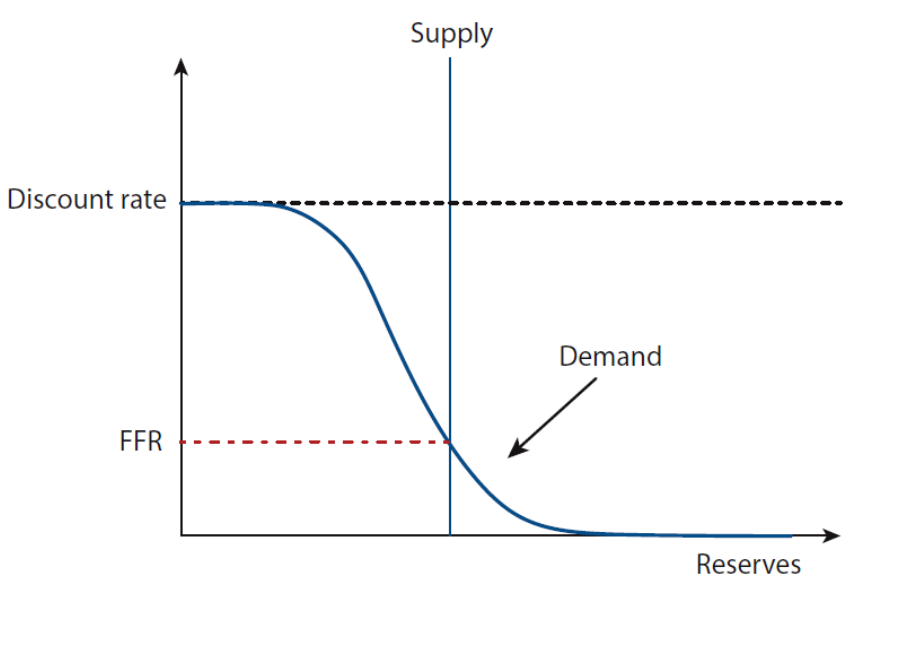
The Fed is uniquely positioned to control this price (i.e. the interest rate) because it can control both supply and demand in this market.
- Demand: The Fed sets reserve requirements so they can increase or reduce demand for reserves via adjusting this requirement. It can make the demand curve for reserves shift left or right.
- Supply: The Fed can determine the total supply of reserves to the system via open market operations.
For most of the modern era, the Fed controlled the fed funds rate by controlling the supply of reserves. Adjustments in reserve requirements are generally not used by modern central banks as part of their monetary policy strategy. When the Fed creates lots of reserves, demand for reserves is low relative to supply and they are cheap to borrow, so the federal funds rate is low. When the Fed keeps the supply of reserves low, demand for reserves is high relative to supply and they are expensive to borrow, so the federal funds rate is high.
11.1.1.1 Demand Side
Let’s describe the demand for reserves as being a function of the Fed Funds rate. The downward-sloping curve means demand for reserves goes up as the Federal Funds declines. This is because the “opportunity cost” of holding reserves is lower with a low Fed Funds rate. We also model upper and lower bounds on the Fed Funds rate:
- The Fed Funds rate should not go above the discount rate (the rate the Fed charges to banks for borrowing from it) since banks should not borrow at rates higher than what is available from the Fed.
- They model a zero lower bound on the Fed Funds rate, on the grounds that banks would not wish to make negative interest rate loans to other banks (because they would lose money doing so).
These bounds mean the demand curve flattens out above and below a certain range.
11.1.1.2 Supply Side
The supply curve for reserves is just a vertical line: The Fed just sets a supply of reserves using open market operations and this supply is not dependent on the federal funds rate. By setting the supply of reserves at the appropriate point, the Fed gets to set the federal funds rate at its target level.
The Fed raises the federal funds rate by cutting the supply of reserves and reduces it by increasing the supply of reserves.
Figure (slide 8): How the Fed Controlled the Federal Funds Rate
11.1.2 The Federal Reserve’s Pre-QE Operational Strategy
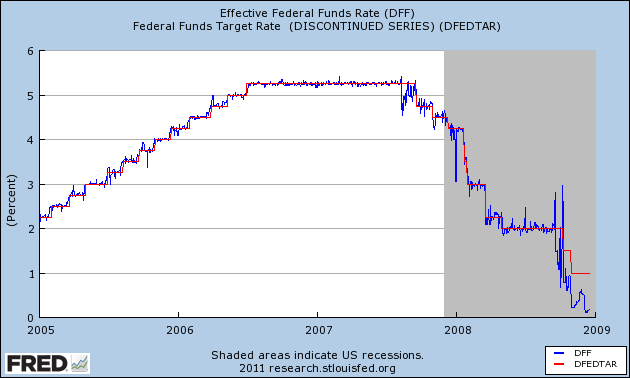
Prior to 2008, the Federal Reserve intervened in the Fed funds market—via its Open Market Desk at the New York Fed—on a daily basis to keep interest rates as close as possible to its target rate.
It adjusted the supply of reserves by varying the amount of short-term loans (1 to 14 days) that it provided to banks via credits to their reserve accounts.The Open Market Desk would consult with the largest banks attempts to figure out how much liquidity was needed and plans its operation accordingly.
Most days, the Fed succeeded in keeping the funds rate close to target.
As discussed above, in addition to daily interventions in the federal funds market, the Fed also had a ’standing facility” for lending to banks, called the “discount window.” The discount window interest rate was traditionally a half percentage point above the target fed funds rate.
There is evidence, however, that banks generally do not want to use the discount window because it is seen as a last resort and there may be a stigma associated with using it, should others find out i.e. it could signal the bank is in crisis.
Figure (slide 10): Historically, the Fed Kept the Funds Rate Close to Target
11.2 Post-2008 Fed Policy
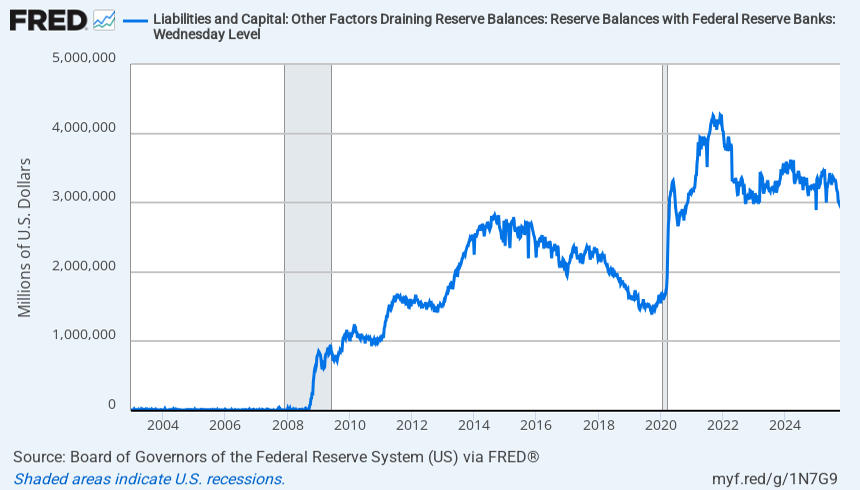
The Fed’s post-2008 QE programs brought the supply of reserves to almost $3 trillion. With a huge supply of reserves, the traditional way of raising interest rates (by generating a shortage of reserves) did not work. This meant the Fed needed to use new tools to raise interest rates:
Interest on Reserves: In October 2008, the Federal Reserve began paying interest on reserves.
“Paying interest on excess balances should help to establish a lower bound on the federal funds rate.” Rates on loans made by banks or other risky investments need to be higher than this interest rate because this is risk free for banks.
Interest to Non-Banks: The Fed also now has a program of taking in money from a wide range of non-bank financial institutions and paying interest. The technical name for this program is the “Overnight Reverse Repurchase Agreement Facility” (ON RRP).
“Any counterparty that can use the ON RRP facility should be unwilling to invest funds overnight with another counterparty at a rate below the ON RRP rate, just as any depository institution eligible to earn interest on reserves should be unwilling to invest funds overnight with another counterparty at a rate below the interest rate on excess reserves.”
Figure (slide 13): Reserve Balances of US Banks
11.2.1 New versus Old Fed Monetary Policy
Recall that in the Fed’s old regime, they carefully decided on setting the supply of reserves so that it would intersect with demand to produce the desired interest rate.
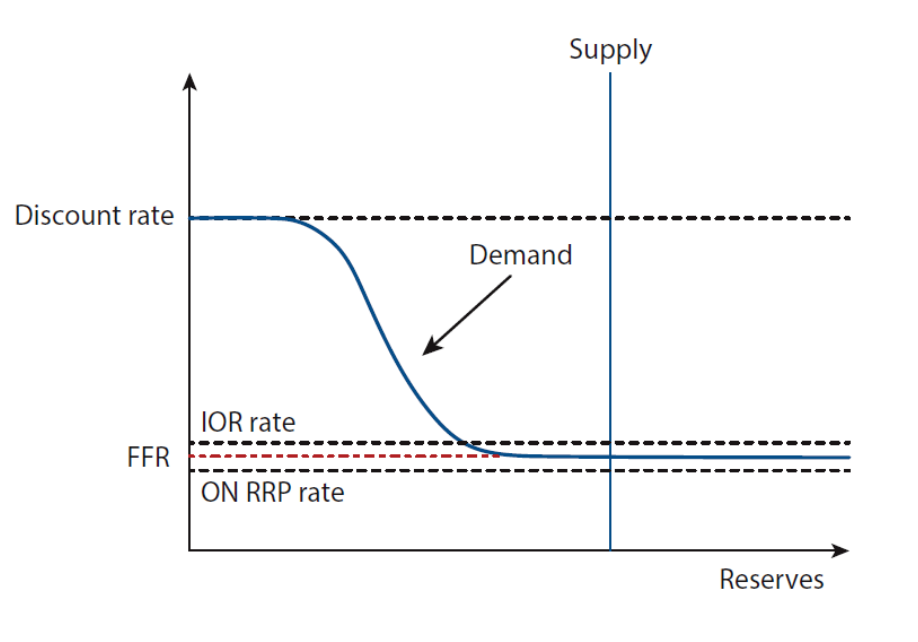
In the new regime (“the ample reserves framework”) without interest on reserves, providing a big supply of reserves would drive the fed funds rate to zero. But the Fed paying interest on reserves prevents that.
The ON RRP rate (and not the interest rate on reserves) sets the floor for the fed funds rate.
This rate can be earned by non-bank financial institutions who don’t hold reserve accounts with the Fed and so don’t earn interest on reserves. The ONRRP rate puts a floor on the rate at which they are willing to make short term loans to other financial institutions.
Figure: The Fed’s New Approach to Controlling the Federal Funds Rate
11.2.2 Fed Policy in Recent Years
Unlike in the past when it had a specific target for the Federal Funds rate, with its new operational regime, the Fed decided to target a range for the federal funds rate that is 25 basis points wide.
These new tools have been effective both in in raising and reducing the fed funds rate when the FOMC has wanted to tighten or loosen monetary policy.
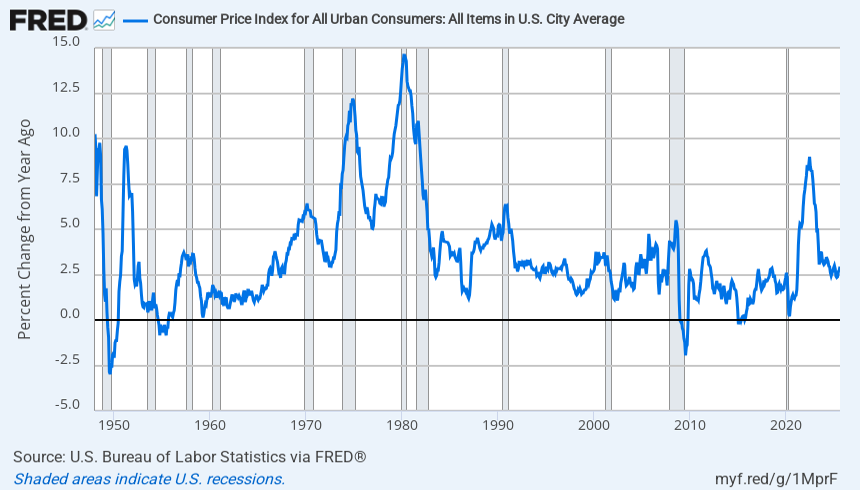
The Fed raised interest rates substantially over 2022/23 in response to post-pandemic inflation rising well above its 2% target. The Fed funds rate rose from almost zero to about 5.25%. Inflation has fallen now and the Fed has begun cutting interest rates. But the latest reading of 2.9% for inflation is still above its 2% target.
- At the time of writing, the FOMC has a target range for the fed funds rate of between 4% and 4.25%, after a 25 basis point cut in September, 2025.
- The interest rate on reserves is currently set at 4.15%.
- The interest rate offered in its ON RPP programs is currently set at 4%.
- The interest rate available from the principal discount window program (“the primary credit rate”) is 4.25%.
Figure : New Tools Have Successfully Increased and Decreased Rates
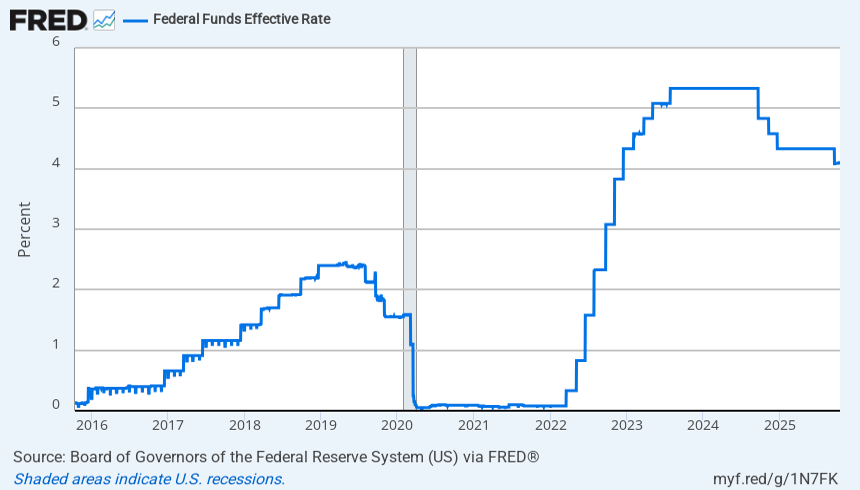
Figure: US CPI Inflation
11.2.3 The Fed’s Balance Sheet Reduction 2015-19
From 2015 to 2019, the Fed reduced the supply of reserves by selling securities and thus retiring the money that was created when the assets were purchased. While the Fed had originally planned to bring its balance sheet back to its pre-crisis size, it decided to change its plans, and stopped selling its security holdings in August 2019 with the supply of reserves being much higher than before the global financial crisis. The reason for this change of plans is particularly the liquidity coverage ratio—mean that banks now want to maintain much higher levels of reserves than previously. The FOMC minutes from its November 2018 meeting:
“banks’ liquidity management practices had changed markedly since the financial crisis, with large banks now maintaining substantial buffers of reserves, among other high-quality liquid assets, to meet potential outflows and to comply with regulatory requirements.
By 2018, the Fed had realised the high demand for reserves was going to prevent going back to its pre-crisis balance sheet size and officials discussed options for implementing monetary policy. Over the course of a number of meetings, the FOMC had a discussion about how to proceed, with lots of technical advice provided by its staff of economists and financial market experts.
In January 2019, the FOMC announced:
“After extensive deliberations and thorough review of experience to date, the Committee judges that it is appropriate at this time to provide additional information regarding its plans to implement monetary policy over the longer run. Additionally, the Committee is revising its earlier guidance regarding the conditions under which it could adjust the details of its balance sheet normalization program.
Accordingly, all participants agreed to the following. The Committee intends to continue to implement monetary policy in a regime in which an ample supply of reserves ensures that control over the level of the federal funds rate and other short-term interest rates is exercised primarily through the setting of the Federal Reserve’s administered rates, and in which active management of the supply of reserves is not required.”
11.2.3.1 The Fed Staff’s Discussion of Two Options
November 2018 FOMC minutes.
The staff highlighted how changes in the determinants of reserve demand since the crisis could affect the tradeoffs between two types of operating regimes:
- Aggregate excess reserves are sufficiently limited that money market interest rates are sensitive to small changes in the supply of reserves.
- Aggregate excess reserves are sufficiently abundant that money market interest rates are not sensitive to small changes in reserve supply.
In the former type of regime, the Federal Reserve actively adjusts reserve supply in order to keep its policy rate close to target. This technique worked well before the financial crisis, when reserve demand was fairly stable in the aggregate and largely influenced by payment needs and reserve requirements.
However, with the increased use of reserves for precautionary liquidity purposes following the crisis, there was some uncertainty about whether banks’ demand for reserves would now be sufficiently predictable for the Federal Reserve to be able to precisely target an interest rate in this way.
In the latter type of regime, money market interest rates are not sensitive to small fluctuations in the demand for and supply of reserves, and the stance of monetary policy is instead transmitted from the Federal Reserve’s administered rates to market rates–an approach that has been effective in controlling short-term interest rates in the United States since the financial crisis, as well as in other countries where central banks have used this approach.”
11.2.3.2 September 2019 Liquidity Shortage and Future Policy
During September 2019, despite reserve balances still being over $1.5 trillion, there was a temporary shortage of liquidity in US financial markets.
The repo market—where people take on short-term loans using securities as collateral—saw a jump in interest rates and the Fed funds rate jumped up to 2.3 percent, just above the top of the Fed’s target range.
The Fed had relied on surveys of financial institutions to assess how much it needed to supply in reserves to maintain its “abundant liquidity” model. (Again, see the New York Fed article). But demand for liquidity can vary over time and in September the Fed was supplying too little.
The Fed reacted to this shortage of liquidity supply relative to demand by conducting open market operations to increase the supply of liquidity.
The Fed is currently unwinding its QE programme which acts to reduce the supply of reserves but other developments have kept the supply of reserves high. When institutions use the ONRRP facility, this drains reserves from the system and reduced usage of ONRRP has been offsetting the reversal of QE over the past few years.
It is unlikely the Fed will end up again with an insufficient supply of reserves.
11.2.4 Regulation
Prior to the global financial crisis, banks generally had very low levels of reserve balances and in September 2019, we saw a “shortage” at a time when the Fed has supplied $1.5 trillion to the system.
New liquidity regulation was introduced after the global financial crisis, particularly the liquidity coverage ratio (LCR). The LCR requires banks to hold sufficient high-quality liquid assets (HQLA) to meet net cash outflows over a thirty-day stress period. In the US, HQLA include reserve balances held in a Federal Reserve account and Treasury securities, as well as some other assets.
But if banks can hold Treasury bonds, why keep the money on reserve at the Fed, which generally earns a lower interest rate?
“Today, banks must hold significant liquid assets to back various sorts of short-term liabilities. The details of the Liquidity Coverage Ratio (LCR) are complex, but the basics are simple: banks need to hold some combination of reserves and U.S. Treasury securities to guard against deposit outflows in times of stress. That is, prior to going to the Fed to borrow, these new regulations envision that banks will use the liquid assets they have on hand to meet withdrawals.
In practice, it turns out that banks prefer to hold reserves than securities to insure against the possibility of outflows. There are several reasons for this.
First, if securities—even U.S. Treasuries—are sold quickly, it can drive prices down (something that banks’ own liquidity stress tests may assume). Second, everyone finds out when someone is selling securities under stress. If a bank uses reserves to meet withdrawals, only the Fed knows. The mix of liquidity considerations and the stigma from large Treasury sales makes reserves very attractive.
It describes how Federal Reserve’s bank supervisors implement the LCR in a way that makes banks prioritise holding reserves rather than Treasury securities.
This regulation explains Why Is Demand for Reserves So High?
11.3 A Final Note on Monetarism
11.3.1 Paul Volcker and Monetarism: 1979-1982
For most of its history, the Federal Reserve has set an implicit or explicit target for the Federal Funds rate and supplied the amount of reserves on a daily basis that kept this rate close to its target.
During the period from October 1979 to October 1982, under the chairmanship of Paul Volcker, the Fed switched from targeting the federal funds rate to targeting reserves with the intention of hitting target levels for the growth rate of the money supply.
The background to this decision was
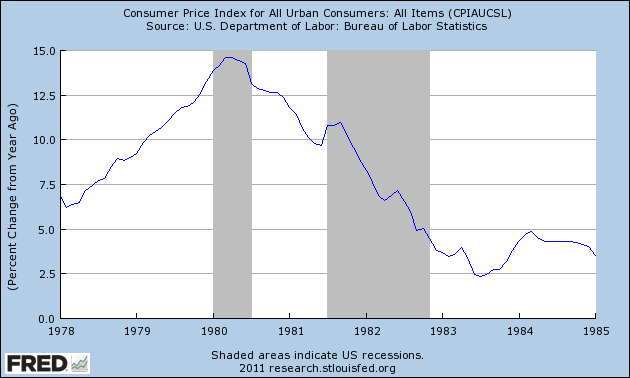
- a large rise of inflation (12% in October 1979) and the appointment of Volcker (a well-known “inflation hawk”) to the position of Fed Chair by President Jimmy Carter
- the increasing influence of Milton Friedman’s monetarist ideas.
The Federal Reserve makes available transcripts of the meetings of its monetary policy decision-making body, the Federal Open Market Committee (FOMC) years after the meetings have happened. The October 1979 transcript suggests Volcker was probably not a hardline monetarist but rather was looking for something to break “inflationary psychology.”
Daily and weekly demand for reserves tends to be very volatile, as the large amounts of transactions moving around systems like on Fedwire or TARGET2 can create unpredictable shortages and excesses of reserves at individual banks.
If central banks follow a monetarist policy and thus supply a fixed level of reserves, this can cause interest rates in money markets to move around a lot from day to day as some days lots of banks are seeking loans, forcing the interest rate up, while other days few banks are seeking loans and interest rates are low.
During the period when monetarist policies were pursued in the US, the Federal Funds rate was highly volatile, moving around on a daily and monthly basis in a way that was not seen before or since. Similar volatility was seen in the UK during this period, as their government also adopted monetary policies.
11.3.2 October 1982: Abandoning Monetarism
In one sense, Volcker’s monetarist strategy was a success: US inflation fell rapidly after the implementation of monetary targeting.
However, if one looks at the pattern for interest rates, this wasn’t too surprising. The Federal Funds rate reached about 20% on three different occasions between 1980 and 1982 and the US economy suffered a severe double-dip recession.
By late 1982, with inflation conquered and interest rates high and volatile, Volcker became dissatisfied with the restrictions placed on him by monetary targeting, particularly because the link between the monetary base and M1 was proving to be so imprecise.
Today, many believe that Volcker’s apparent embrace of monetarism was a tactical decision to avoid having to take direct responsibility for the high interest rates required to bring down inflation.
Figure : The Federal Funds Rate: 1978-1984
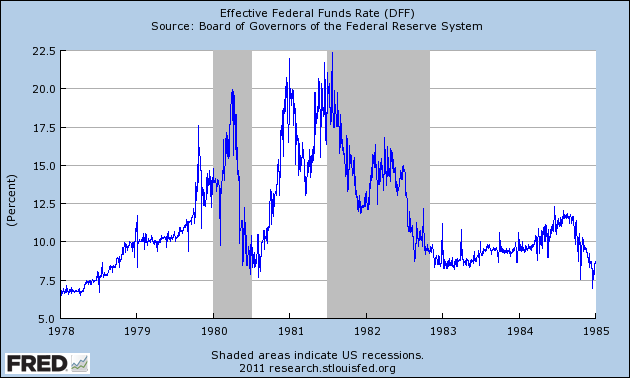
Figure: US CPI Inflation: 1978-1984