5 Banking Crises
We have discussed how the banking system works and the role that banks play as financial intermediaries during “normal times.” Over the next few weeks, we are going to cover banking crisis. We will focus on how and why they happen, on how governments attempt to prevent them, and on policy options for dealing with them when they occur.
We will cover these topics in the following order:
- Banking Crisis Basics:
- How banking crises happen, why they are so damaging,
- how the structure of the modern banking system has changed the nature of banking crises.
- Policies to prevent and cope with crises and how they have evolved in recent years.
- Incentive Problems: How banking crises can occur because bankers may have incentives that are not aligned with the public good.
- Banking Regulation: Overview of both micro-prudential and macro-prudential regulation.
5.1 Banking Crises and Their Consequences
Banks generally make profits by charging higher interest rates on loans than they pay out on deposits. But things can go wrong sometimes. Sometimes, borrowers don’t pay back their loans or the other assets invested in lose much of their value. Banks can also sometimes make bad investments in other assets such as stocks or bonds.
What if a bank makes losses so that its assets go below what it owes to depositors and bond-holders, i.e. it has negative equity capital?
5.1.1 Insolvency and Bank Runs
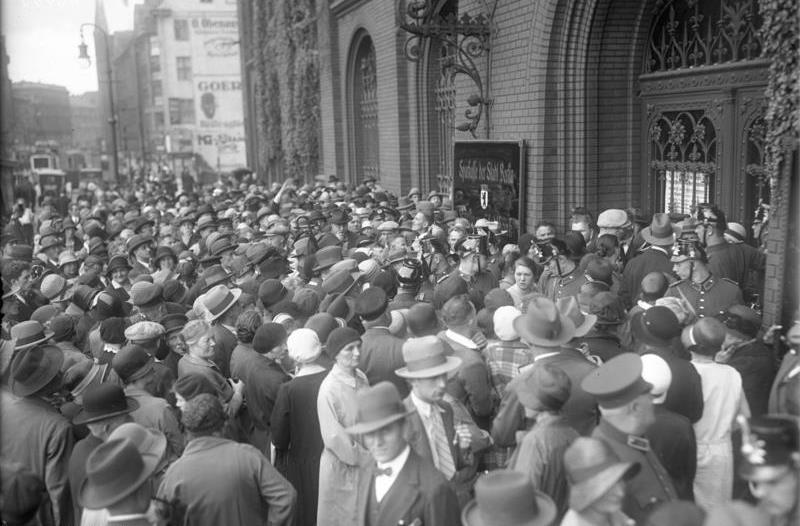
Once it is suspected a bank is insolvent, if depositors fear that they may not get their money back, this can trigger a bank run: Depositors line up to demand their money back.
In September 2007, depositors of Northern Rock, who had limited deposit insurance from the UK government, started to take their money out of its branches. This was the first time since the 1930s that advanced economies saw retail bank runs of this type. More recently, a number of US banks (most notably Silicon Valley Bank) experienced bank runs in which customers withdrew their deposits online.
The bank can start paying off depositors by selling off its most liquid assets, e.g. cash, excess reserves at the central bank, government debt securities. But once those assets are gone, the bank will have to start selling assets that are not liquid and so not easy to quickly turn into cash, e.g. long-term customer loans or property assets.
Selling off non-liquid assets quickly (an asset fire-sale) often requires having to sell the assets for less than if they had been sold in a more orderly manner. The bank run triggered by its insolvency ends up making the bank even more insolvent—the value of its assets fall even farther behind liabilities.
Sometimes a bank run can be triggered by mere rumours that the bank is insolvent. Even if the rumours are false, the bank may still end up being insolvent if it has to sell its assets quickly at a discount to pay back its liabilities. For this reason, bankers and governments are always quick to declare that banks are fully solvent. Even if they are not so sure, the bank and the government will want to prevent a run.
5.1.2 Contagion
On its own, a single bank failing and some depositors losing some money is unfortunate but not necessarily a major concern. However, once one bank fails, it can often put other banks under pressure.
If one bank has lost money on a particular type of loan or security investment, how can depositors be sure that other banks are not also about to lose similar amounts?
To depositors, two banks with similar loan portfolios probably look the same.
If one has lost plenty of money and is insolvent, how can we be sure that the other isn’t heading in the same direction? Northern Rock’s problems were triggered by US banks with similar-looking business models getting into trouble rather than clear problems with the value of its assets. Indeed, two banks with similar names may seem similar to the public.
So bank runs can be contagious: After one bank fails, depositors start to look for their money back from other banks. Bank failures thus tend to come together in batches. The banking system may seem healthy one minute and then suddenly the whole system becomes unstable.
5.1.3 Implications of Banking Crises for Credit
Banking crises usually lead to severe restrictions on the availability of credit to firms and households. To see why, let’s look at a stylized balance sheet and think about what happens during a banking crisis:
| Assets (Uses of Funds) | Liabilities (Sources of Funds) |
|---|---|
| Cash and Reserves | Deposits |
| Securities | Other Borrowings |
| Loans | Equity Capital |
By definition Loans = Deposits + Other Borrowings + Equity Capital - Cash and Reserves - Securities.
Banking crises see movements in deposits, other borrowings, and bank cash and securities holdings, all of which lead to a lower quantity of loans.
- Deposits: If some customers lose faith in banks and prefer to keep cash in a mattress, then banks will have less funds to loan out.
- Other Borrowings: Similarly, bond markets and other providers of funds may be less willing to lend to banks that they worry may fail.
- Cash and Reserves: To survive potential runs on the banks, they will keep larger amounts of cash and reserves for precautionary reasons.
- Securities: Even when money is invested, banks will shift towards securities that can be quickly sold to raise cash.
The result is a reduction in loans. It’s hard for banks to “call in” existing loans but when loans are paid off, banks will keep the funds as cash or reserves or invest in securities instead of making new loans or use them to pay off deposit outflows or maturing bond liabilties.
So both bank and customer behaviour contributes to a credit crunch: Banks are no longer in a position to lend to borrowers and financial intermediation breaks down.
5.1.4 Macroeconomic Effects of Banking Crises
Financial intermediation is crucial for economic activities like house purchases, car purchases, starting a new business and so on. When banking crises happen, banks stop playing their crucial role as financial intermediaries and the economy suffers: Sectors such as housebuilding and consumer durables suffer particularly badly.
Without access to credit, business and consumer confidence suffers and this has further negative effects on the economy. For these reasons, banking crises can be hugely damaging, triggering severe recessions. We know that the global financial crisis of 2007/2008 triggered a severe worldwide recession but this was not the first time.
Ben Bernanke was Fed Chair during the 2008/09 financial crisis. His early research (long prior to joining the Fed) had focused on the role played by the banking crisis in worsening the Great Depression of the 1930s. Here are some quotes from a
.
The banking problems of 1930-33 disrupted the credit allocation process by creating large, unplanned changes in the channels of credit flow. Fear of runs led to large withdrawals of deposits, precautionary increases in reserve deposit ratios, and an increased desire by banks for very liquid or rediscountable assets. These factors, plus the actual failures, forced a contraction of the banking system’s role in the intermediation of credit.
As the real costs of intermediation increased, some borrowers (especially households, farmers, and small firms) found credit to be expensive and difficult to obtain. The effects of this credit squeeze on aggregate demand helped convert the severe but not unprecedented downturn of 1929-30 into a protracted depression.
5.1.5 Additional Complications in Modern Banking Crises
Modern banking systems have a number of additional features that make banking crises more difficult to deal with than in the past.
- Non-Deposit Funding: While deposit insurance tends to reduce the chance of retail bank runs, many modern banks obtain substantial non-deposit funding via bond markets or inter-bank money markets. These providers of funds are more prone to “run” than depositors, who are often viewed as a “sticky” source of funding.
- Interbank Linkages: Funding links between banks can mean that the failure of one bank can directly threaten the failure of other banks.
- Financial Assets and Negative Feedbacks: Many banks now have very large holdings of financial assets, whose valuations (unlike loans) are set in the market every day. During crises, we can see negative feedback loops involving banks selling assets, which then decline in value, thus making bank solvency problems even worse.
These additional complications led to a range of government interventions during the global financial crisis of 2008/09, many of which were expensive for taxpayers.
5.1.5.1 Why More Non-Deposit Funding?
A common feature of the modern financial system is that many banks now rely heavily on non-deposit sources of funding. There are a number of reasons for this.
- Deepening of Financial Markets: Modern financial systems contain more options than in the past for people to channel their savings towards. Two that are relevant for banks are pension funds, which commonly buy bonds issued by banks and money market mutual funds, which commonly make shorter-term loans to banks.
- Financial Globalisation: In closed economies, savings must equal investment. Banks that are provided with savings from depositors must make loans within their own country. In an open economy, savings do not need to equal investment. In a country that has high savings but low investment, banks will often lend funds to banks in other countries. In pre-crisis Europe, banks in countries with current account surpluses (like Germany) provided lots of funds for banks in countries with current account deficits (e.g. Ireland, Portugal, Greece).
- Deregulation: Regulations about where banks get funds from, and who they can loan these funds to, have generally been loosened over time.
5.1.5.2 Modern Bank Runs: Non-Deposit Funding
Problems with failing banks in recent years have rarely involved depositors getting jittery and withdrawing money: Modern bank runs mainly come from those who lend money to banks through interbank markets and bond markets deciding not to continue supply a bank with funds.
Non-deposit funding is much less “sticky” than deposit funding. Those who provide it are more likely than depositors to check on the bank’s situation and pull money at the first sign of trouble.
Northern Rock may have looked like an exception but it actually wasn’t: The depositor runs happened well after other lenders to the Rock had begun to pull money. Only after the Bank of England announced emergency support did retail depositors realise what was going on.
Much of Northern Rock’s funding was in the form of “securitised notes”: These were bonds backed by the mortgages issued by Northern Rock as collateral in case the bank defaulted. When doubts about Northern Rock’s business model emerged, its non-deposit funding quickly tailed off.
Non-branch-related deposits also left the bank very quickly.
5.1.5.3 Interbank Lending and Systemic Risk
Interbank markets make it easier for banks to cope with reserve requirements (by lending and borrowing short-term funds) and allowing banks with lots of deposits but without good loan opportunities to lend to banks with good loan opportunities but limited deposits. But they can also contribute to making the banking system unstable.
Consider the following example:
- Three banks (A, B and C) all have equity capital of €10 million.
- Bank A has borrowed €25 million from Bank B and Bank B has borrowed €15 million from Bank C.
- Now suppose Bank A loses €35 million in bad property loans. This wipes out its equity capital. The bank becomes insolvent and is wound up and Bank B does not get its €25 million back.
- Bank B is now insolvent and cannot pay back the €15 million it owes Bank C. This means that Bank C also has no equity capital and so is insolvent.
Bank A going down brings the whole system down. This example describes what is known as systemic risk.
5.1.5.4 Asset Price Fire Sales and Spillovers
The previous example is not very realistic. It required the first bank to lose an amount that wasn’t just greater than its own capital but an amount greater than the capital of the whole system. But we have left out another important channel through which one bank getting in trouble affects others.
When banks get into trouble and start selling liquid assets (stocks, bonds, etc) in a hurry to pay off depositors or lenders—often termed a fire-sale of assets—this places downward pressure on the prices of these assets.
Modern banking regulations have required banks to “mark their tradeable assets to market” as much as possible. So if the failure of one bank leads to the prices for some financial assets falling, then other banks have to mark down the value of their assets also.
The asset price fire sales reduce the equity capital of other banks and place them under threat. A single bank failure can lead—via contagion and spillovers from asset sales—to the whole system becoming unstable.
5.1.6 The Bank-Sovereign “Doom Loop”
The euro area crisis of 2011/12 illustrated a new form of systemic risk: The interaction between banks and governments.
The global banking crisis saw many European banks receiving support from their national governments. In some cases, such as Ireland, the extent of this support undermined the confidence of financial markets in the confidence of governments. Weakness in the banking sector spread to the sovereign.
But euro area banks also had large (and increasing) holdings of their own country’s sovereign debt, so a sovereign debt default (as occurred in Greece) would threaten the solvency of the banks. Weakness in the government sector spread to the banking system.
Banks in countries with weak fiscal situations were also more likely to experience runs because depositors and investors would think the state was unable to provide funds for a bail out or for recapitalisation.
This created a sort of “doom loop” in which weaknesses in different parts of the system fed upon each other. In a June 2012 statement, the Euro Area leaders said “We affirm that it is imperative to break the vicious circle between banks and sovereigns.” Some progress has been made but elements of this loop still exist.
5.2 The Global Financial Crisis of 2008/09

5.2.1 The Roots of the Crisis
The early 2000s was an era of unprecedented low interest rates around the world. Low mortgage rates made it easy to borrow more money to buy houses. This produced a huge boom in house prices and many countries (such as Ireland, Spain and the US) had big housing construction booms.
In the US, there was a boom in sub-prime mortgage lending (i.e. borrowing by people with poor credit records). This was largely financed by securitisation: Banks would bundle together a set of mortgages and use their repayments to provide the income flows for securities that would be purchased by investors.
These mortgage-backed securities (MBS) were risky. If people defaulted on the mortgages, then the investors who bought these securities would lose money.
Despite the risks, the MBS were purchased by financial institutions all over the world. Why did banks and other investors buy sub-prime MBS given the risks involved?
- Confidence in House Prices: There was recognition of higher default risk but confidence that high and rising house prices would mean no losses when units were foreclosed (repossessed).
- Geographic Diversification: MBS were backed by mortgages from all over the US. There had been regional house price booms and busts but the modern era had not seen simultaneous falls in house prices all over the country.
- Credit Ratings: Many of the MBS—even many of those backed by subprime mortgages—had been rated AAA by ratings agencies, so they seemed safe.
- Fraud: Many of the subprime mortgage applications featured incorrect or fraudulent documentation of salaries, property values, owner occupancy and second liens. It is not clear how much investors knew.
- The Great Moderation: Macroeconomic fluctuations since the mid-1980s had been much smaller. People believed they were living in a “great moderation” period with limited macroeconomic risk.
5.2.2 House Prices Fall and Delinquencies Start
Eventually, anything that is unsustainable has to stop. Subprime mortgage origination peaked in 2005 and by 2006, with mortgage rates rising and some evidence mounting of the poor credit quality of recent loans, the financing boom ended.
With prices already out of line with reality and the funding boom over, house prices began to fall in Spring 2006, slowly at first and then quickly. Not only were many people who took out mortgages unable to pay them back but soon many of them were in negative equity.
Many US states have “non-recourse” mortgages: You can give the keys back to the bank and tell them to take the house (so-called “jingle mail”), so the bank takes a loss if the house is sold for less than the value of the mortgage.
Investors, in particular, were happy to just walk away. Even when banks do have recourse to pursue the debts, the legal process is slow and expensive.
Rather than supplying a steady stream of repayments to service the MBS, many of these mortgages became “salvage operations” as the mortgage server repossessed the houses and hoped to sell them for as much as possible.
Quickly, there was an unprecedented wave of delinquencies.
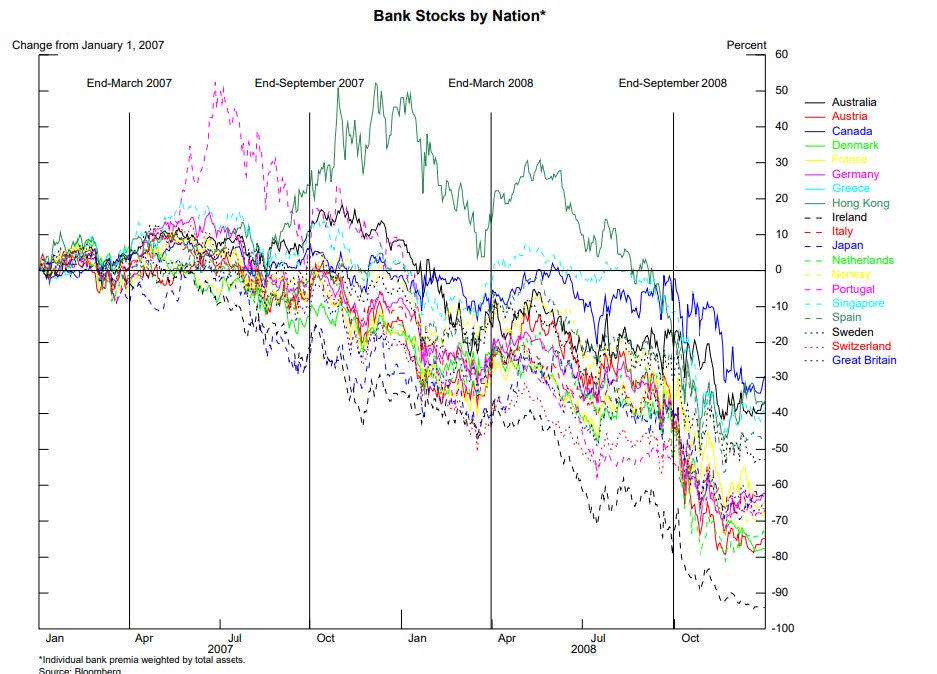
Over 2008, investors began to realise the riskiness of banks around the world.
- Risk Exposure:
- Many global banks (particularly European banks) had purchased large quantities of MBS.
- Some of the banks that were selling the MBS also ended up holding large amounts of their own products in 2008.
- Many leading banks were also engaged in lots of proprietary trading activity. With markets falling, there was the risk of large losses.
- Capital and Funding Weaknesses
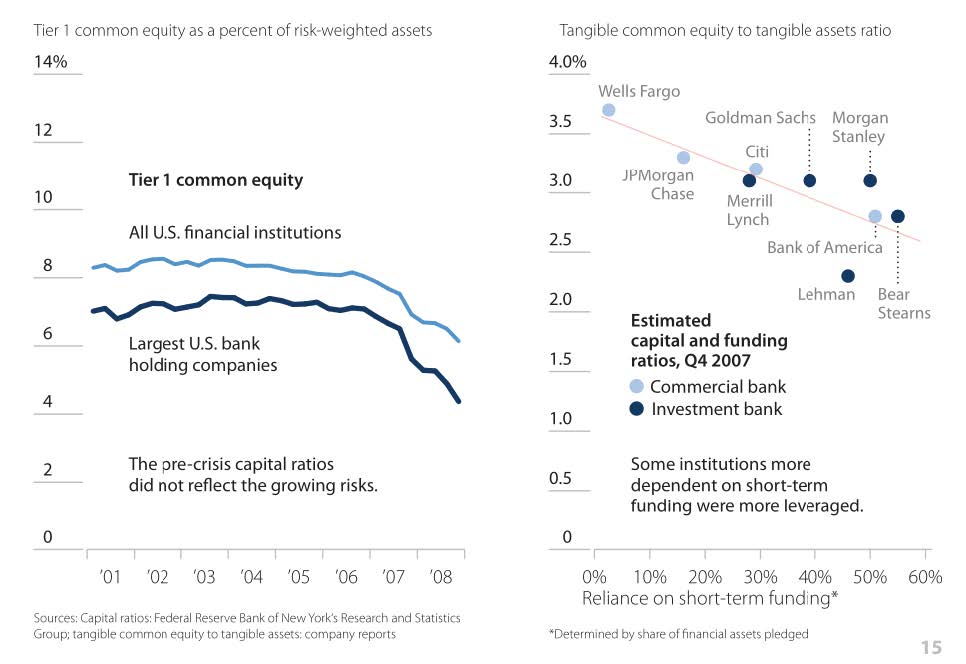
- Leading banks were highly leveraged, with insufficient capital to absorb large losses.
- The heavy reliance on short-term non-deposit funding end up triggering a series of liquidity crises.
5.2.3 The Policy Response: Pre-Lehmans
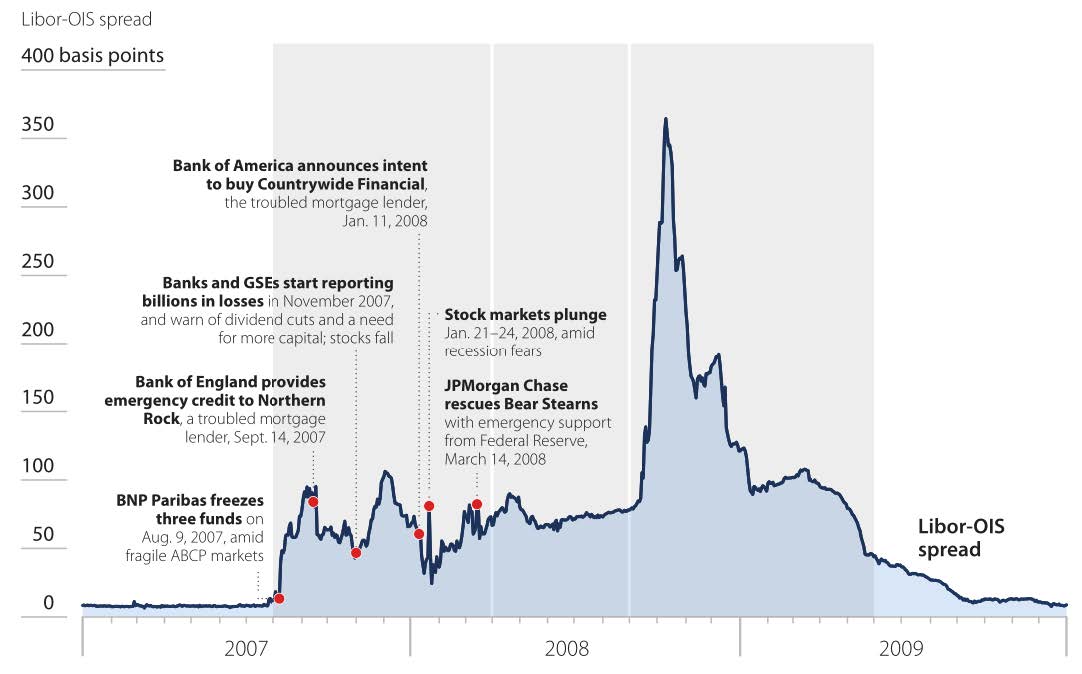
The first seeds of the crisis became evident in August 2007 as doubts grew about the implications of losses on subprime MBS for various financial institutions. From August 2007, the Fed, ECB and Bank of England greatly stepped up their liquidity providing operations as banks considered vulnerable began to lose funding.But very little was done to address the solvency problems of major international banks, which lay at the heart of the crisis.
Over the first year, the global response to the crisis was somewhat ad hoc.
- In August 2007, the UK authorities were slow to help Northern Rock, because of concerns about moral hazard. They only stepped in to nationalise the bank after a full-scale run had taken place. Northern Rock shareholders lost all their money.
- In March 2008, there was a non-deposit run on Bear Stearns. JP Morgan bought Bear Stearns with the US government insuring them against the losses on Bear’s mortgage-backed security portfolio.
- In early September 2008, MBS issuers Fannie Mae and Freddie Mac were put into conservatorship.
5.2.4 The Lehmans Decision and the Aftermath
By September 2008, the US authorities felt the previous bailouts had been politically unpopular and had set a bad precendent. So, when Lehman Brothers investment bank suffered the same kind of non-deposit run that Bear Stearns had, the Fed and the US Treasury made the decision to not help and Lehmans filed for bankruptcy on September 15, 2008.
Financial markets panicked.
Faced with uncertainty about which institutions could survive to pay back their debts and which couldn’t, many financial markets effectively collapsed in the weeks and the months after Lehman brothers bankruptcy saw the world economy plunge into its worst recession since the 1930s.
Around the world, authorities decided that they simply could not afford to let any more banks fail for fear of further disruptions. The US quickly passed the Troubled Assets Relief Programme bill, a $700 billion package of measures to restore stability to the banking system. Other countries also passed emergency measures.
5.2.5 Why Did It Become a Global Banking Crisis?
Why did the US subprime crisis turn into a global banking crisis?
One answer is because of the exposure of European banks through their holdings of subprime MBS. However, losses on MBS represented only a small fraction of the equity of European banks.
There wer other, more indirect, channels that lead investors to pull their funds from banks.
- Complexity: The complexity of MBS and the widespread use of off-balance sheet vehicles to purchases these securities made it difficult to identify the exposure of counterparties to subprime. This led to a generalized retreat from lending and risk.
- Short-Term Funding: Reliance on short-term funding such as repo or asset-backed commercial paper was also widely used in the European banking system. The US crisis exposed the fragility of this model.
- Reassessment of Risk: Beyond the exposure to subprime, the US crisis exposed many bad practices that were also in use at European banks such as excessive leverage, excessive dependence on credit ratings, inadequate risk management and lax oversight by supervisors.
5.2.6 A Severe Global Recession
The period after the Lehman Brothers failure saw the most severe global recession since the Great Depression. The recession had three principle drivers.
- Direct Effects of Falling House Prices: As the value of people’s homes declined, households spent less money. The “home equity release” source of money disappeared. House construction collapsed as it became much less profitable.
- Debt Crisis: Governments, businesses and households that had taken on large amounts of debt prior to the crisis had to tighten their belts. This led to reduced consumption spending, less business investment and fiscal austerity.
- Financial Conditions: It is well known that financial sector weakness exacerbates recessions. Banks were required to reduce the size of their balance sheets and this lead to big declines in lending to households and firms.
Due to trade and financial linkages, the whole world ended up being severely affected by this recession. However, the recession was larger in advanced economies, most likely due to their greater reliance on large financial systems.
5.3 Bank Failure and Resolution
5.3.1 The Need to Intervene Early on Failing Banks
Banking supervisors could hold off on intervening on a weak bank until it is clear to the public that the bank has major problems. But there are important reasons to intervene prior to that point.
Firstly, it is important to avoid panic and possible contagion.
Secondly, failing banks can cause serious problems. Bankers who know their bank is failing but are not reporting the true figures have an incentive to “gamble for resurrection” by seeking out highly risky investments with a potentially high upside. History is littered with stories of bank executives engaging in highly risky or even illegal behaviour in order to save their bank or else prevent the public from seeing its true state. These actions can end up having a serious impact on the bank’s creditors by raising the total amount of losses and may also cost the taxpayer if the bank’s creditors are bailed out because of deposit insurance or other guarantees.
Financial supervisors thus usually intervene early either to demand a recapitalisation of the bank or, if that is not possible, to shut the bank down.
5.3.2 Who Loses When a Bank Fails?
Consider the stylized balance sheet:
| Assets (Uses of Funds) | Liabilities (Sources of Funds) |
|---|---|
| Cash and Reserves | Deposits |
| Securities | Debt Securities (Bonds) |
| Loans | Equity Capital |
A bank that is insolvent has negative equity capital: It does not have sufficient assets to pay back its liabilities. So who loses out?
Shareholders in the wound-up bank get nothing (though there is a hierarchy between common and preferred equity, with regular shareholders losing first).
What about other claims? Who loses out among depositors and bond holders? Some bonds (“senior bonds”) come with contracts claiming they rank equally (“pari passu”– Latin for “equal footing”) with depositors. If there are only enough funds to pay out 80 percent on deposits and senior bonds, then senior bonds get 80 cents for each dollar owed.
However, there is no requirement for government deposit insurance to make up for the missing 20 cents that bondholders lost.
5.3.3 Subordinated Bonds
Some bonds, known as subordinated bonds, rank behind senior bonds and deposits. If the bank is wound up, these bond-holders will only get their money back if there is money left after assets have been sold off to pay off the depositors and senior bond-holders.
Here’s an example of the legal rights of a subordinated bond holder, in this case an AIB “Perpetual Preferred Security.” “The obligations of the Guarantor under the Subordinated Guarantee will rank junior as to payments to all liabilities to creditors of the Guarantor (including without limitation depositors, general creditors and subordinated debt holders) and claims of holders of senior ranking securities. In the event that the Guarantor is wound-up, liquidated or dissolved, the assets of the Guarantor would be available to pay obligations under the Subordinated Guarantee only after all payments have been made on such senior liabilities and claims.”
Why would someone purchase a bond that could lose out if the bank is wound down? Higher interest rates. To compensate for the additional risk, they yield a higher return and some investors are happy to take this risk.
5.3.4 Dealing with Insolvent Banks: Bank Resolution
Often, before the bank actually publishes a report admitting to being insolvent, supervisors seize the bank and begin the process of using its the assets to pay off its creditors, i.e. the people it owes money to. This process is often referred to as bank resolution.
If these assets do not cover the value of deposits, then the deposit insurance fund can be used to compensate the depositors. This occurs particularly often in the US, where there are many banks and the FDIC seeks to avoid having insolvent banks abuse the deposit insurance cover that they provide. See the “failed bank” list on the website for a list of banks that the FDIC has closed this year.
In an extreme case, the bank is wound up and depositors are sent cheques.
More common is the purchase and assumption approach. The FDIC arranges for another bank to take on the deposits and provides it with funds to make up for the shortfall in assets required to cover these liabilities.
Another common approach to bank resolution is to split the bank into a “good bank” and a “bad bank” with the bad bank taking on both lower-ranked liabilities and having lower-quality assets.
5.4 Policies to Prevent and Deal With Banking Crises
5.4.1 Preventing Crises: Deposit Insurance
One potential solution to banking instability is government deposit insurance: The government guarantees the depositors money.
If depositors know their money is fully covered by the government, they won’t turn up in large numbers looking for their money back. This can act to prevent the kind of damaging bank runs that afflicted the US banking system in the 1930s.
After the Great Depression, deposit insurance was introduced into the US. The deposit insurance scheme is run by the Federal Deposit Insurance Corporation (FDIC) and is financed by a charge on banks covered by the insurance. Even if a bank fails, most depositors would get all their money back, with shortfall due to bank insolvency being covered by the deposit insurance fund. Deposit insurance has since spread around the world and retail bank runs are now rare.
Note that deposit insurance operates separately from any pari passu clauses for bank liabilities. A bank that is put into liquidation inflicts losses on depositors as well as senior bondholders. The government then makes up for losses incurred by depositors.
5.4.1.1 Problems with Partial Deposit Insurance
Prior to the global financial crisis of 2008/09 many governments had only partial insurance schemes in place. For example, in Ireland, the government used to just insure 90% of deposits up to a maximum of €20,000.
These partial insurance schemes don’t really prevent bank runs. A similar partial insurance scheme existed in the UK and failed to prevent the depositor run on Northern Rock. Who wants to lose even 10% of their money? And most deposits come from big depositors so limits on insurance means most of their money will still be at risk.
After the financial crisis, many governments made deposit guarantee schemes more generous, raising maximum amounts and eliminated the “partial” element of insured deposits.
- In the US, deposits in individual accounts are now fully insured up to $250,000 and people can have multiple insured accounts. But this didn’t stop a run on SVB, who had large amounts of uninsured deposits from clients such as technology firms.
- EU members all now provide full deposit insurance up to €100,000.
5.4.1.2 Risks Due to Deposit Insurance
Deposit insurance schemes can help by acting to prevent deposit runs, which are one of the key triggers for banking crises. However, there are a number of downsides to such schemes.
In the absence of any risk of losing their money, depositors won’t spend any time monitoring the riskiness of the lending being taken by their banks.
And banks can now take big risks with their loans, knowing the government will bail out depositors if things go bad. This may encourage the bankers to take greater risks: One could argue that they are gambling with the state’s money.
This issue is known as the moral hazard problem and it applies to all types of insurance: Once you know insurance against certain behaviour is in place, you may be more likely to engage in this behaviour.
There is evidence that deposit insurance in developing countries made banking systems less stable. And banking system bailouts tend to be very expensive.
5.4.2 Lender of Last Resort Policies
Even with deposit insurance, banks can still run into liquidity problems so that they are having trouble meeting outflows. As we discussed before, a key role of central banks is to act as a lender of last resort to banks. If banks cannot get loans from elsewhere, then the central bank can provide them with one.
But what policies should a central bank follow in providing these kinds of loans?
Usually, central banks follow the recommendation set down in 1873 by English journalist Walter Bagehot:
To avert or contain panics, central banks should lend freely to solvent institutions, against good collateral.
Since 2008, both the Fed and ECB have provided large amounts of “last resort” lending to banks. However, the ECB’s procedures in relation to Emergency Liquidity Assistance are unclear and decision-making have seemed arbitrary and sometimes politicised.
These central bank liquidity programs undoubtedly helped to contain the various banking crisis since 2008 but they are not without controversy.
5.4.2.1 Controversy over The Lender of Last Resort Function
Earlier we discussed the need for central banks to carefully assess the risks they need to take when creating money. This means they need to be careful when loaning money to banks during crises.
If a bank is really insolvent and only has poor quality collateral, then effectively public money is being used to compensate the bank’s private creditors. One can question whether this is a good use of public money.
And, as we have noted before, it can be hard to distinguish during a crisis between liquidity and solvency problems.
For these reasons, deciding on the terms and quantity of last resort lending can be a difficult policy decision. In 2007, Bank of England Governor Mervyn King was very reluctant at first to lend exceptional amounts to Northern Rock, citing “moral hazard” concerns (i.e. that it would set a bad precedent and encourage other banks to be less carefully managed.)
In the euro area, there has been lots of controversy over the ECB Governing Council’s approval of ELA to distressed banks and the process of emergency loans has often been politicised. We will discuss this in greater detail later.
5.4.3 How Should Governments Respond?
The problems discussed here—unstable uninsured non-deposit funding, large holdings of financial market assets, and the inter-connected nature of the financial system—have posed serious questions for policy makers responding to banking crises.
One of the first question governments need to ask about whether a bank should be let fail (i.e. introduce bank resolution and see that uninsured creditors lose money) is whether this institution is of systemic importance. Would the bank’s failure lead to the whole financial system becoming unstable? Is the bank “too big to fail”?
On the other hand, governments need to be careful about insuring banks simply because they are big:
- Large banks may turn out to be “too big to save”. For example, the Irish state was unable to rescue its banks without ruining the government’s credit rating and requiring an EU-IMF bailout.
- Bailing out large banks that are too big to fail presents another kind of moral hazard problem: Will large banks take more risks knowing the government can pay off their creditors if the risks don’t pay off?
When faced with a bank that is in serious trouble, governments can choose between bank resolution methods (protecting insured deposits and seeing that other creditors lose out) or intervene by using public funds to pay off uninsured creditors such as bond holders.
When making this decisions, governments usually have two considerations in mind:
- Would the failure of the bank represent a source of systemic risk? If the failure of the bank to pay back its creditors will lead to the failure of other banks and a systemic banking crisis, then the government may decide it has to guarantee uninsured creditors.
- Moral Hazard: Alternatively, governments may worry that providing state guarantees to uninsured creditors will encourage these investors to be reckless with their money, knowing that the government will always bail them out. Guaranteeing these creditors will likely encourage further crises and raise the cost of the required bailouts.
5.4.4 Responses to the 2008 Crisis: Non-Deposit Guarantees
The global banking crisis of late 2008 saw non-deposit funding from large institutional investors (pension funds, money market mutual funds, other banks) fleeing from banks.
Governments all across the world intervened to help banks continue availing of non-deposit funding. Many countries gave state backing to new borrowings from banks so that these banks could continue to access medium and longer-term funding.
A more extreme case: On 30 September 2008, Ireland gave an almost blanket state guarantee to all the liabilities of our six main banks. This meant that, if these banks were unable to pay back their bond market borrowings, the Irish government were going to pay them back on behalf of these banks.
- Two of the banks guaranteed that night—Anglo Irish Bank and Irish Nationwide—turned out to be deeply insolvent.
- The final cost of paying off creditors at Anglo Irish Bank and Irish Nationwide Building Society was about €36 billion.
Page 14 of Patrick Honohan’s report
“As regards the substance of the guarantee itself, it is hard to argue with the view that an extensive guarantee needed to be put in place, since all participants (rightly) felt that they faced the likely collapse of the Irish banking system within days in the absence of decisive immediate action. Given the hysterical state of global financial markets in those weeks, failure to avoid this outcome would have resulted in immediate and lasting damage to the economy and society. There would have been additional lost income and employment surely amounting, if it could be quantified, to tens of billions of euros. Nevertheless, the extent of the cover provided (including to outstanding long-term bonds) can – even without the benefit of hindsight – be criticised inasmuch as it complicated and narrowed the eventual resolution options for the failing institutions and increased the State’s potential share of the losses.”
Page 128: “The inclusion of existing long-term bonds and some subordinated debt (which, as part of the capital structure of a bank is intended to act as a buffer against losses) was not necessary in order to protect the immediate liquidity position. These investments were in effect locked-in. Their inclusion complicated eventual loss allocation and resolution options.”
5.4.5 Other Responses: Bad Banks, Insurance, Equity Injections
Other state responses to the banking crises included:
- State-Funded Recapitalisations: After the Lehman Brothers collapse in 2008, governments around the world put state funds into banks to recapitalise them, taking shares for the state but usually on generous terms for the banks (who were reluctant to admit they need funds and don’t want to take them from the state.) US Troubled Asset Relief Program (TARP) was originally intended to purchase assets (as in the NAMA approach) but quickly became a scheme to add equity to the leading US banks.
- State Asset Management Agencies: Another way to reduce uncertainty is to move the assets into a government-owned agency (e.g. Irish NAMA plan). If buying from private banks, it may require over-paying for the assets to get the banks to participate.
- Asset Insurance Schemes: The UK government provided insurance to banks such that in return for a fee, the UK government agreed to cover loan losses above a certain amount. This reduced the uncertainty of potential losses for banks but exposed the UK taxpayer to large downside risk.
5.5 Bank Resolution in Europe
Due to concerns that the global financial crisis of 2008/09 placed too much burden on taxpayers, a new approach to dealing with failing banks was introduced.
The Bank Recovery and Resolution Directive (BRRD) was introduced in 2015, providing a new “single rulebook for the resolution of banks and large investment firms”.
BRRD set up a new body, the Single Resolution Board (SRB) with various powers to deal with banks that are “failing or likely to fail” These powers include
- A “bail-in” tool, allows the write-down of debt owed by a bank to creditors or its conversion to equity.
- The power to enforce FDIC-style “purchase and assumption” deals.
In 2017, Banco Popular of Spain was declared “failing or likely to fail”. Shareholders and subordinated bondholders lost their money. The bank was sold to another bank (Santander) for one euro. Depositors were protected and no state money is used.