3 Central Banks
Central banks occupy a central position in modern monetary and financial systems. Two characteristics explain many of the functions performed by central banks:
- The central bank is the “bank for banks.” Commercial banks maintain reserve accounts at the central bank, which facilitates payments and settlement between them.
- The central bank is the monopoly issuer of base money. It can create currency and the balances held by commercial banks in their reserve accounts.
These two characteristics are interrelated:
- All banks must keep what are known as “reserve” accounts with their central bank and there are regulations requiring banks to keep a certain amount of funds in these accounts.
- And it is through adjustments to these accounts that money is created in modern economies.
Governments also keep their own account at the central bank, depositing tax revenue and paying their bills from this account.
Central banks are public bodies and they generally return the profits from their operations to the fiscal authorities.
3.1 Payments & Settlement
When funds are transferred from one commercial bank to another, the banks do not normally need to move physical cash. Instead, the central bank debits one bank’s reserve account and credits the other bank’s reserve account. Central banks therefore provide the settlement infrastructure at the core of the banking system.
Major payment and settlement systems include:
| System | Region | Function |
|---|---|---|
| Fedwire | United States | The Federal Reserve’s funds-transfer and settlement system |
| T2 (successor to TARGET2) | Euro area | The Eurosystem’s large-value payment and settlement system |
According to the lecture slides, in 2023 Fedwire processed an average of 773,267 transfers per day, with an average daily value of $4.3 trillion. The euro area’s T2 system processed an average of 409,444 transfers per day, with a daily value of approximately €2.2 trillion. These examples illustrate the importance of central banks in supporting the payment system.
3.2 Money Creation
Historically, governments could issue coins or paper money and use the revenue from issuing currency to finance public expenditure. In modern advanced economies, however, the creation of central bank money is primarily carried out by central banks rather than directly by fiscal authorities.
The discussion in this section concerns money created by central banks, rather than the deposit money created when commercial banks extend loans. Here, money primarily refers to central bank money, also called base money.
Central bank money consists of:
- Currency in circulation: Banknotes and coins held by the public.
- Bank reserves: Balances held by commercial banks in accounts at the central bank.
The process by which commercial banks create deposit money is a separate topic.
| Type of money | Form | Issuer |
|---|---|---|
| Central bank money (base money) | Currency and bank reserves | Central bank |
| Commercial bank money | Bank deposits | Commercial banks |
3.2.1 Open Market Operations
The famous Nobel prize winning economist, Milton Friedman, used a “helicopter drop” of cash as a simple analogy for central bank money creation. Since helicopter drops are not practical or fair, in practice, central banks create money via methods such as open market operations:
Open market operations (OMOs) involve central bank purchases or sales of securities, such as government bonds. Consider the example from the lecture:
- The central bank purchases a bond worth $1,000 from Janet.
- In exchange, the central bank gives Janet a cheque for $1,000.
- Janet deposits the cheque at her commercial bank, OmoBank.
- OmoBank presents the cheque to the central bank for payment.
- The central bank credits OmoBank’s reserve account by $1,000.
This raises a fundamental question:
Where does the central bank obtain the $1,000 that it credits to OmoBank’s reserve account?
It does not need to obtain the money from elsewhere. The central bank creates the additional reserves by crediting OmoBank’s account.
This is one mechanism through which a central bank creates base money. Importantly, the money initially created in this example takes the form of reserve balances, not newly printed banknotes. Janet also receives a new bank deposit, which is a liability of OmoBank rather than of the central bank.
If bank customers subsequently withdraw cash from ATMs, OmoBank can obtain banknotes from the central bank. Its reserve account is debited by the corresponding amount. In this way, bank reserves are exchanged for physical currency; the exchange itself does not create additional base money.
| Form of central bank money | Explanation |
|---|---|
| Bank reserves | Electronic balances held by commercial banks at the central bank |
| Currency | Physical notes and coins supplied through the banking system and held by the public |
We can understand this operation more precisely by examining how it affects the balance sheets of Janet, OmoBank, and the central bank.
3.2.1.1 Is Janet Wealthier?
No, not as a direct result of the transaction. Janet initially owns a bond worth $1,000. After selling it to the central bank, she holds a bank deposit worth $1,000 instead.
| Before the transaction | After the transaction |
|---|---|
| Bond: $1,000 | Bank deposit: $1,000 |
Janet’s portfolio composition changes, but the transaction does not immediately change her total wealth: she has exchanged one asset for another of equal value.
3.2.1.2 Is OmoBank Wealthier?
No. OmoBank receives an additional $1,000 in reserves, but it simultaneously incurs an additional $1,000 deposit liability to Janet.
| Change in OmoBank’s assets | Change in OmoBank’s liabilities |
|---|---|
| Reserves: +$1,000 | Janet’s deposit: +$1,000 |
Since OmoBank’s assets and liabilities increase by the same amount, its equity capital (net worth) remains unchanged.
3.2.1.3 What Happens to the Central Bank’s Balance Sheet?
The central bank acquires a bond worth $1,000 and creates a corresponding $1,000 reserve liability to OmoBank.
| Change in central bank assets | Change in central bank liabilities |
|---|---|
| Securities: +$1,000 | OmoBank’s reserves: +$1,000 |
The central bank’s assets and liabilities both increase by $1,000, so its accounting capital does not change at the time of the transaction.
3.2.2 Loans to Commercial Banks
Purchasing securities is not the only way a central bank can create money. It can also lend directly to commercial banks.
For example, the Eurosystem—the European Central Bank (ECB) and the national central banks of euro-area countries—provides loans to commercial banks at specified interest rates. Traditionally, the rate on these lending operations was a key ECB policy rate.
To obtain such a loan, a commercial bank must generally pledge eligible assets as collateral. The purpose of collateral is to protect the central bank against the borrower’s failure to repay:
If a commercial bank fails to repay its loan, the central bank may claim the pledged collateral to recover the amount owed.
As with an open market purchase, the central bank supplies the loan by crediting the commercial bank’s reserve account, thereby creating additional reserves.
For example, consider a central bank loan of $100:
| Change in central bank assets | Change in central bank liabilities |
|---|---|
| Loan to a commercial bank: +$100 | Bank reserves: +$100 |
The central bank obtains a loan asset and simultaneously creates a reserve liability. The commercial bank acquires additional reserves and incurs a corresponding borrowing liability.
3.3 Central Bank Balance Sheets
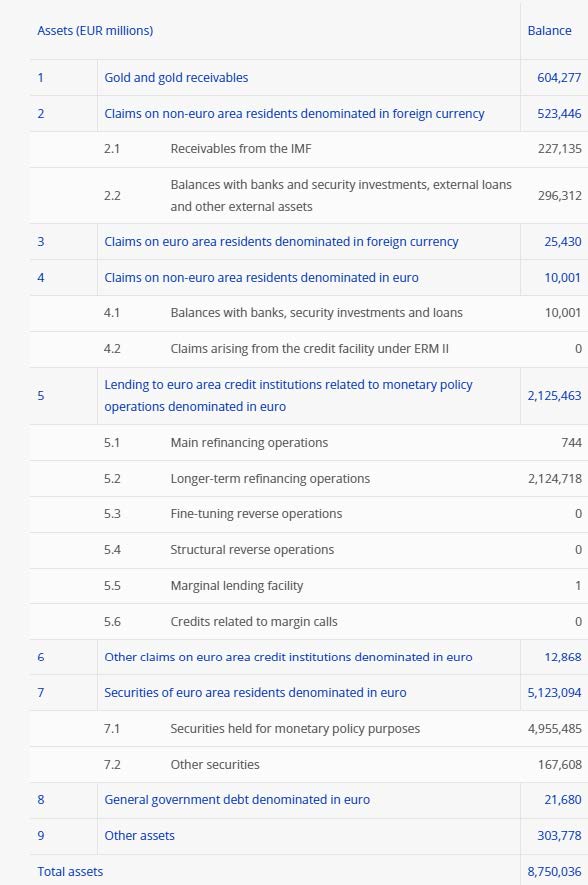
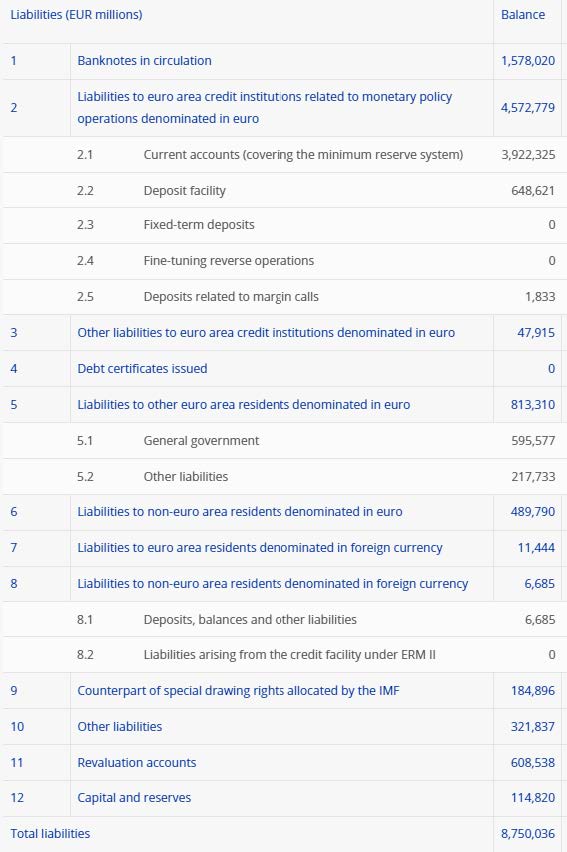
Like commercial banks, central banks publish both balance sheets and income statements (or profit and loss statements).
3.3.1 Balance Sheets
A simplified central bank balance sheet has the following structure:
| Assets | Liabilities and Capital |
|---|---|
| Securities | Money created |
| Loans | Capital |
The key point is that money issued by the central bank is recorded as a liability on its balance sheet.
In a more detailed representation, these monetary liabilities are divided into:
- Currency in circulation, held by the public.
- Reserve balances, held by commercial banks at the central bank.
| Assets | Liabilities and Capital |
|---|---|
| Securities | Capital |
| Loans | Reserve Accounts |
| Currency in Circulation |
However, central bank liabilities differ fundamentally from the liabilities of ordinary commercial banks or nonfinancial firms. For example, the cash that is in circulation is not in any meaningful sense a liability of the central bank. The central bank does not pay interest on cash notes and does not make any promise to swap the notes for some quantity of gold or some other asset.
Reserve balances are somewhat different. They are liabilities of the central bank, and major central banks now generally pay interest on them. Nevertheless, reserve liabilities differ from ordinary debt in several ways:
- A central bank can create additional reserves rather than first borrowing money from another institution.
- Reserve balances do not have a contractual maturity date on which the central bank must repay a fixed principal amount.
- The central bank determines the interest rate paid on reserves as part of its monetary policy framework.
- Reserve interest rates can even be negative, as they were in the Eurosystem for several years.
3.3.2 Income Statements
Due to their money creating activities, central banks build up large stocks of assets over time. The central bank may subsequently earn a profit if the interest income on the bond exceeds the interest it pays on the newly created reserves, after allowing for relevant expenses. More generally, a central bank’s income may come from several sources:
- Interest earned on securities, including government bonds.
- Interest earned on loans to commercial banks.
- The ability to issue currency, which generally pays no interest to its holders.
- The difference between returns on its assets and the interest it pays on reserve balances.
These features help explain why central banks have traditionally earned profits. They often hold interest-bearing assets while issuing currency that does not pay interest and reserve balances that may carry a lower interest rate than their assets.
Although central banks generally operate separately from government fiscal authorities, they are public institutions and usually transfer a substantial portion of their profits to the government. Governments also maintain accounts at their central banks: tax receipts can be deposited into these accounts, and government payments can be made from them.
Their income includes interest on loans to banks, interest on securities, gains or losses from financial trading, and fees. Their expenses include interest paid on reserves as well as staff costs, currency production, and other operating expenses.
| Income | Expenses |
|---|---|
| Interest on loans to banks | Interest expenses |
| Interest on securities | Other operating expenses |
| Net gains from financial trading | |
| Other income |
An important qualification: Central banks do not always make profits. For example, a central bank can incur losses when the interest rate it pays on reserves rises above the return on fixed-rate securities purchased during a period of low interest rates.
3.4 Can a Central Bank Become Insolvent?
Under a commodity-backed monetary system, such as the gold standard, a central bank may promise to convert its currency into a specified amount of gold or another asset at an agreed exchange rate. In that case, maintaining sufficient assets to honour the conversion commitment is important.
Under a modern fiat money system, by contrast, central bank currency is generally not redeemable for a fixed quantity of gold or other assets. In the sense discussed in the lecture, the obligation represented by currency in circulation is therefore largely notional: the central bank has no promise to redeem banknotes for a particular physical asset.
Consequently, a fiat-money central bank can, in an accounting sense, have negative capital—its assets may be worth less than the monetary liabilities recorded on its balance sheet—without necessarily experiencing the same kind of insolvency crisis as a commercial bank.
The purchasing power of fiat currency is reflected in the price level: what a unit of currency can buy. As emphasized in the lecture, it is not mechanically determined by the book value of the assets held by the central bank.
This does not imply that central banks can acquire risky assets without consequences. Sound asset management and risk-control procedures remain important for at least two reasons:
- Opportunity cost. If a central bank purchases a low-return or unnecessarily risky asset, it forgoes the return it might have earned on a more attractive alternative. That foregone income could otherwise have been transferred to the government.
- Indirect costs through inflation. Monetary expansion can, under some circumstances, contribute to inflation and reduce the purchasing power of money. This creates a potential social cost even if the central bank does not face an immediate accounting constraint.
The central bank therefore needs to manage the risks associated with assets acquired through money creation, even though central bank solvency is not equivalent to commercial bank solvency.
3.5 Functions of Central Banks
3.5.1 Monetary Policy
Monetary policy refers to the policies implemented by a central bank to influence monetary and financial conditions in the economy. Open market operations are one instrument of monetary policy.
In traditional textbook models, monetary policy is often presented as control over the quantity of money issued by the central bank, whether in the form of currency or reserves. Over recent decades, however, major central banks have generally focused less on directly targeting monetary aggregates and more on influencing interest rates, especially the rates at which households, firms, and financial institutions borrow and lend.
Central banks use their ability to create reserves, together with their operating frameworks and policy instruments, to influence market interest rates. The lecture indicates that later material will explain why interest rates have become the principal operational focus of monetary policy and how the Federal Reserve and the ECB implement their policies.
3.5.2 Lender of Last Resort
A bank may experience a liquidity crisis when depositors or other creditors withdraw funds rapidly. If the bank lacks sufficient liquid assets to meet these withdrawals and cannot obtain funding from other banks or financial markets, it needs an alternative source of liquidity.
In practice, this emergency financing role is often performed by the central bank, which acts as the lender of last resort.
There are several reasons why governments may prefer central banks to perform this function:
- Money-creation capacity: A central bank can provide emergency liquidity by creating and crediting reserves to a commercial bank’s account.
- Greater confidentiality and speed: Central bank lending may be arranged more discreetly than direct government support, which may require public debate or legislation.
- Different fiscal treatment: Central bank lending is not ordinarily recorded as direct government expenditure.
Because of this role, central banks are often given an explicit responsibility for financial stability.
3.5.3 Banking Regulation and Supervision
It is important to distinguish banking regulation from banking supervision:
- Banking regulation refers to the rules that banks must follow, including capital adequacy and liquidity requirements.
- Banking supervision refers to the process of monitoring and assessing whether banks comply with those rules. Supervisors may also evaluate corporate governance and risk-taking practices and, in extreme cases, revoke a bank’s operating licence.
There is an ongoing debate about whether central banks should be directly responsible for banking supervision. One concern is that supervisory objectives might conflict with monetary policy objectives, such as price stability. For example, a central bank could face difficult trade-offs between tightening monetary conditions to control inflation and protecting a fragile banking system.
An opposing view, supported by the lecturer, is that participation in banking supervision helps central banks understand financial conditions, conduct monetary policy more effectively, and carry out their lender-of-last-resort responsibilities.
The lecture also discusses the ECB’s role in the euro area’s Single Supervisory Mechanism (SSM).
3.5.4 Public Finances and Monetary Financing
Central bank money creation may generate income that can ultimately benefit the government, particularly when a central bank earns profits and transfers them to the fiscal authorities. Historically, revenue associated with money issuance has been an important fiscal resource in some circumstances.
Some proponents of Modern Monetary Theory (MMT) argue that a government issuing its own currency has considerable capacity to finance expenditure through monetary arrangements, subject ultimately to real resource and inflation constraints. In simplified accounts of this approach, taxes may be used to reduce private-sector purchasing power when the economy is overheating.
Similar ideas predate MMT. In the 1940s, Abba Lerner developed the concept of functional finance, which emphasizes evaluating fiscal policy according to its macroeconomic effects rather than treating a balanced budget as an end in itself.
In practice, however, many modern economies maintain institutional separation between central banks and fiscal authorities, and impose legal or operational restrictions on direct monetary financing of government expenditure. These arrangements reflect concerns that excessive reliance on monetary financing could:
- Encourage governments to depend too heavily on money creation.
- Generate excessive inflation.
- Undermine central bank independence.
- Subordinate monetary policy to the government’s financing needs.
The distinction is therefore between the technical capacity to create central bank money and the institutional, legal, and macroeconomic constraints on using that capacity to finance public spending.