19 The Euro Crisis
The global financial crisis was at its most intense in late 2008 and early 2009 but the global economy began to improve in summer 2009.
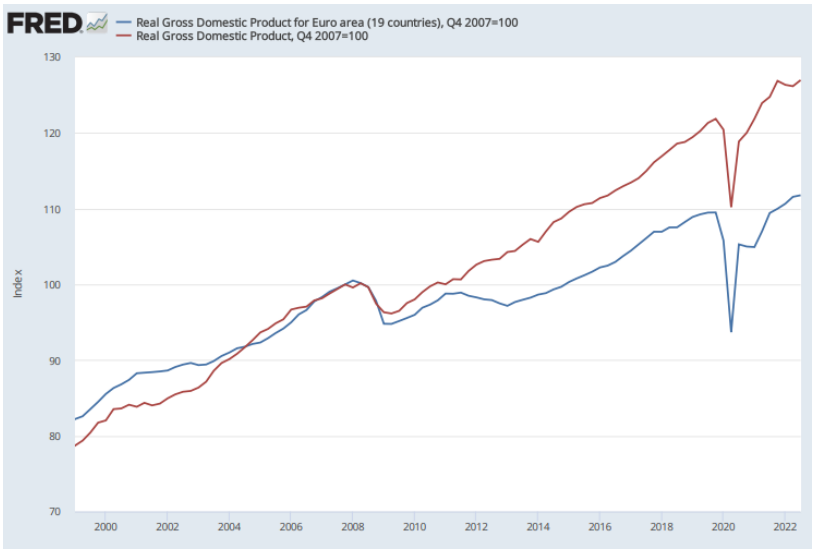
Europe also began to recover but the Euro Area economic recovery sputtered out in 2010 and went back into recession.
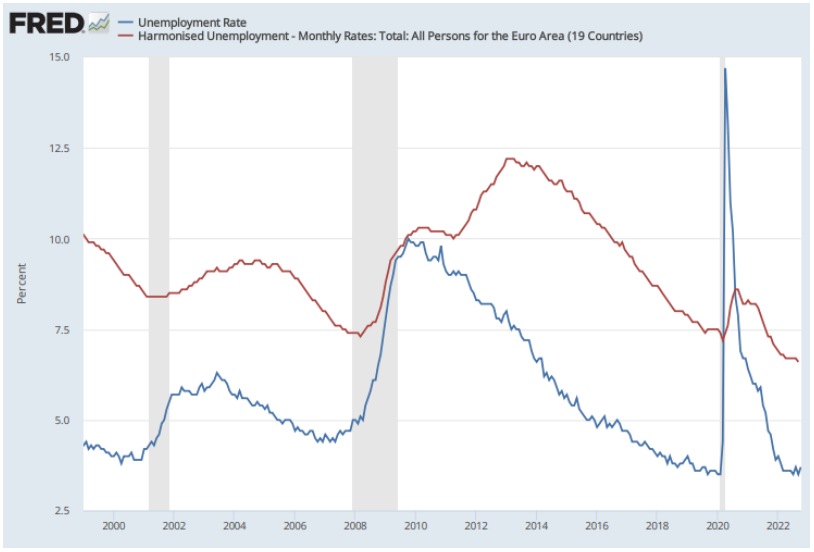
The Euro Area unemployment rate which had flattened out at about 10 percent climbed to over 12 percent before starting a slow decline in 2013.
Momentous events took place during 2010–2013:
- Greece defaulting on its debt,
- bank depositors in Cyprus losing much of their money, and
- Greece, Ireland, Portugal and Spain all accessing EU/IMF adjustment programmes.
By summer 2012, the very future of the euro itself was considered to be at risk. This euro crisis of 2010-12 followed on from but was distinctly different from the global financial crisis.
How did it get so bad and how was it fixed?
Real GDP in the Euro Area (blue) and the US (red), 2007Q1 = 100
Unemployment rates in the Euro Area (red) and the US (blue)
19.1 The Euro Crisis
19.1.1 The Build Up to the Crisis: Sovereign Debt
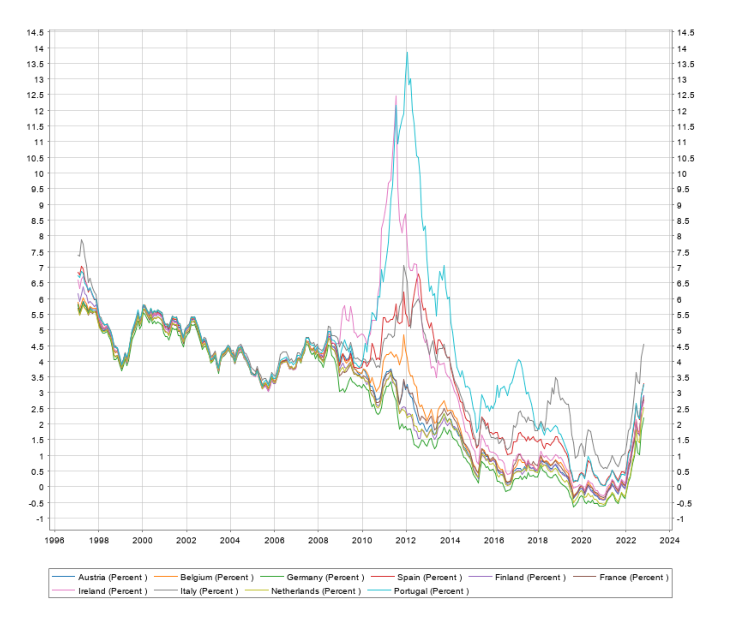
With the adoption of the euro in 1999, financial markets should perhaps have seen that with no option to inflate debt away or to use financial repression, high public debt could translate into possible sovereign defaults.
However, with no advanced country sovereign defaults in living memory, markets celebrated the elimination of devaluation and inflation risk and began to price all Eurozone sovereign debt very similarly.
Public debt levels—which had previously had a big influence—now had almost no impact on government borrowing rates.
Even the signs in the early years that the EU’s fiscal rules were not being adhered to had no impact.
However, it would not be correct to say governments accumulated debt irresponsibly during this period. Debt-GDP ratios generally fell during this period.
Low sovereign debt yields fuelled self-fulfilling expectations of low default risk. While debt levels did not fall much, the cost of servicing it did e.g. Debt interest share of Italian GDP fell from 14% in 1993 to 5% in 2004, so a much smaller primary surplus was needed to stabilise the debt.
10-year sovereign bond yields of selected countries
19.1.2 The Build Up to the Crisis: Banks
With most of Europe now using a single currency, an integrated European financial market emerged which channelled a lot of money from Europe’s rich high-saving core (Germany, Netherlands, Austria) to its poorer lower-saving periphery (Greece, Ireland, Spain, Portugal).
With the risk of devaluation apparently gone, investors in the core countries viewed providing money to banks in peripheral countries as a much safer investment than they were prior to the euro.
Bank credit in the periphery increased through three channels.
- Foreign Deposits in these banks increased substantially, particularly large corporate depositors.
- Bond Funding rose as banks in countries like Ireland and Spain found it easier than before to borrow on the international bond market.
- Foreign Banks Subsidiaries: Foreign banks were more likely to opene their own subsidiaries in these countries once there was no more currency mis-match.
Unfortunately, once the banks in the periphery got into trouble, the foreign deposits and bond market funding disappeared and foreign banks started shutting their subsidiaries.
19.1.3 The Build Up to the Crisis: Private Sector Debt
With money pouring into banks in the periphery and sovereign interest rates at all-time low levels, the private sector saw credit available in quantities and at costs never seen before.
This was a big asymmetric shock in the Euro Area. The change in borrowing costs had a profound effect in countries like Spain and Ireland while core states such as Germany saw no change.
Firms and households could now borrow at much lower rates and they (and their banks) believed that they could handle much larger stocks of debt.
These developments boosted domestic demand in many countries leading to a loss of competitiveness and higher current account deficits.
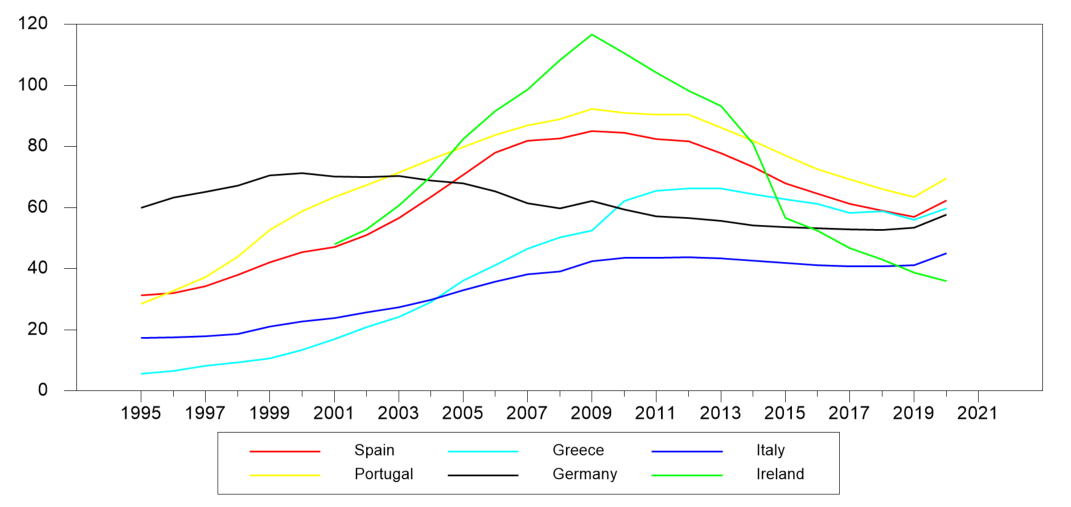
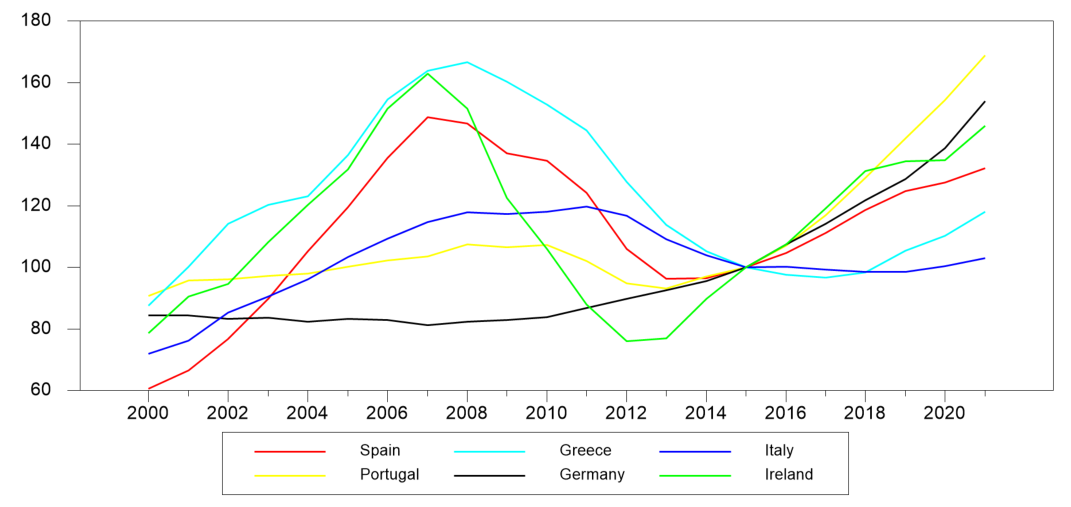
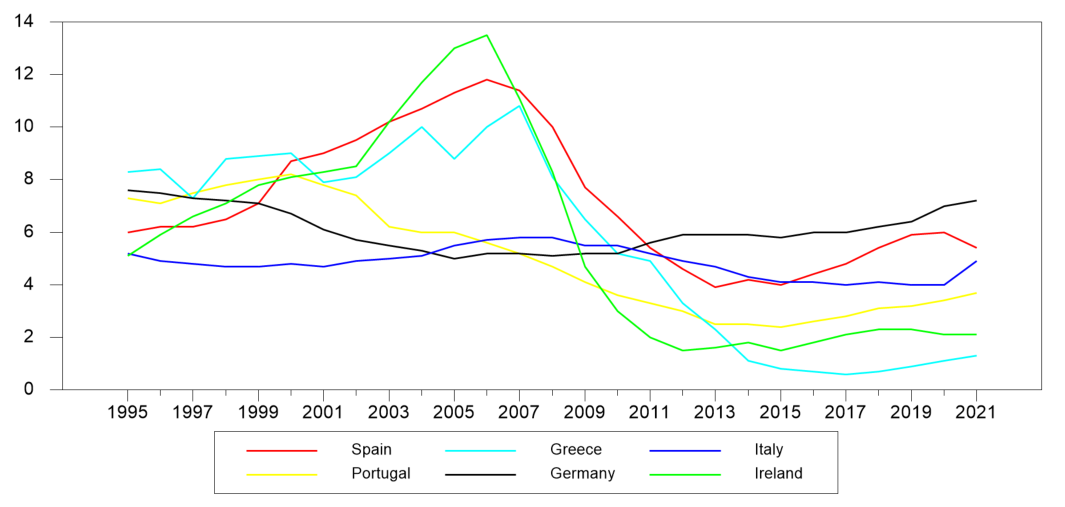
In countries like Ireland and Spain in particular, the huge increases in debt fueled house price bubbles and construction booms.
When the global financial crisis came, many peripheral economies were left with high levels of private sector debt and highly exposed weak banking sectors.
Household debt to GDP ratio (Source: Eurostat)
House prices, 2015 = 100 (Source: Eurostat)
Residential construction as a share of GDP (Source: Eurostat)
19.1.4 2007: A Sudden Stop
The global financial crisis that began in 2007 brought a sudden end to many of the trends that had allowed the build-up of debt in the periphery.
- Re-Appearance of Sovereign Risk Premia: After a long period in which financial markets ignored sovereign default risk, global financial disruptions beginning in 2007 saw sovereign debt risk premia re-emerge with much of this increase being passed through to private sector rates.
- Increases in Private Risk Premia: The Lehman Brothers default of September 2008 led to a re-pricing of financial sector risk. In particular, financial markets began focusing on the build-up of debt that occurred in peripheral Euro Area economies.
- Financial Sector Deleveraging: The global crisis brought home to investors and regulators the problems associated with over-sized and over-leveraged financial institutions. As banks executed deleveraging programmes, there was a significant decline in private sector lending to peripheral economies.
- Reversal of Financial Integration: With major banks in core countries having received significant assistance from governments, banks chose to deleverage via withdrawing from lending to peripheral economies rather than cut back lending in their own countries.
19.2 The Failed Recovery and the Euro in Crisis
19.2.1 The Policy Response and Recovery
The global financial crisis hit all advanced economies hard and was the most severe seen since the Great Depression.
The crisis provoked a wide-ranging policy response from governments over 2008-09.
- Fiscal Policy: Fiscal stimulus packages were introduced in many countries (though not so much in the Euro Area).
- Monetary Policy: Policy rates were cut to zero (or close to it) and QE programmes started.
- Liquidity Provision: Central banks played their roles as lender of last resort to the banking system, providing liquidity to replace investors who moved money out of weak banks.
- Bank Supports and Restructuring: Governments provided supports to banks in the form of funding guarantees, asset insurance and funds for recapitalisation and initiated restructuring plans for failing banks.
Thanks to these measures, financial stability was restored and the global economy, including the Euro Area, began to recover during 2009 and this continued into 2010.
19.2.2 The Failed Recovery
The Euro Area recovery sputtered out in 2010 and fell back into a recession. After a small decline, the unemployment rate rose again until 2013.Three factors contributed to derailing the recovery:
- fiscal austerity,
- a credit crunch, and
- concerns about sovereign default and euro exits.
These factors interacted with each other, particularly in the countries that had previously seen large increases in private debt.
By 2012, there was a full scale crisis in the euro area with banking crises and sovereign debt crises affecting many member states.
19.2.3 Fiscal Austerity
When the crisis hit economies hard in the 2008, some countries were in the euro area were in a position to do some fiscal stimulus to partially protect their economies from the shock.
But many were not. Some already had high debt levels. For others (e.g. Ireland) it was clear from the start that the scale of the collapse of the economy was such that the government deficit was going to explode as tax revenues collapsed so stimulus was not an option.
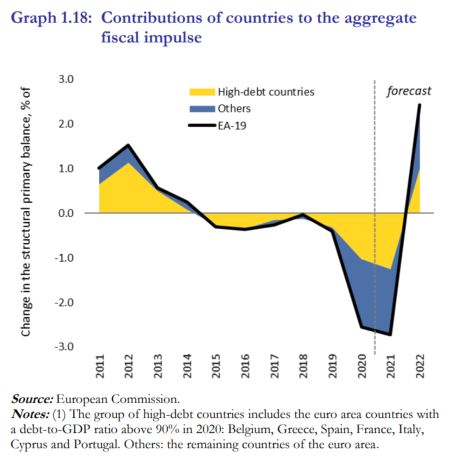
By 2010, there was fiscal contraction across the euro area. The hard-hit peripheral economies were still enforcing fiscal austerity while other countries removed the stimulus they had provided and moved to consolidation mode.
This meant that fiscal policy had a negative impetus on the euro area economy from 2010 to 2014.
While reckless fiscal policy did not play a big role in causing the crisis, the narrative that it did was highly influential in Germany and other core countries. An enhanced “fiscal compact” was passed but there is little evidence that following its rules would have prevented the crisis e.g. both Ireland and Spain would have been compliant.
Fiscal consolidation in the Euro Area (Source: European Fiscal Board (2021))
19.2.4 The Credit Crunch
The global financial crisis and the ongoing economic slump meant that European banks suffered significant losses that reduced their capital.
Capital adequacy requirements are expressed as a percentage of risk-weighted assets. Banks that need to adjust their capital ratios to meet these requirements can either (a) Raise capital or (b) Reduce risk-weighted assets.
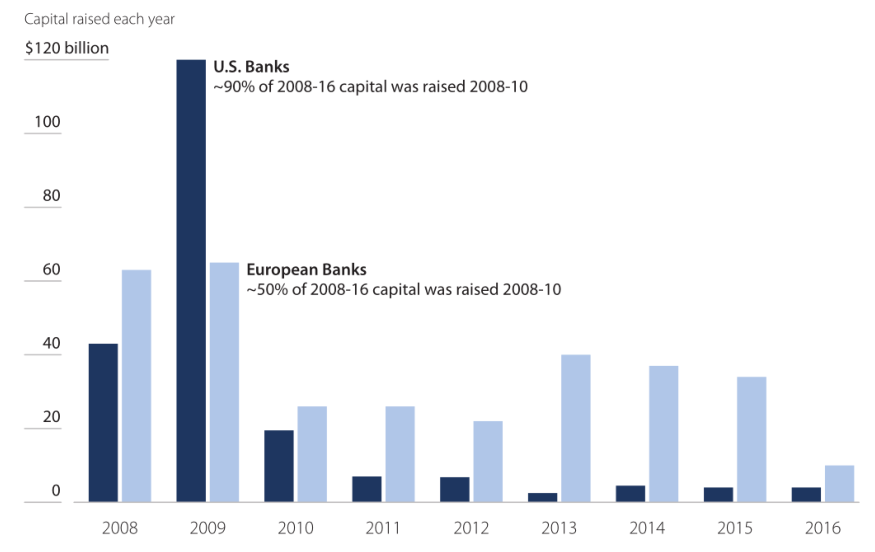
In the US, the government investment in the banks meant there was a large and quick recapitalisation of the banking system.
In the Euro Area, fiscal problems meant governments were less keen to commit public money to recapitalise banks.
This meant less capital raising than in the US and more focus on reducing risk-weighted assets, both by shrinking balance sheets and by reducing risk weights by cutting back on loans to households and businesses.
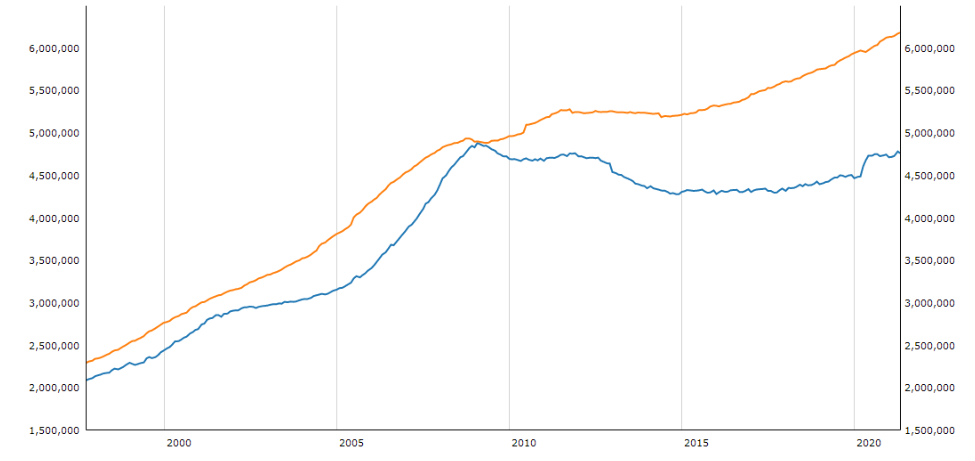
- Loans to households which had risen rapidly prior to 2008 stalled after the Lehman’s bankruptcy, rose a bit during 2010 and then declined during the euro crisis years.
- Loans to businesses fell in 2008, stabilised and then fell again during the euro crisis.
US banks were recapitalised much faster than Europe’s (Source: Brookings Institution (2018))
Euro Area loans to businesses (blue) and households (orange) (Source: ECB Statistical Data Warehouse)
19.3 The ECB’s Role in Resolving the Crisis: Providing Liquidity
19.3.1 A Multi-Year Multi-Country Banking Crisis
The GFC of 2008/09 was a global event for all banking sectors. But Europe’s bank stresses continued for a lot longer than in other parts of the world.
Property prices continued to fall, leading to big losses for banks on mortgages and commercial property lending (the latter being the big issue in Ireland).
Depositors and investors lost faith in banks in Ireland, Spain, Greece, Portugal and Italy and continued pulling their funding and placing them in banks in countries considered safer, like Germany.
This crisis had a liquidity element (the deposit withdrawals were a slow form of bank run) and also a solvency element (many banks need to be recapitalised or shut).
We will discuss the ECB’s role in this process.
19.3.2 The ECB’s Response to the Banking Crisis
The banking crisis of 2008 was the first element of the overall euro crisis.
As discussed above, a lot of the funding that had been provided to banks in countries like Greece, Spain, Portugal and Ireland began to move back to “core” European countries.
Without support from the Eurosystem, banks in these countries would have had to default on the bonds they had issued and also perhaps be unable to honour requests for deposit withdrawals.
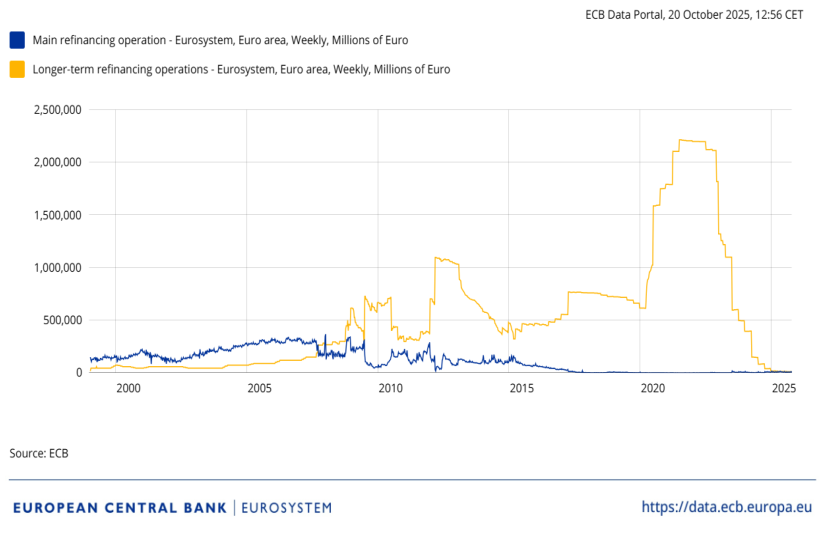
The ECB’s move to providing fixed-price full allotment funding and to provide longer-term funding for banks were crucial in containing the crisis.
The chart shows the large increase in ECB funding in response to the crisis and how longer-term funding replaced the short-term weekly funding previously provided.
ECB refinancing operations, long-term (orange) and main (blue)
The ECB did a good job in coping with the initial phase of the liquidity crisis. But questions can be raised about some of its later actions.
19.3.3 Recap on the Eurosystem’s Rules on Loans to Banks
The Eurosystem has a relatively clear set of rules on lending to banks:
- Loans must be collateralised. There is a publicly available list of eligible collateral with “haircuts” for each asset. There are over €13 trillion of marketable assets acceptable as collateral.
- Losses on regular Eurosystem loans are shared among Eurosystem central banks.
But there are some important nuances.
- The composition of the eligible collateral list can change, for instance if the ECB views the credit quality of an asset as declining.
- The risk control framework can be used to select individual assets or institutions as not being eligible for regular credit from ECB.
Banks can also received loans through Emergency Liquidity Assistance (ELA) ECB says
“ELA aims to provide central bank money to solvent financial institutions that are facing temporary liquidity problems, outside of normal Eurosystem monetary policy operations.”
Responsibility for ELA (and the risk involved) lies with the issuing NCB.
19.3.4 The ECB and ELA
When a bank has run out of eligible collateral for regular Eurosystem loans, it can apply for ELA. This decision occurs at a national central bank level and the NCB takes on the balance sheet risk.
But the ECB still plays a role. An example of the ECB’s description of its role (from October 2014):
The ECB neither provides nor approves emergency liquidity assistance. It is the national central bank … that provides ELA to an institution that it judges to be solvent at its own risks and under its own terms and conditions. The ECB can object on monetary policy grounds; in order to do so at least two thirds of the Governing Council must see the provision of emergency liquidity as interfering with the tasks and objectives of Euro Area monetary policy.
You could argue that the ECB’s is saying here that it doesn’t provide or approve ELA but also that it sort of does.
Procedures underlying ELA used to be secret but an “ELA agreement” was published in 2013 and updated in 2017.
19.3.5 Some Examples of ELA
Three cases of ELA provision are
- Ireland (2009–2010),
- Cyprus (2011–2013), and
- Greece (2014–2015).
19.3.5.1 Ireland: 2009-2010
- September 2008: Anglo Irish Bank runs out of eligible collateral. No ELA is provided but the Irish government provides a near-blanket guarantee.
- March 2009: €11.5 billion in ELA given to Anglo, which turns out to be highly insolvent in the absence of government-provided equity investment.
- 2010: ELA provided to other Irish banks. Total rises to over €40 billion.
- November 2010: Ireland opens negotiations to begin an EU-IMF programme. During negotiations, ECB President Trichet sends a letter to the Minister for Finance insisting Ireland enter an EU-IMF programme requiring fiscal and structural reforms as a condition for continued authorisation of ELA. The programme is agreed on November 28.
- 2011 onwards: ELA rises to almost €70 billion in early 2011 but begins to fall as the banking sector stabilises. Ireland successfully exits the EU-IMF programme at the end of 2013 and ELA is fully repaid.
19.3.5.2 Cyprus: 2011-2013
- Late 2010: Cyprus Popular Bank (“Laiki”) and Bank of Cyprus (BoC) build up holdings of €5.8 billion in Greek government bonds (1/3 of Cypriot GDP).
- 2011: Losses wipe out Laiki’s equity and almost all of BoC’s.
- October 2011: Laiki receives €2.5 billion in ELA.
- February 2012: European Banking Authority communicates that Laiki needs a recapitalisation of €2 billion while BoC requires €1.5 billion.
- 2012: Deposits flow out, capital position worsens and ELA increases, reaching €9.6 billion in July 2012. Background negotiations on an EU-IMF programme take place but are not concluded.
- In 2013,
- after an election, the previous quasi-Communist government is replaced.
- Post election, the ECB insists on an EU-IMF programme and bank recapitalisation as a condition for continuing ELA.
- The government is judged by EU-IMF as too indebted to recapitalise banks so haircuts are applied to depositors.
- Capital controls are put in place and remain there for years. ELA is strictly capped.
19.3.6 Greece: 2014-2015
- 2014: ECB conducts a Euro Area wide comprehensive assessment and stress test and announces the results in October 2014. It declares Greek banks solvent and have limited need for recapitalisation to meet their requirements.
- 2015: political uncertainty surrounding an upcoming election leads to deposit outflows from Greek banking system and ELA increases. Various Greek government-issued and government-backed assets removed from the eligible collateral list. After the election of a new left-wing government, the ECB insists that a new EU-IMF programme be put in place by new government as a condition for providing higher ELA. Greek government ends up imposing capital controls because banks do not have access to liquidity. Damage done to the economy and banking system requires further round of bank recapitalisation. Capital controls kept in place for years. ELA finally ends in 2019.
19.3.7 Questions About How ELA Has Been Practiced
- Have the ECB’s procedures been clear and transparent?
- Unlike regular Eurosystem operations, collateral requirements for ELA differ from case to case, depending on the NCB’s decisions and Governing Council approval.
- Unclear relationship between national authorities and the ECB Governing Council.
- Is ELA only provided to solvent banks?
- Laiki bank was not solvent when it was provided with ELA.
- Anglo solvency was dependent on Irish government support.
- Should liquidity support be suspended for banks that ECB itself has declared solvent and have passed stress tests?
- Why did ECB keep ELA limits in place even after banks (such as those in Cyprus and Greece) had been recapitalised?
- Are decisions to limit ELA really made “on monetary policy grounds” or are some other set of criteria used?
- Links between willingness to approve ELA and wider political events (Irish and Greek EU-IMF programme negotiations, Cyprus election)
19.4 The ECB’s Role in Resolving the Crisis: Sovereign Debt and Whatever It Takes
19.4.1 Three Responses to High Levels of Sovereign Debt
There is a large literature on sovereign debt crises and how they end.
Traditionally, countries with very high debt-GDP levels reduce them in one of three ways:
- High Rates of Nominal GDP Growth: It is rare to see countries actually pay down large amounts of nominal debt. Instead, debt ratios come down mainly through high growth in the denominator, i.e. nominal GDP. In many cases, it is high rates of inflation and currency devaluation that drives this nominal growth.
- Financial Repression: Governments can pass laws that force banks or pension funds to hold their debt even if it carries a low rate of interest.
- Default: The direct way to cut debt! Default can mean a complete failure to pay but it can also mean a restructuring that sees maturities extended and interest payments reduced.
Without a separate currency for countries to devalue, the ECB targeting a low rate of inflation and financial repression methods running against EU laws on free movement of capital, you might have expected before the euro came into existence that debt problems for euro area countries would be dealt with via sovereign defaults.
19.4.2 Self-Fulfilling Sovereign Debt Crises
Sovereign debt restructurings can sometimes happen as the result of a fast and unexpected crisis.
Suppose investors begin to think there is a small chance (say 10 percent) that a country will restructure its debt inflicting losses on investors (let’s say a 50 percent “haircut”).
This reduces the average expected return on the country’s bonds by 5 percent. New investors would thus need to be paid a higher interest rate to compensate for this additional risk.
But investors may then see that this high cost of public debt will make a default even more likely.
The outcome can be a swift shutting off of access to international borrowing for the government.
This kind of self-fulfilling sovereign debt crisis can occur quite fast and have very negative outcomes: Often a country needs to cut its deficit to zero or rely on funding from the IMF which will requires a large fiscal adjustment as a condition of the programme.
19.4.3 Greece, Ireland and Sovereign Default Fears
In Autumn 2009, Greece announced that it was re-stating its public deficit and debt figures and they were larger than had previously been realised.
Markets quickly began to speculate that Greece may have to default on its debts. And they were right. Greece’s debts were huge and there was a default in 2012.
Many European and international leaders, particularly the leadership of the ECB, were extremely concerned about the prospect of a Greek default, viewing at as possibly another “Lehman Brothers” event.
But the possibly of a country defaulting or possibly even leaving the euro started to be priced into the sovereign bond yields of various countries.
For example, the markets began to doubt that Ireland could honour its commitments to its banks without having a sovereign default and the cost of borrowing for the Irish government began to rise.
By 2010, there was a full-scale crisis in Greece, Ireland and Portugal and increasing concerns about the situations in Spain and Italy.
19.4.4 The Bank-Sovereign “Doom Loop”
The global banking crisis saw many European banks receiving support from their national governments. In some cases, such as Ireland, the extent of this support undermined the confidence of financial markets in the confidence of governments. Weakness in the banking sector spread to the sovereign.
But euro area banks also had large (and increasing) holdings of their own country’s sovereign debt, so a sovereign debt default (as occurred in Greece) would threaten the solvency of the banks. Weakness in the government sector spread to the banking system.
Banks in countries with weak fiscal situations were also more likely to experience runs because depositors and investors would think the state was unable to provide funds to honour liability guarantees or for recapitalisation.
This created a sort of “doom loop” in which weaknesses in different parts of the system fed upon each other. In a June 2012 statement, the Euro Area leaders said “We affirm that it is imperative to break the vicious circle between banks and sovereigns.” Some progress has been made but elements of this loop still exist.
19.4.5 Bailouts
By 2010, Greece had lost access to the sovereign debt markets and was heading for a “buyers strike” induced default on its debt.
This was prevented in May 2010 by loans from the rest of the Euro Area and secondary market bond purchases by the ECB.
During the early years of the euro, people often claimed there was a “no bailout clause”. But Article 125 TFEU did not rule out countries making loans to other member states. It just ruled out being liable for or assuming the commitments of other governments.
When the crisis began, many simply assumed euro member states would not receive loans from the other euro members. However, this underestimated
- perceptions in the Euro Area of shared political damage due to defaults,
- populist desires to blame “speculators” for the euro’s problems
- concerns about knock-on effects of sovereign defaults on banks.
After the initial ad hoc response, in May 2011, the Euro Area leaders set up the bailout fund that has now become the European Stabilisation Mechanism (ESM).
19.4.6 Adjustment Programmes
Five countries ended up borrowing from Europe’s bailout funds and the IMF.
Greece (2010-2018): Despite the debt restructuring in 2012, Greece still ended up heavily indebted to the ESM and the IMF. These loans have been restructured many times and most do not mature until the fairly distant future.
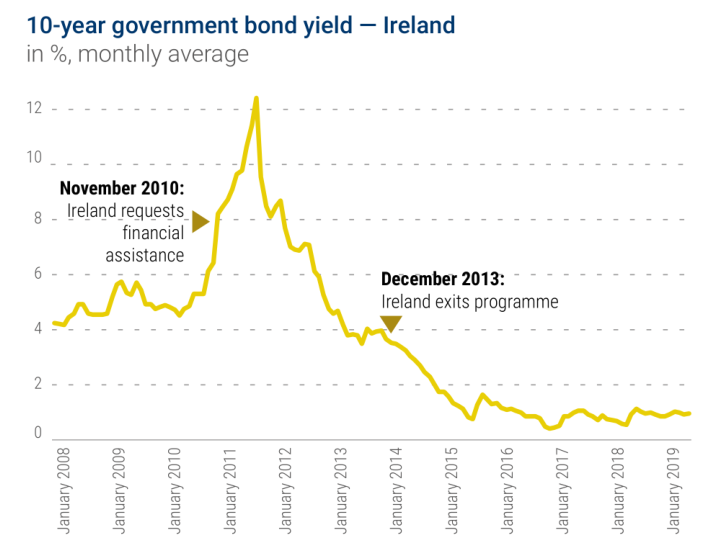
Ireland (2010-2013): After being shut out of the sovereign debt market, Ireland recapitalised its banks and reduced its budget deficit via further fiscal austerity.
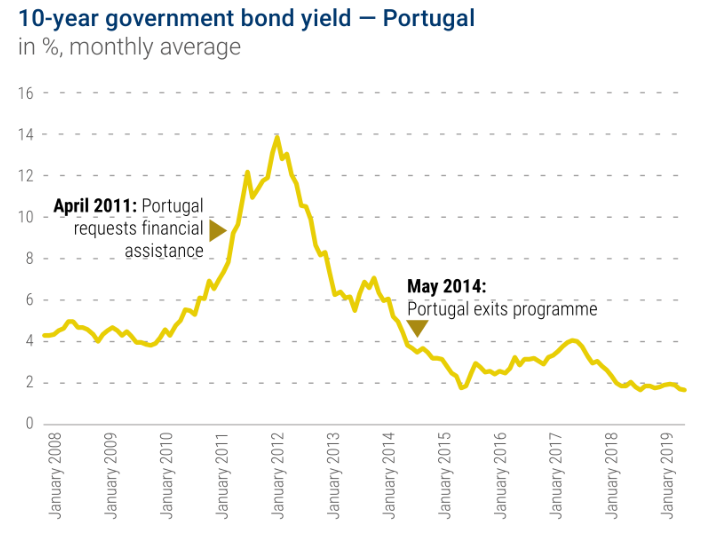
Portugal (2011-2014): With an economy that was weak even prior to the euro crisis, large fiscal debts and weak banks, Portugal was forced to request programme funds a few months after Ireland.
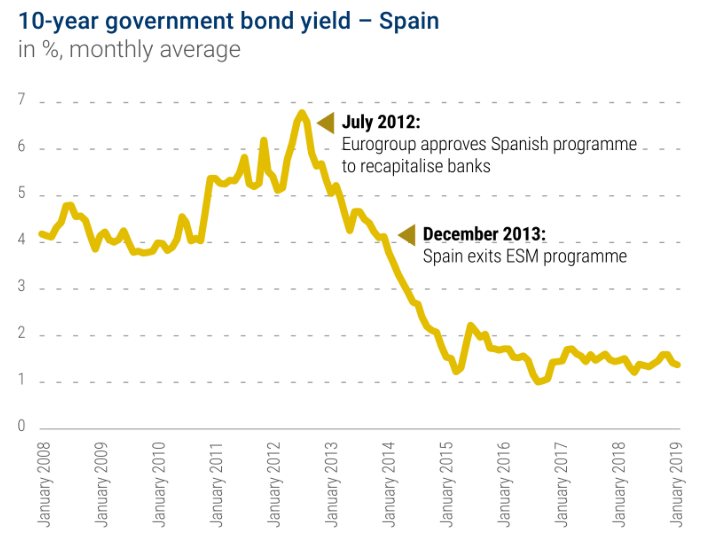
Spain (2012-2013): With its banking sector in crisis and sovereign yields rising, Spain borrowed money from ESM to recapitalise its banks.
Cyprus (2013-2016): Cyprus’s banks were insolvent and the country was shut of sovereign debt markets. The programme provided funding for the government but Cyprus’s banks were recapitalised by imposing a “haircut” on deposits above €100,000.
19.4.7 Default Inside the Euro
Those who thought the Euro Area would never set up a bailout fund were proved wrong. But those who expected no default ever in the Eurozone were also proved wrong. Setting up the bailout fund prevented default in Ireland and Portugal but it only delayed default in Greece.
European leaders at first engaged an “extend and pretend” exercise about Greece but ultimately Europe’s key leaders—Merkel and Sarkozy—decided it would be politically unpopular for the needed restructuring to be fully focused on other member states losing money on their loans to Greece.
The Franco-German Deauville declaration of October 18, 2010 calling for “adequate participation of private creditors” or “Private Sector Involvement (PSI)” was a key turning point.
By summer 2011, Europe’s leaders reluctantly accepted that Greece was not going to be able to pay back all of its debts and that its private-sector debt should be “restructured.” A deal swapping privately-held Greek bonds for new ones with lower value took place in April 2012.
Contrary to the fears of the ECB, there was no financial crisis as a result. Greek government bonds were not a systemically important asset.
19.4.8 2012: The Euro on the Verge
By late 2011, with states such as Italy and Spain under massive pressure and the Eurozone in recession, there was widespread concern that countries would leave the euro rather than deal with long-term austerity and/or disruptive sovereign defaults.
Sovereign yields were rising to unsustainable rates in many countries and banks in the periphery were seeing huge withdrawals of funds as depositors and bond investors feared their investments could be redenominated into new, lower-valued, currencies.
Pressure began to grow on the ECB to use its money-creation powers to ease pressure on governments and help to keep the euro together.
The first significant step taken by the ECB was the introduction of the huge Long-Term Refinancing Operations (LTRO) of late 2011 and early 2012 eased funding pressure on banks in the periphery. Many of the funds loaned to banks were used to purchase sovereign bonds of peripheral countries and yields temporarily declined.
But by summer 2012, the LRTO purchases were seen as a temporary “sticking plaster” measure and talk that various countries would soon possibly leave the euro was rampant.
19.4.9 Draghi’s “Whatever It Takes Speech”
On July 26, 2012 at a small investment conference, ECB President Mario Draghi gave a short speech (1359 words) that changed the history of the euro
He said:
“Within our mandate, the ECB is ready to do whatever it takes to preserve the euro. And believe me, it will be enough.
Some additional quotes from the speech, on the next few pages, are worth reading.
19.4.9.1 Draghi’s speech: The Bumblebee
I asked myself what sort of message I want to give to you; I wouldn’t use the word “sell”, but actually I think the best thing I could do, is to give you a candid assessment of how we view the euro situation from Frankfurt.
And the first thing that came to mind was something that people said many years ago and then stopped saying it: The euro is like a bumblebee. This is a mystery of nature because it shouldn’t fly but instead it does. So the euro was a bumblebee that flew very well for several years. And now – and I think people ask “how come?” – probably there was something in the atmosphere, in the air, that made the bumblebee fly. Now something must have changed in the air, and we know what after the financial crisis. The bumblebee would have to graduate to a real bee. And that’s what it’s doing.
19.4.9.2 Draghi’s Speech: Whatever it Takes
But there is another message I want to tell you.
Within our mandate, the ECB is ready to do whatever it takes to preserve the euro. And believe me, it will be enough.
There are some short-term challenges, to say the least. The short-term challenges in our view relate mostly to the financial fragmentation that has taken place in the euro area. Investors retreated within their national boundaries. The interbank market is not functioning. It is only functioning very little within each country by the way, but it is certainly not functioning across countries.
And I think the key strategy point here is that if we want to get out of this crisis, we have to repair this financial fragmentation.
19.4.9.3 Draghi’s Speech: Interbank Markets
There are at least two dimensions to this. The interbank market is not functioning, because for any bank in the world the current liquidity regulations make - to lend to other banks or borrow from other banks - a money losing proposition. So the first reason is that regulation has to be recalibrated completely.
The second point is in a sense a collective action problem: because national supervisors, looking at the crisis, have asked their banks, the banks under their supervision, to withdraw their activities within national boundaries. And they ring fenced liquidity positions so liquidity can’t flow, even across the same holding group because the financial sector supervisors are saying “no”.
So even though each one of them may be right, collectively they have been wrong. And this situation will have to be overcome of course.
And then there is a risk aversion factor. Risk aversion has to do with counterparty risk. Now to the extent that I think my counterparty is going to default, I am not going to lend to this counterparty. But it can be because it is short of funding. And I think we took care of that with the two big LTROs where we injected half a trillion of net liquidity into the euro area banks. We took care of that.
Then you have the counterparty recess related to the perception that my counterparty can fail because of lack of capital. We can do little about that.
19.4.9.4 Draghi’s Speech: Sovereign Yield Premia
Then there’s another dimension to this that has to do with the premia that are being charged on sovereign states borrowings. These premia have to do, as I said, with default, with liquidity, but they also have to do more and more with convertibility, with the risk of convertibility. Now to the extent that these premia do not have to do with factors inherent to my counterparty - they come into our mandate. They come within our remit.
To the extent that the size of these sovereign premia hampers the functioning of the monetary policy transmission channel, they come within our mandate.
So we have to cope with this financial fragmentation addressing these issues.
I think I will stop here; I think my assessment was candid and frank enough.
Thank you.
19.4.10 The ECB’s Policy Responses: OMT
The week after Draghi’s speech, the ECB announced a new programme of potential secondary market bond purchases, known as the Outright Monetary Transactions (OMT) programme.
This programme would see the ECB making sovereign bond purchases on the secondary bond markets without placing any limits on how much would be purchased.
Countries seeking the ECB to make OMT purchases would have to agree a programme of fiscal adjustment with the European Stabilisation Mechanism (ESM).
While no country ever requested an OMT intervention from the ECB, the existence of the OMT programme cut off the vicious circle by which a loss of confidence in a country leads to higher yields and a quick default.
The existence of OMT greatly reduced sovereign bond yields in the periphery and allowed Ireland, Portugal and Spain to all successfully exit their ESM programmes.
Almost all indicators of the crisis began to ease following Draghi’s speech and the OMT announcement.
ECB Exective Board member, Isabel Schnabel, describes the economics of the OMT programme as follows:
“financial markets are neither always rational, nor efficient. They can be prone to panic and instability. Acute periods of market stress can drive a considerable wedge between a country’s cost of borrowing, as justified by economic fundamentals, and actual financial conditions, giving rise to self-fulling price spirals. Such periods of turmoil—if left unaddressed—can quickly turn a liquidity crisis into a solvency crisis, giving rise to huge costs for society as a whole. Central banks are best placed to protect the public from such destabilising forces. In the euro area, the ECB can only be a lender of last resort to financial institutions. The Treaty explicitly prohibits monetary financing of public debt. But the ECB can, and should, provide liquidity when the market fails to coordinate and when the risk absorption capacity of financial market participants is severely constrained. Central bank interventions quickly instil confidence and allow the market to coordinate on the “good” equilibrium once the initial fog of panic and fear has lifted.”
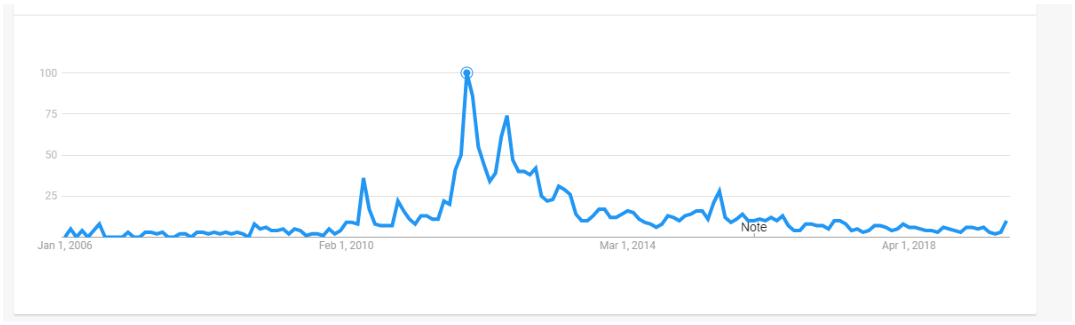
Google searches for “Euro Crisis” (peak = 100)
The rise and fall of Irish government bond yields (Source: European Stabilisation Mechanism (2019))
The rise and fall of Portuguese government bond yields (Source: European Stabilisation Mechanism (2019))
The rise and fall of Spanish government bond yields (Source: European Stabilisation Mechanism (2019))
19.5 Developments Since the Euro Crisis
19.5.1 Changes in the Euro Area’s Policy Infrastructure
The Euro Area’s governments are often criticised for being slow and indecisive in making decisions but there has been a significant amount of institutional change over the past decade and these changes have improved the Euro Area’s ability to cope with crisis.
19.5.1.1 Banking
In banking, the ECB’s becoming the single supervisor for the Euro Area’s banks has been an important step forward for trust and transparency.
The Bank Recovery and Resolution Directive provides crucial tools for facilitating bank restructuring and resolution while minimising fiscal cost and (hopefully) maintaining financial stability.
19.5.1.2 Sovereign Debt Crisis Management
In sovereign debt crisis management, the creation of the European Stabilisation Mechanism (ESM) has provided an institution to help states under funding pressure to manage a fiscal adjustment without defaulting.
At the same time, the relatively efficient Greek debt restructuring has led to an acceptance that sovereign default is part of the crisis resolution toolkit in the Euro Area.
19.5.2 Changes in the Euro Area’s Policy Infrastructure
In macroeconomic and financial monitoring, the European Commission’s new Macroeconomic Imbalance Procedure (MIP) are an improvement over its previous approach of just monitoring fiscal developments.
There is a far greater acknowledgement among policy makers of the need for macro-prudential policies to address potential financial instabilities.
In monetary policy, the ECB has introduced many different new monetary policy instruments.
ECB was slow to introduce measures like LTROs, QE or the OMT programme but they are now in place and can be used to address future economic weakness.
19.5.3 The Resilience of the Euro
Despite the difficulties of the past decade and lots of predictions of its demise, the euro is still with us and is now used by more countries than it was in 2008.
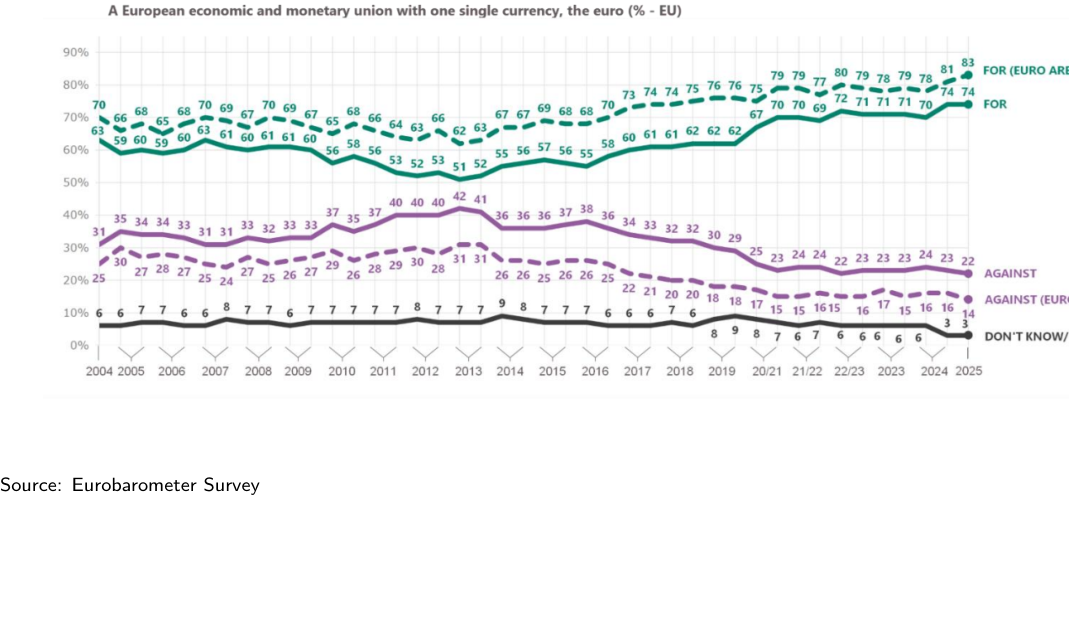
And the euro is more popular than ever with its citizens: The summer 2022 Eurobarometer survey shows 80 percent of the Euro Area’s citizens are in favour of EMU.
One explanation for its popularity is that the ECB has generally delivered good macroeconomic performance. In particular, for most of the time, inflation has been lower than it was for most members prior to joining the euro.
But there is also a fear factor: People worry about what a euro break-up might look like.
Even people who think joining the euro was a mistake don’t necessarily think leaving it is now a good idea.
Even populist nationalist parties that previously indicated support for exiting the euro have backed away from this position.
The euro is popular with citizens (Source: Eurobarometer Survey)