12 How Central Banks Set Interest Rates: The ECB
12.1 The Early Years: M3 Reference Value
The ECB’s Monthly Bulletin of January 1999 described its monetary policy strategy as follows:
“The strategy consists of three main elements:
- a quantitative definition of the primary objective of the single monetary policy, namely price stability; and the ‘two pillars’ of the strategy used to achieve this objective
- a prominent role for money, as signaled by the announcement of a reference value for the growth of a broad monetary aggregate;
- a broadly based assessment of the outlook for future price developments and the risks to price stability in the euro area as a whole.”
Price stability was defined as inflation below 2 percent.
A reference value (i.e., a target) was initially set at a 4.5% growth rate for M3 and was used to produce a “monetary overhang” measure: the difference between actual M3 growth and the reference value, with higher numbers representing higher risks for medium-term inflation.
After 2001, the growth of M3 started to accelerate to values well above 4.5%, hitting 10.9% in December 2001. According to the monetary overhang framework, this suggested significant risks for inflation. But inflation remained low.
12.2 Post 2003: Less Emphasis on Money
In May 2003, the ECB published a review of its monetary policy framework that included several elements.
- The medium-term target for inflation was redefined as a value “below but close to 2%.”
- The presentation of monetary policy decisions would start with the “economic analysis to identify short- to medium-term risks to price stability.”
- Monetary analysis would mainly serve as a means of cross-checking, from a medium- to long-term perspective, the indications coming from the economic analysis.
- The annual review of the M3 growth reference value was dropped. A reference value for M3 growth has not been used since then.
The speech by former ECB Vice-President Vítor Constâncio, “Past and future of the ECB monetary policy,” discusses the early years of the ECB.
12.3 Short-Term Interest Rates and the ECB’s Policy Tools
Traditionally, the ECB’s target interest rate was EONIA, a measure of average interest rates in overnight interbank markets.
In October 2019, EONIA was replaced as the standard reference rate by €STR (or ESTER), which is published by the ECB. This is a broader measure of short-term interest rates based on a superior sample of quotes to EONIA.
The ECB controls market interest rates via a range of tools.
The Eurosystem conducts a weekly lending operation, known as the main refinancing operation (MRO), with funds due back a week later.
The loans take the form of repurchase agreements (repos). The central bank takes a security from a commercial bank, which acts as collateral for the Eurosystem. It provides the bank with a short-term loan by boosting its reserve account and sells the security back to it later at an agreed higher price.
Because all banks in the Eurosystem could borrow from the ECB as an alternative to interbank “money markets,” during the early years of the ECB the MRO interest rate was the key influence on short-term market interest rates.
12.4 The ECB’s Pre-2008 Operational Strategy
Prior to 2008, the ECB’s operational strategy worked as follows.
Banks needed to hold money in their reserve accounts with the central bank, to use to supply banknotes to the public and to satisfy reserve requirements. This money had to be supplied by the central bank.
The ECB decided how much money it would loan out and then conducted an auction for these funds.
It announced the minimum interest rate that banks would have to pay for the loans and then rationed the loans by giving them out to those willing to pay the highest rate.
This “minimum bid rate on the main refinancing operation” was the “headline” interest rate during the ECB’s first decade.
The ECB also had a three-month refinancing operation that provided about one third of the liquidity.
The ECB maintained a list of high-quality assets that it was willing to accept as collateral in the refinancing operation, as well as a list of “haircuts” it would apply to these assets. For example, an asset worth €100 million might be used to obtain a loan of €95 million.
12.5 Standing Facilities
In addition to its regular refinancing operations, the ECB also has “standing facilities,” so called because they are always available (standing ready to act).
A marginal lending facility loans reserves to banks. In the early years of the ECB, this facility charged an interest rate 1% above the MRO rate.
A deposit facility pays interest on reserves. In the early years of the ECB, this facility paid an interest rate 1% below the MRO rate.
These standing facilities are intended to set an interest rate “corridor” for short-term market interest rates, meaning they set an upper and lower bound for rates.
Since banks can borrow from the lending facility, they do not need to pay a higher interest rate than this in the money market. Similarly, banks do not need to lend at a rate lower than they can get from the deposit facility.
12.6 How Policy Rates Affected Market Rates Up to 2008
Prior to 2008, the ECB supplied a small amount of reserves to the banking system, usually just a bit more than was needed for banks to satisfy reserve requirement rules.
This meant that many banks had to borrow reserves to meet reserve requirements, so there was an active interbank market for borrowing and lending reserves.
Most commercial bank reserves were kept in their “current accounts” with the Eurosystem (the accounts used to satisfy reserve requirements). Money kept in the current accounts did not earn interest.
Very little money was kept in the deposit facility, so the deposit facility interest rate had little influence on average market rates.
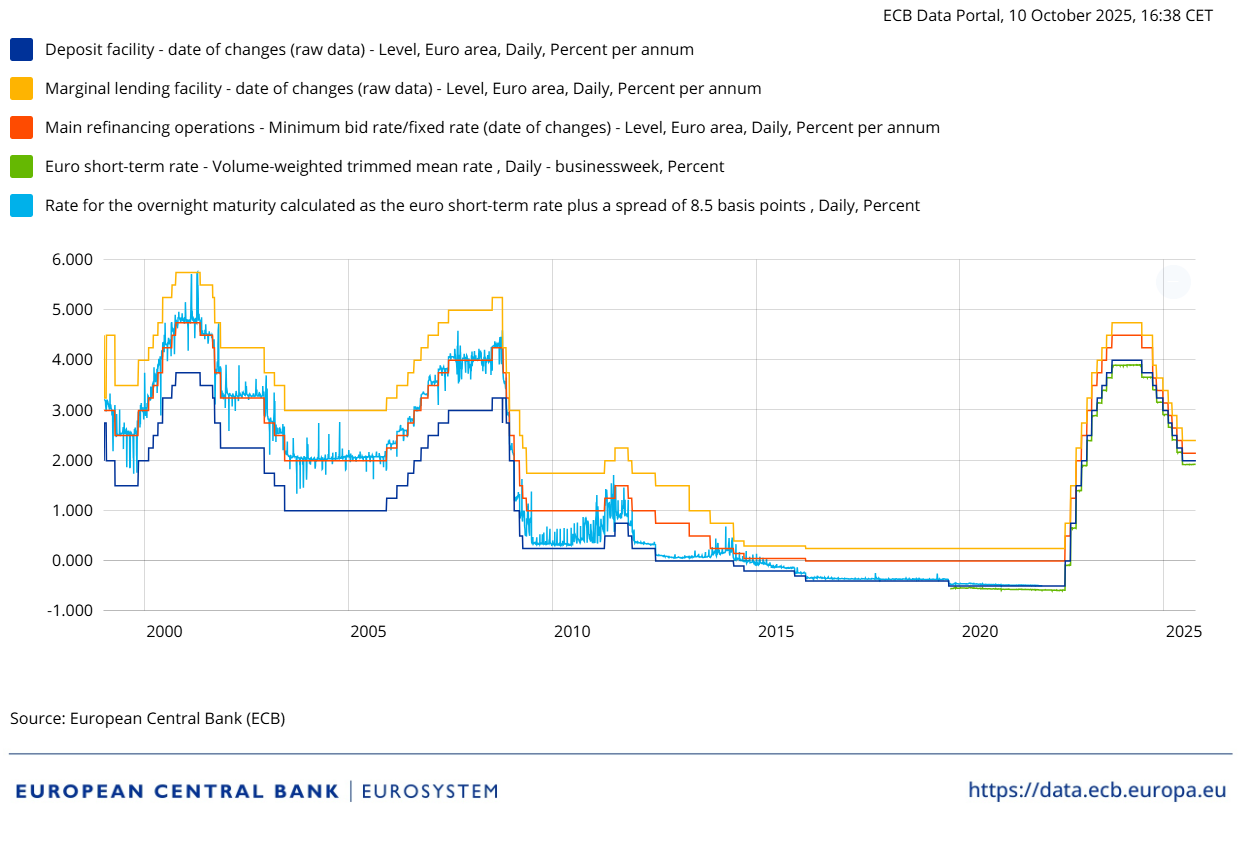
EONIA tended to be close to the MRO rate, reflecting the fact that banks could substitute between borrowing from the ECB and borrowing in interbank markets.
Market rates did not go above the marginal lending facility rate or below the deposit facility rate.
12.7 How the ECB Controls Money Market Interest Rates
How the ECB Controls Money Market Interest Rates (ECB policy rates and short-term market rates).
12.8 Changes to ECB Strategy After 2008
During the global financial crisis in 2008, many European banks lost deposit and non-deposit funding because of fears they might fail or that their country might leave the euro. Activity in interbank markets fell steeply.
This meant the Eurosystem had to step in to become a more significant source of funds for the euro area banking system.
There were major changes to ECB operations.
Under full allotment, since October 2008, the MRO has been conducted on a fixed-rate basis and all bidders have been allocated their requested amount of funds. They still need to have eligible collateral to obtain an MRO loan.
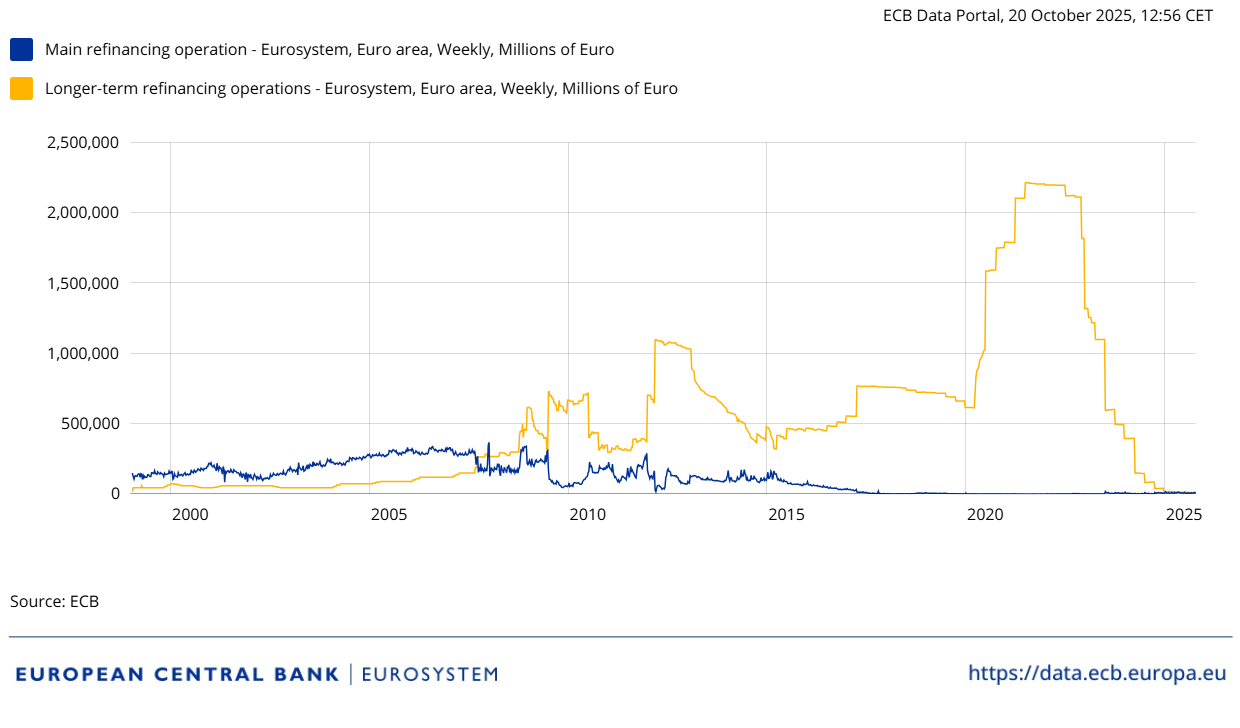
With longer maturities, the weekly MRO ceased to be the major source of funding provided by the ECB. It was replaced by longer-term refinancing operations (LTROs), which are loans with maturities of three months or above but which in recent years have been up to three years.
Under looser collateral requirements, the list of eligible collateral for all ECB operations was widened. In particular, starting in early 2012, the ECB widened the amount of “credit claims” (i.e., bank loans) that it would accept as collateral.
12.9 Size of the ECB’s Refinancing Operations
Size of the ECB’s Refinancing Operations (Yellow = Long-Term, Blue = Main).
12.10 Ample Reserves and a Change in the “Key” Interest Rate
Since 2008, the ECB has supplied a lot more reserves, either via LTRO loans or via its QE programme, which involved huge open market operations purchasing securities and created lots of reserves since 2015.
This changed how policy affects market rates.
Banks now had large amounts of reserves, and so in recent years there has been almost no borrowing from the MRO facility.
As with the Federal Reserve, the deposit rate has become the ECB’s key interest rate. Short-term market interest rates have followed the deposit rate closely in recent years.
Since its introduction in 2019, the ESTER reference interest rate has been a little bit below the deposit facility rate. Banks will not make short-term loans at below the deposit facility rate, but non-bank financial institutions (who do not have access to the deposit facility) may be willing to do so.
Today, the deposit facility rate is 3.5%, the MRO rate is 3.65%, and the marginal lending facility rate is 3.9%. In current circumstances, the MRO rate and the marginal lending rate are of little importance (unless you have a “tracker” mortgage rate linked to the MRO).
12.11 Low Inflation and Pre-Pandemic ECB Policy
After years of recession after 2008, the euro area economy began to recover in 2012.
However, despite several years of steady growth, inflation remained below the ECB’s target of “close to but below 2 percent.”
From about 2014 onwards, the ECB introduced a series of policies aimed at boosting the economy and raising inflation.
These included low interest rates, setting the MRO rate to zero and setting the interest rate on its deposit facility to negative values.
The ECB also introduced Targeted Long-Term Refinancing Operations (TLTROs), incentivising banks to make loans.
Another policy was forward guidance about the future path of policy, which the lecture notes indicate will be discussed later.
Finally, the ECB used Asset Purchase Programmes, i.e., the ECB’s version of quantitative easing (QE). These programmes involved large amounts of purchases of securities paid for with a huge expansion in the supply of central bank reserves. They were particularly ramped up during the pandemic period. The rationale for these programmes is reserved for a future lecture.
12.12 Total (Blue) and Core (Yellow) HICP Inflation
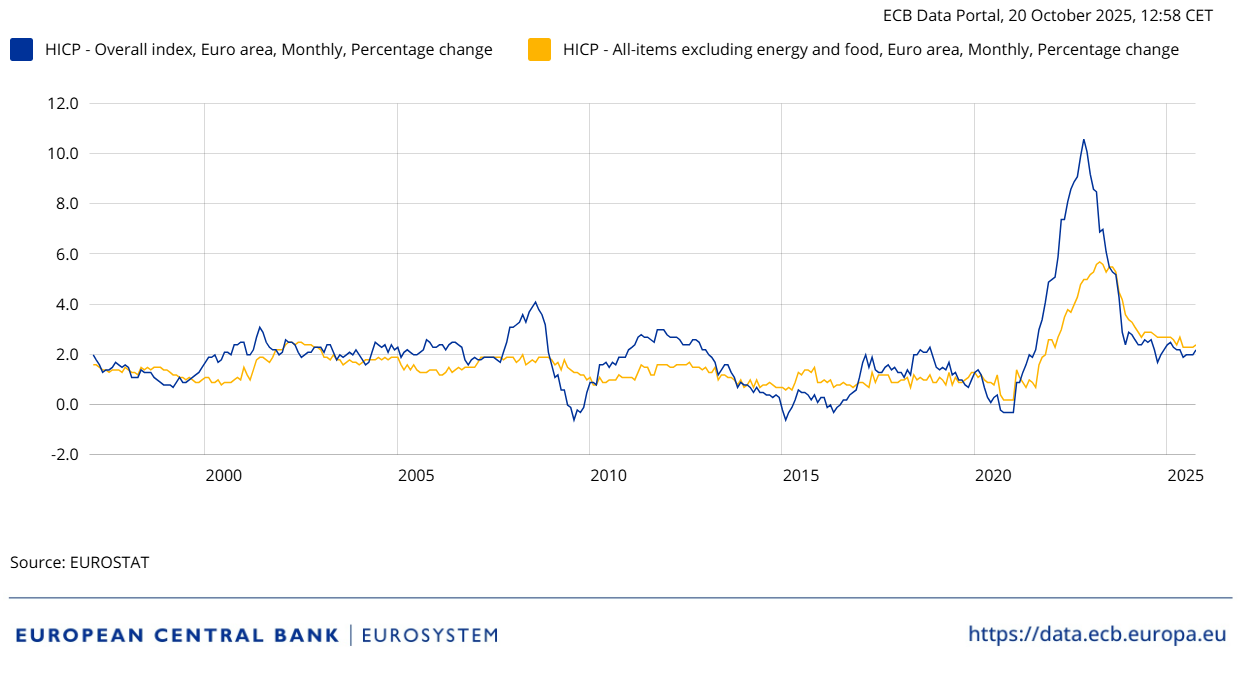
Total (Blue) and Core (Yellow) HICP Inflation.
Source: ECB Data Portal.
12.13 About the Negative Deposit Rate Policy
From 2014 to 2022, the ECB set a negative interest rate on funds that commercial banks held on deposit with the national central banks (either in the “current accounts” or the “deposit facility”).
This meant banks needed to pay the Eurosystem for keeping their reserves with it. From 2015 onwards, the quantity of reserves increased dramatically due to the ECB’s QE policy.
Why did banks keep money as reserves when they were being charged money for it? Shouldn’t they have just taken the money out as cash and stored it in warehouses?
We did not see this. Banks decided that storage and insurance costs for large sums of cash were higher than the cost of the negative rate.
This was a new development. Prior to the ECB and other central banks (the Bank of Japan and the Swiss National Bank) introducing negative interest rates, economists had often assumed there was a “zero bound” on policy interest rates.
Other major central banks, such as the Fed and the Bank of England, did not introduce negative interest rates even when they were engaged in various “non-standard” stimulus policies.
12.14 Tiering of Reserves
The negative interest rate policy was successful in reducing market interest rates, but there were concerns about a possible negative side effect.
This policy acted effectively as a “tax” on the euro area banking sector at a time when banking profitability was already quite low.
This raised concerns that, by reducing bank profits and thus their capital levels, it might lead to a reduction in the provision of credit. Alternatively, banks could decide to increase the interest rates they charge customers to compensate for the costs associated with the deposit facility.
In response to these concerns, in September 2019, the ECB introduced a “tiering” policy for reserves. The negative deposit facility rate was only applied to reserves banks held in excess of six times their reserve requirements.
This maintained the negative deposit facility rate as the key “marginal” rate in the banking system but reduced the impact on bank profits, roughly reducing the size of the “tax” on the banking sector in half.
Tiering was eliminated once the deposit facility rate became positive. But perhaps it should not have been. The Eurosystem is paying more interest to commercial banks than is necessary for controlling market rates.
12.15 TLTROs
Targeted Longer-Term Refinancing Operations (TLTROs) provided financing to banks over maturities of up to three years.
They were “targeted” because the amount banks could borrow, and the interest rate, were linked to the amount of loans they made to businesses and households.
The first TLTROs were announced on 5 June 2014, a second series (TLTRO-2) on 10 March 2016, and a third series (TLTRO-3) on 7 March 2019.
When TLTRO-3 was introduced, the borrowing rate for banks that met the various lending “benchmarks” was 10 basis points above the average rate on the deposit facility over the period of the loan.
In April 2020, the TLTRO-3 programme was amended so that the borrowing rate for banks that met the various lending “benchmarks” was 50 basis points below the average rate on the deposit facility over the period of the loan.
This meant banks could borrow from the ECB at the rate of minus 100 basis points (minus one percent per annum).
In 2022, the ECB subsequently revised the terms of these loans to be much less generous, and banks paid most of them back.
12.16 The ECB’s Monetary Policy Strategy Review
In July 2021, the ECB concluded a review of its monetary policy strategy. This review included the following changes.
- The ECB adopted a 2% inflation target over the medium term, replacing the previous “close to but below 2%.” This target is symmetric, meaning negative and positive deviations of inflation from the target are equally undesirable.
- It decided to continue using forward guidance, asset purchases, and longer-term refinancing operations, as appropriate.
- It replaced the “monetary analysis” focus in preparation for Governing Council meetings with “monetary and financial analysis.”
- It adopted a climate-related action plan. The Governing Council will adapt the design of its monetary policy operational framework in relation to disclosures, risk assessment, corporate sector asset purchases, and the collateral framework.
- The review also recommended including a measure of the costs of owner-occupied housing in the HICP in the coming years.
12.17 ECB Policy Since 2022
HICP inflation reached a high of over 10% in September 2022 but then fell steadily for two years and has flattened out this year.
The ECB reacted to higher inflation by raising its policy rates by 4.5%, but implemented a series of cuts of 0.25% each starting in June 2024, so the key deposit rate is currently 2%.
Year-over-year inflation was 2.2% in September, essentially on target.
The “core inflation” measure—excluding food and energy—was 2.3% in September.
So a successful return to target inflation has been achieved.
What happens next?
It is unclear. The ECB has paused cutting rates for a while and may keep them at their current level for a while. Economic weakness could see rate cuts next year. Alternatively, geopolitical uncertainty and tariffs could see inflation increase again and the ECB raise rates.