1 Banks and Financial Intermediation
1.1 Banks and their Financial Statements
The vast majority of economic transactions today use money kept in bank deposits to pay for goods and services.
Banks play a key role in the financial system and in the economy and much of the influence that central banks have on the economy via monetary policy works through the influence that it has on the banking system.
The banking sector also played a key role in many major historical crises, including the Great Depression, the global recession of 2008-09, Ireland’s economic crisis of 2008-11 and the “euro crisis” of 2010-12. And sometimes, you see large banks getting in trouble in “normal” times, like when Credit Suisse and Silicon Valley Bank (SVB) failed in 2023.
In these notes, we will start with a simple introduction to banks and their role in the economy. As the course goes on, we will introduce more complex topics, focusing on banking crises and their impacts as well as issues related to banking regulation.
1.1.1 The Origin of Banking
Though it is a fascinating topic, we will not have time to cover the history of coins and paper money being accepted as means of payment. However, once money became widely accepted as a way to conduct transactions, the question arose of where people stored their money.
You could keep it all at home (perhaps under the mattress) but this would not be very safe.
Banks began as safe depositories for cash: You had your own separate locker in the bank’s vaults for your cash. And you could go to the bank when you needed to get out your cash. Of course, the bank would charge you some fees to secure your money.
But why waste your time going yourself? Why not pay your bills with a special piece of paper (clearly identifiable as coming from you) that says the bearer is entitled to payment of cash from your account? In other words, you can write a cheque.
Once many people had bank accounts, then they weren’t taking money out of the bank after receiving a cheque. Instead, they were instructing the bank to move cash from someone else’s locker to theirs. This means banking not only secure your money, but also take the responsibility of payments.
1.1.2 History of Central Banks
Suppose Bank A’s depositors ask to have their accounts credited by \(€10\) million by presenting cheques from Bank B’s depositors. At the same time, Bank B’s depositors ask to be credited \(€15\) million from Bank A depositors. How do we settle these demands?
We could send \(€19\) million in cash around town to the various vaults. But the couriers could get held up by bandits!
A better idea was the following: Settle accounts at a “clearing house” bank. At end of the day, the clearing house orders the transfer of \(€1\) million from B’s vaults to A’s. Actually, the clearing house could mingle all the cash together and just deduct \(€1\) million from the ledger entry for Bank B’s account and add it to Bank A’s.
These clearing houses were the forerunners of today’s central banks. Today, all commercial banks in a country maintain an account with their country’s central bank.
Note again that lots of transactions are happening without any cash being withdrawn.
At this stage, all deposits were still backed by cash; banks had not yet fully begun to “create credit.”
1.1.3 Fractional-Reserve Banking
Most of the time (and most here is a very important qualifier!) only a small fraction of a bank’s total deposits will be withdrawn on any given day. And new money also gets deposited every day. Consider the example on the previous section: Despite \(€10\) million in total claims against it, Bank B still only needed to hand over \(€1\)million at the end of the day.
At some point, there was a “eureka moment”: Why do we have to keep all this cash sitting around doing nothing to back up the deposits? Why not loan out some of these deposits and just keep enough cash reserves on hand to deal with day-to-day demands?
And so, fractional-reserve banking was born: Banks don’t keep all your money in a vault anymore. They lend it out to other people. This is called fractional-reserve banking because banks only keep a fraction of the money people have deposited with them “on reserve” in case people come looking for their money.
A bank’s balance sheet lists its assets and liabilities.
| Assets | Liabilities and Equity |
|---|---|
| Use of Funds | Source of Funds |
Here’s a simple example of a balance sheet:
| Assets (Uses of Funds) | Amount | Liabilities and Equity (Sources of Funds) | Amount |
|---|---|---|---|
| Cash and Reserves | €15 | Deposits | €100 |
| Loans | €95 | Equity Capital | €10 |
| Total | €110 | Total | €110 |
This bank took in €100 in deposits and added this to €10 in funds that belong to its owners (equity capital). It then took these €110 in funds and made €95 in loans and kept €15 in cash and reserves (deposits with the central bank). This €15 is kept in case some of the depositors come looking for money.
Note that the bank’s deposits are liabilities. If depositors want their money back, the bank has to give it to them.
1.1.4 Net Interest Margins and Bank Profits
Banks earn profits mainly from the gap between interest received on assets and interest paid on liabilities. This difference is the net interest; expressed as a rate gap it is the net interest margin.
Overnight deposits—funds available to withdraw anytime—pay lower rates than time deposits (where you agree to wait one year or more to take your money out.) The low rate on overnight deposits reflects a convenience yield: People accept low interest rates on these deposits to get immediate access and payment ability.
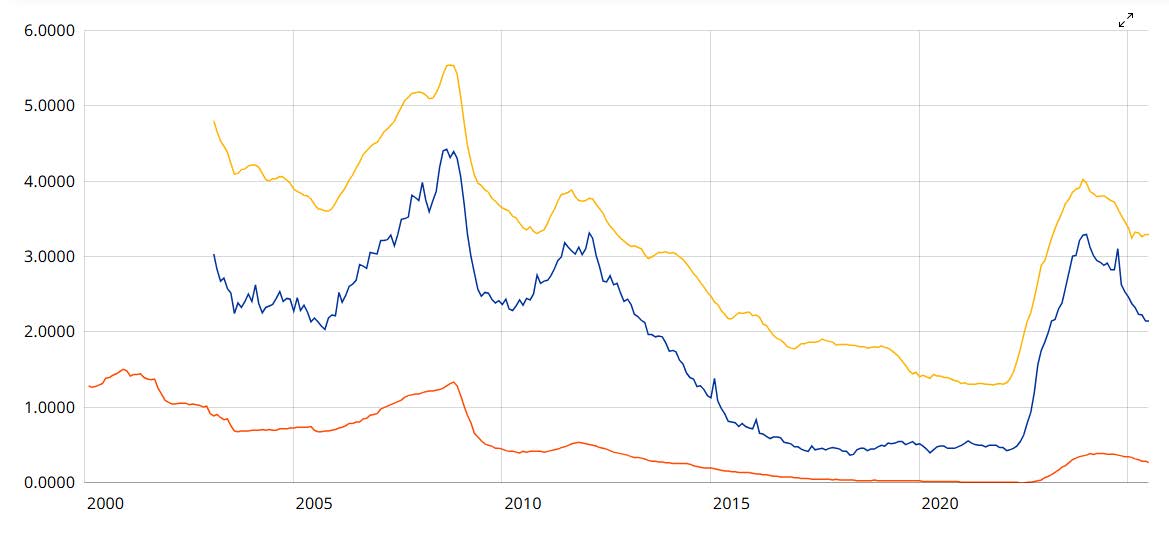
You can see one way that banks could make losses: If they own a portfolio of assets that pay low interest rates and then have to start paying higher interest rates on their liabilities.
A bank’s income statement lists its revenues and its expenses. Here’s a simple example of an income statement:
| Revenues | Amount | Costs | Amount |
|---|---|---|---|
| Interest Income | €2.5 | Interest Paid | €0.5 |
| Fees | €1.0 | Salaries | €1.5 |
| Trading Income | €0.5 | Rent | €1 |
| Total | €4.0 | Total | €3.0 |
Once a bank earns profits, they can either pay those profits to the owners in the form of dividends, or else they can retain these profits within the bank. Retaining the profits increases assets without affecting liabilities. Notice that means it increases the bank’s equity capital.
1.1.5 Real World Examples: Bank of Ireland
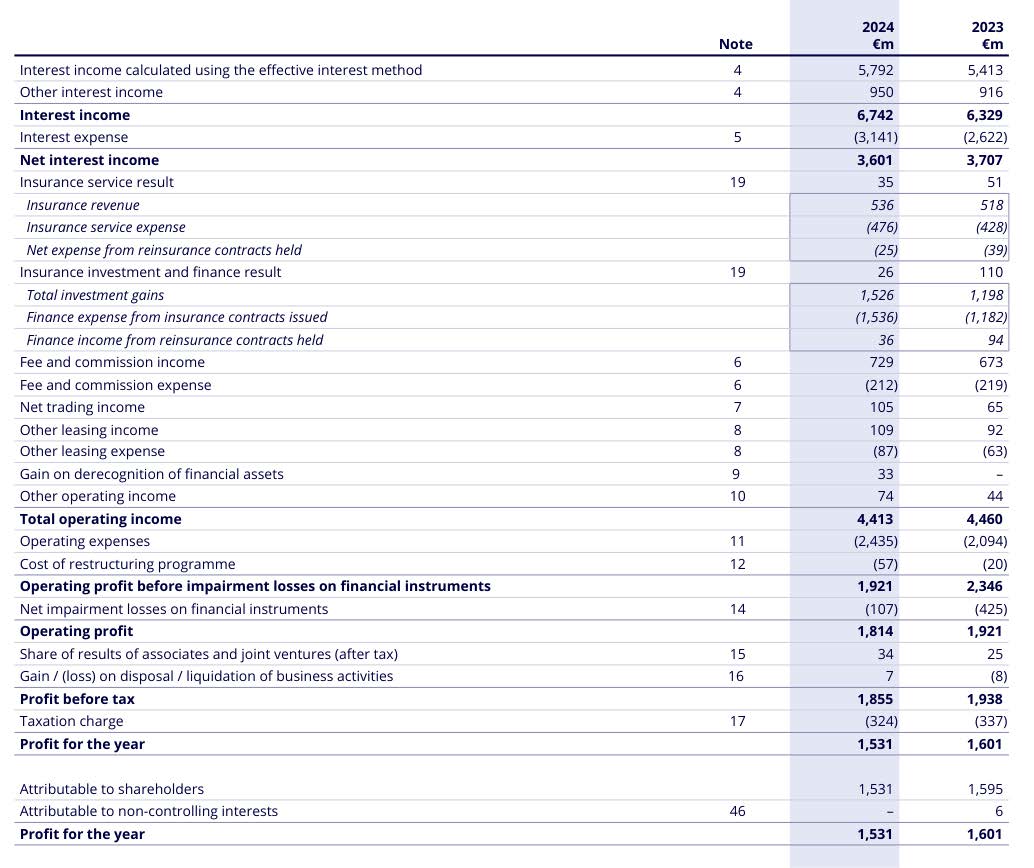
The following balance-sheet extracts show Bank of Ireland at the end of 2024 (the first column), compared with 2023. All amounts are in millions of euros.
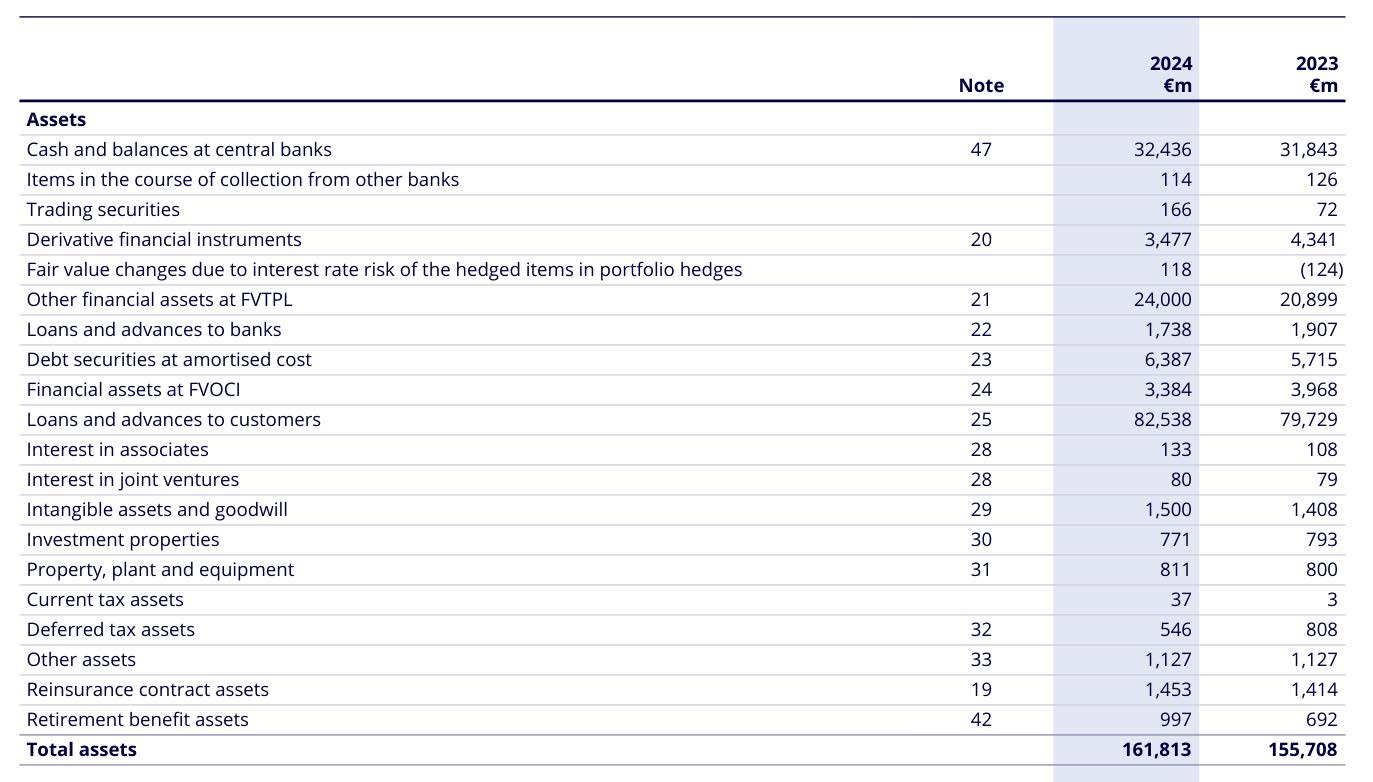
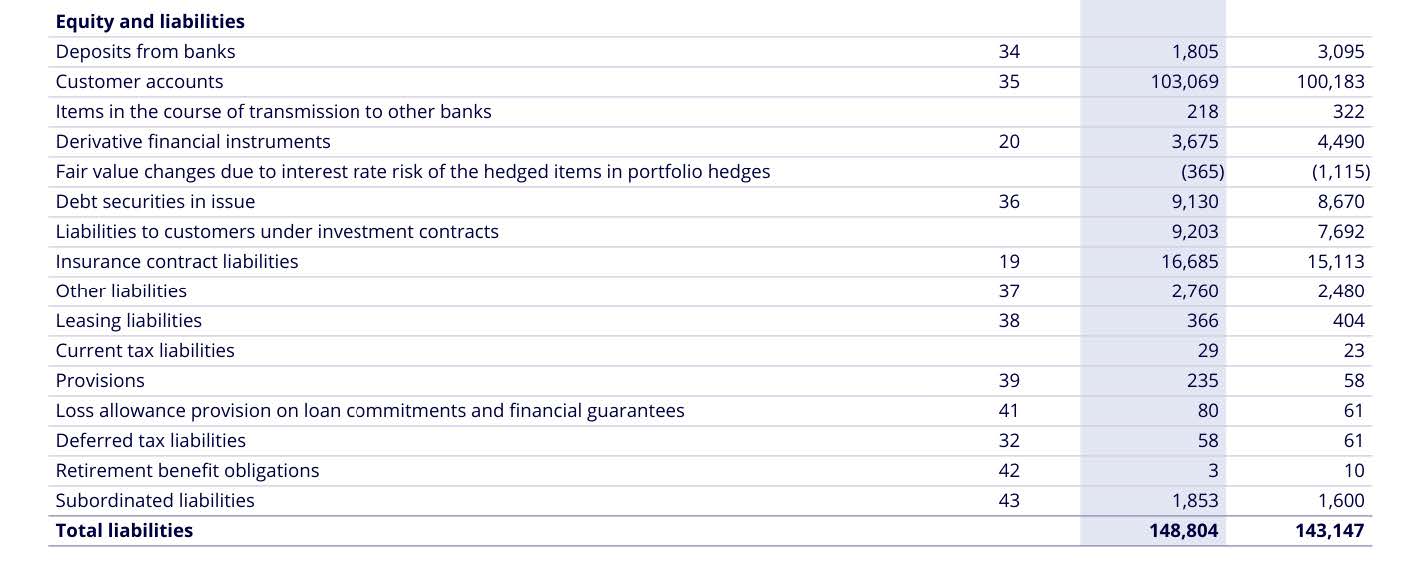
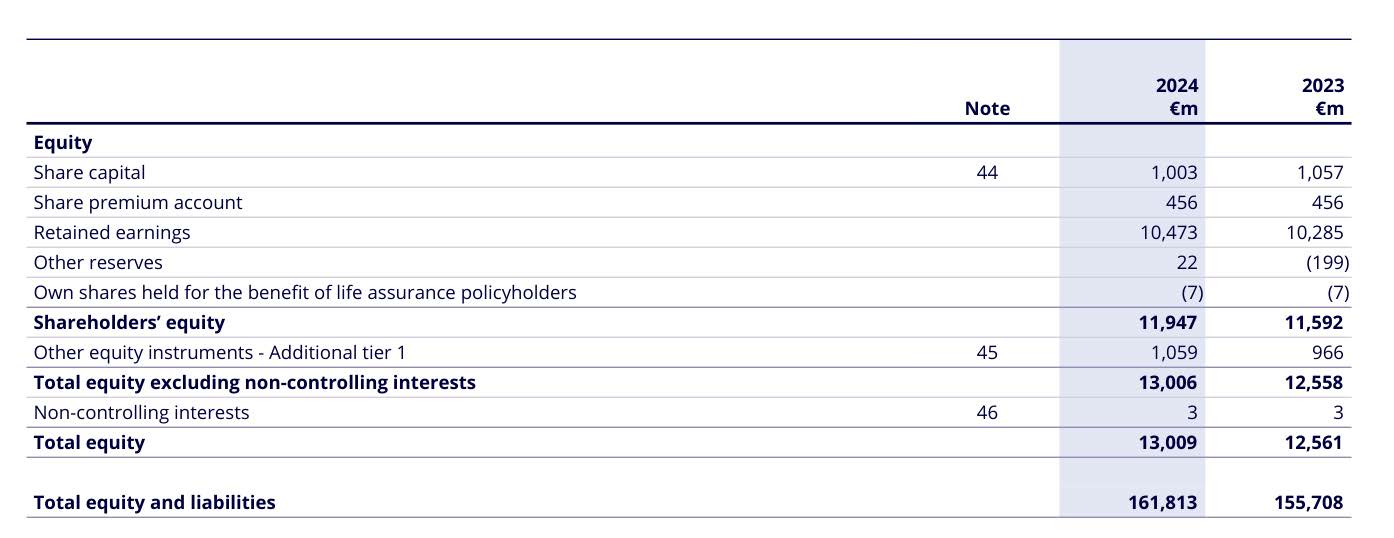
The income statement follows. Profits were about the same in 2024 as in 2023 but had greatly increased from previous years because of higher net interest income earned on loans and from money they have on deposit with the central bank.
1.1.6 Advantages of Fractional Reserve Banking
Fractional-reserve banking has generated a lot of criticism over the years along the lines of “how dare these people pretend they have your money when they’ve actually given it to someone else.”
Don’t take these criticisms too seriously. Banks don’t pretend they have your money in the vault but they will (almost always) give you your money back on request if you ask.
But fractional-reserve banking has important advantages:
- Saves Depositors Money: Banks can charge interest on their loans. Without this interest income, the only way a bank can make a profit is to charge fees to depositors. Interest earned can be used as an alternative source of income for banks and (assuming competition between banks) this reduces the need for fees related to safeguarding their money.
- Financial Intermediation: It makes banks an intermediary between those that have money and those that need to borrow money. They take money from some people and lend it out to others. This financial intermediation function is a crucial element of the modern economy.
Why can’t those with savings just lend them directly to those who want to borrow? i.e why not just have peer-to-peer lending?
- Pooling Savings: Many savers deposit small amounts. Someone looking for a big loan can get it from a bank rather than having to look for a saver with the correct amount of funds.
- Risk Diversification: Savers lending their funds to an individual borrower face idiosyncratic risk. If that borrower fails to pay back, they lose everything. The bank can lend to many borrowers, take its cut, and pass a safe return back to the saver.
- Information Processing: Banks can specialize in screening borrowers, processing and sharing information, and in writing sophisticated debt contracts.
- Maturity Transformation: If I want to have my savings back when I want them, I won’t lend the money for one year or more, as borrowers may want.
Therefore, the essence of financial intermediation is to pool dispersed funds and reallocate them across different individuals, time periods, and risk profiles. Banks can make these long-term loans, knowing that (hopefully) each period, only some of its depositors will want their money back.
1.2 Some Bogus Debunking
There is a popular argument stating: “Banks are not financial intermediaries; since loans create deposits, banks do not need to hold deposits before they can issue loans.” While this view seizes upon a specific accounting detail, it exaggerates it into an erroneous conclusion. We illustrate the accounting process of “loans creating deposits” to explain why this argument is incorrect.
Suppose our bank makes a loan for €10 to Lucy. In some cases, the bank opens a special deposit account with their own bank and tells Lucy she can get her €10 from it.
The bank’s balance sheet changes from
| Assets (Uses of Funds) | Amount | Liabilities and Equity (Sources of Funds) | Amount |
|---|---|---|---|
| Cash | €15 | Deposits | €100 |
| Loans | €95 | Equity Capital | €10 |
| Total | €110 | Total | €110 |
to:
| Assets (Uses of Funds) | Amount | Liabilities and Equity (Sources of Funds) | Amount |
|---|---|---|---|
| Cash | €15 | Deposits | €110 |
| Loans | €105 | Equity Capital | €10 |
| Total | €120 | Total | €120 |
In other words, the bank’s loan assets increase by €10 because Lucy owes the bank €10. At the same time, the bank’s deposit liabilities also increase by €10 because Lucy now has an additional €10 in her account.
This is what “loans create deposits” means. It does not mean that the bank has created additional resources out of thin air that it can freely use. Rather, it means that at the moment a loan is issued, the bank can record the transaction by simultaneously expanding both sides of its balance sheet.
Indeed, it appears that the bank has created a loan and a deposit without first raising funds from anyone else. From this perspective, it may seem that banks are not financial intermediaries.
However, the question is: Why does Lucy borrow money in the first place? She certainly does not borrow €10 just to leave it sitting in her bank account, especially since the interest rate she pays on the loan is typically higher than the interest she earns on her deposits. Instead, she borrows money to finance consumption or investment.
Suppose Lucy uses the loan to buy a car. She purchases the car from Evil Elmo, a car dealership whose bank account is held at another bank, X Bank. To complete the payment, Lucy needs her bank to transfer the money to X Bank, which then credits the dealership’s account.
This means that Lucy’s bank must transfer funds to X Bank. Typically, this interbank payment is settled through reserve accounts held at the central bank: the reserve balance of Lucy’s bank decreases, while the reserve balance of X Bank increases.
As a result, the balance sheet of Lucy’s bank becomes:
| Assets (Uses of Funds) | Amount | Liabilities and Equity (Sources of Funds) | Amount |
|---|---|---|---|
| Cash and Reserves | €5 | Deposits | €100 |
| Loans | €105 | Equity Capital | €10 |
| Total | €110 | Total | €110 |
Two things have happened here:
First, the loan still exists, so the bank’s loan assets remain at €105.
Second, Lucy’s €10 deposit has been transferred out of her bank, so the bank’s total deposits return to €100. At the same time, to settle the payment to X Bank, the bank’s cash and reserves decrease from €15 to €5.
When a bank issues a loan, it can create a corresponding deposit. However, once the borrower spends the money and the payment is transferred to another bank, the lending bank must use its reserves to settle the transaction.
Therefore, banks cannot simply “create loans out of thin air” without limits. They are still constrained by their funding sources, reserve availability, liquidity requirements, and regulatory restrictions.
Thus, the statement “loans create deposits” is perfectly valid from an accounting perspective. However, it does not imply that banks do not need funding or that banks are not financial intermediaries.
1.2.1 Further Debunking
- Not How Large Loans Work: The “give Lucy a deposit account” story is correct for small personal loans but it’s not how most loans work. With mortgage loans, the money is usually sent to a lawyer who then ensures the seller obtains the funds and that the buyer obtains the legal deeds for the property. Car loan funds are commonly issued directly to dealerships selling the cars with the bank obtaining a title deed for the car.
- Bond Borrowing: If banks can expand their lending without having to source funds, why do they bother borrowing money in the form of interest-bearing bonds to obtain funding for their activities?
- Borrowing from Money Markets or the Central Bank?
- The debunkers have a response to the idea that banks need to have reserves to make loans: No, they can just borrow from other banks or from central banks. As much as they want! Banks can make as many loans as they want.
- This is utter nonsense, contradicting both basic banking regulations, the role central banks play when loaning money to banks and many of the lessons from the global financial crisis.
1.3 Instability
Having listed all the advantages of fractional-reserve banking, it turns out there is also a very important disadvantage associated with it. Banks are supposed to have assets greater than liabilities owed to non-investors (i.e. positive bank capital). What if the bank makes bad loans to borrowers that default? What if customers suspect the bank does not have assets to pay back money to depositors?
If this happens, the earlier arguments that only some customers wanting their money back may turn out to be incorrect. We may have a run on the bank: Lots of depositors look to get their money back. Banks usually find it difficult to cope with these runs.
For these reasons, fractional reserve banking systems are subject to occasional periods of instability.
We mentioned “maturity transformation” as one of the cool features of fractional reserve banking. But when things are going badly for banks, you are more likely to hear about maturity mismatch i.e. the fact that the average maturity of a bank’s assets is longer than the average maturity of its liabilities.
Most banks are thus vulnerable if situations arise in which there are demands to pay back a large amount of liabilities over a short period of time. They have loaned out large amounts of money in the form of, for example, 30-year mortgages and they are not able to call these people up and say “We’re in a spot of bother. We know we said you could pay back over 30 years but could you instead pay it all back now?”
Banks also have legally binding contracts with depositors, e.g. people with “’demand deposits” have been told they can get their money out on demand. These two sets of legal contracts cannot always be jointly honoured.
In the past, governments imposed regulations to limit maturity mismatch: Mortgage lenders took in longer-term savings, banks that had demand deposits only made shorter loans. However, these restrictions have generally been lifted over the years.